




Abstract
The papyrus published here was used as a notebook to register payments for various work carried out privately by (most probably) the chief draughtsman Amenhotep son of Amennakht. The beginning of the reign of Ramesses IX is suggested as the date of the papyrus. In addition to the documentary notes, remains of what seem to be an excerpt from a literary text are preserved on the papyrus as well.

1. Introduction
2. Materiality
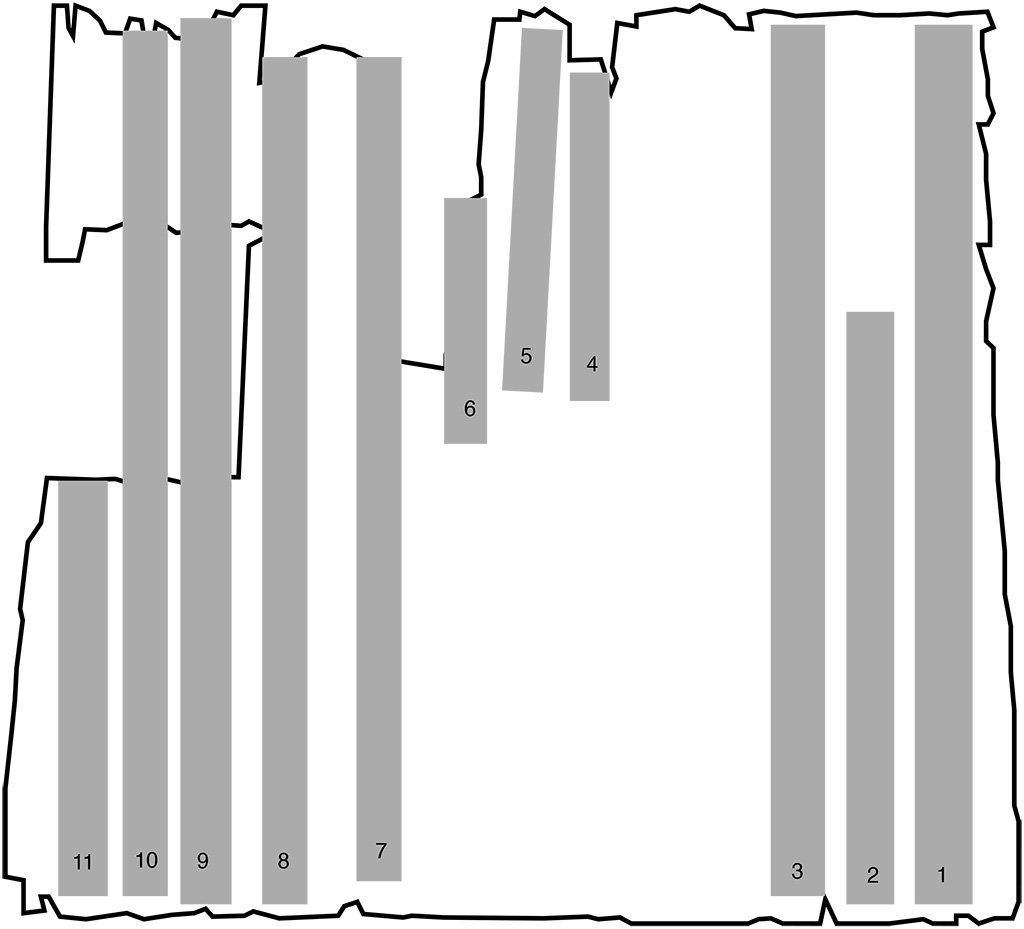
Papyrus Provv. 6252 is an almost square piece of papyrus, rather thick and of a darkish colour, measuring 210 × 220 mm. A strip of papyrus is added at the lower end of the side of the sheet with the fibres running horizontally (Fig. 1; henceforth called obverse), which corresponds to the right edge of the other side, where the fibres run vertically (Fig. 2; henceforth called reverse). This additional strip of papyrus must be what is left of a sheet join, as it covers the whole extant length of the sheet. Here, the right-hand sheet on the reverse side (displaying vertical fibres on top) overlaps the left-hand sheet (displaying horizontal fibres on top).2 The papyrus sheet is written transversa charta on the obverse side, i.e., the scribe flipped the sheet by 90°. This might have been done because of the rather coarse texture of the papyrus on the reverse side. Therefore, the sequence of writing agrees with the original papyrus roll’s sides, i.e., the side we refer to as reverse was the recto side of the papyrus roll, and our obverse the verso side. That means that the scribe first used the verso side turning it by 90°, and later added the sundry notes on the recto going back to the original direction of the papyrus.
In the lower right part of the reverse are some dirt stains. As the area is largely void of script, they do not affect the text for the most part. However, the two last lines of reverse ii and some line beginnings of reverse i are blurred by these surface stains.
P. Turin Provv. 6252, obverse.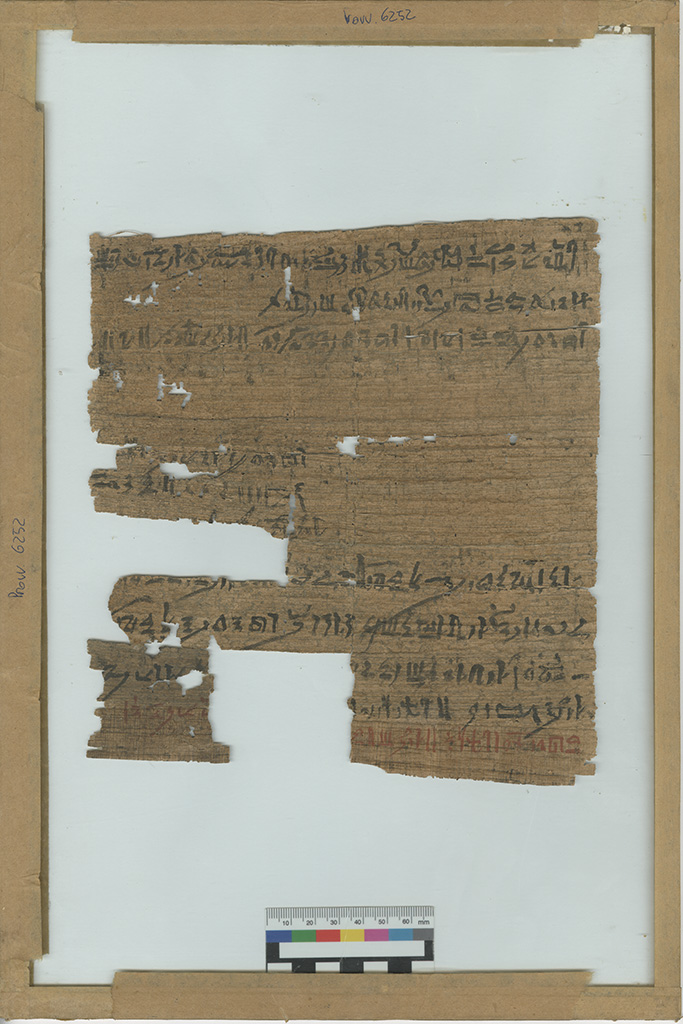
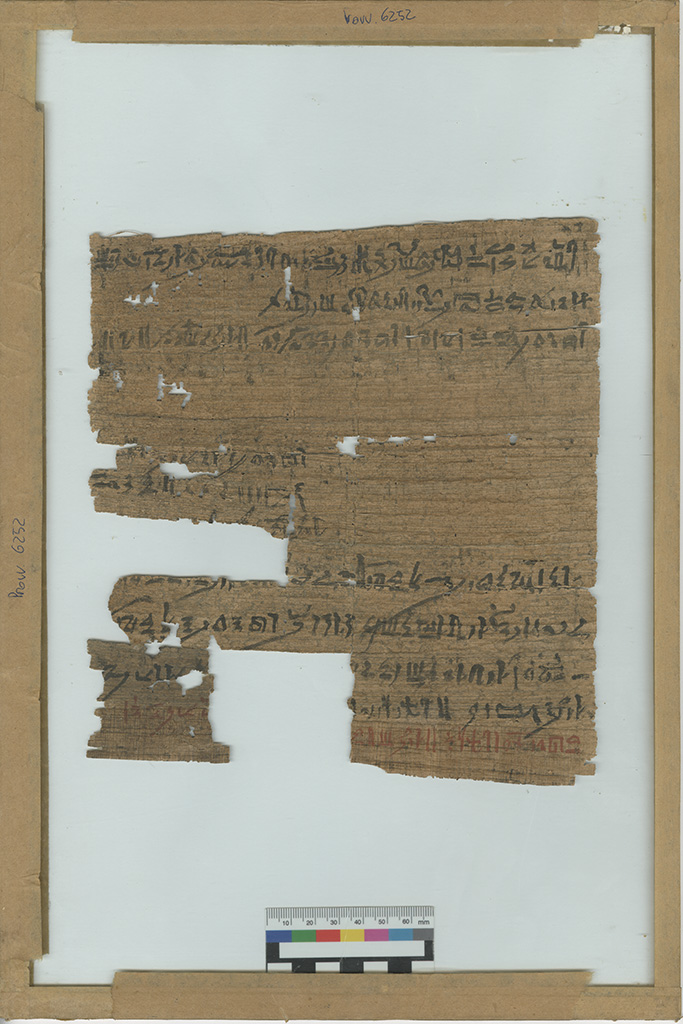
P. Turin Provv. 6252, reverse.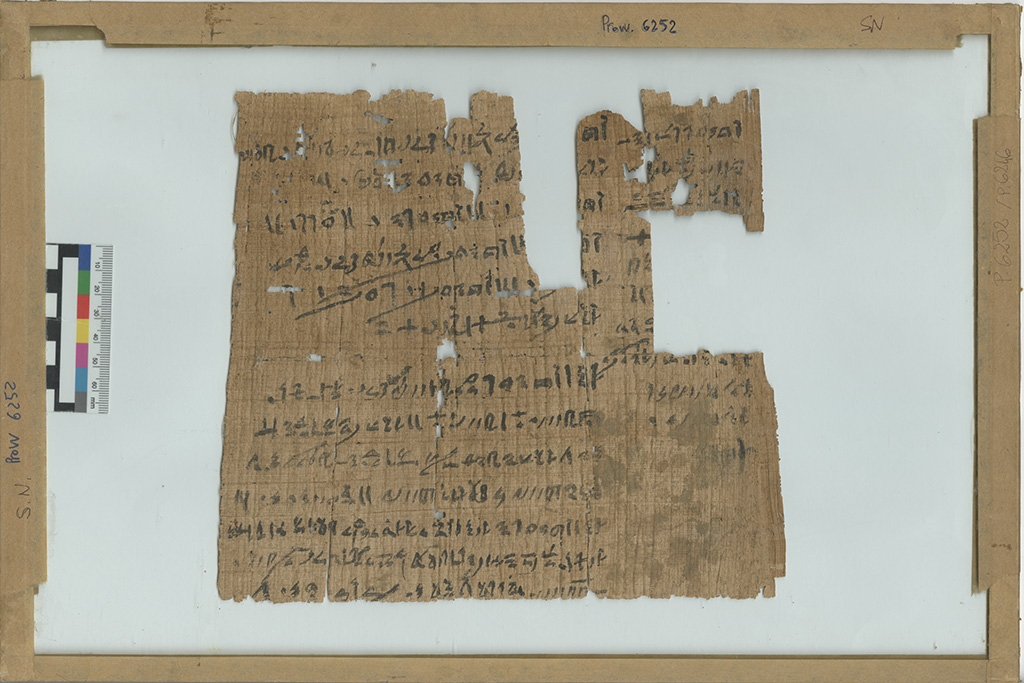
P. Turin Provv. 6252, outline sketch of obverse.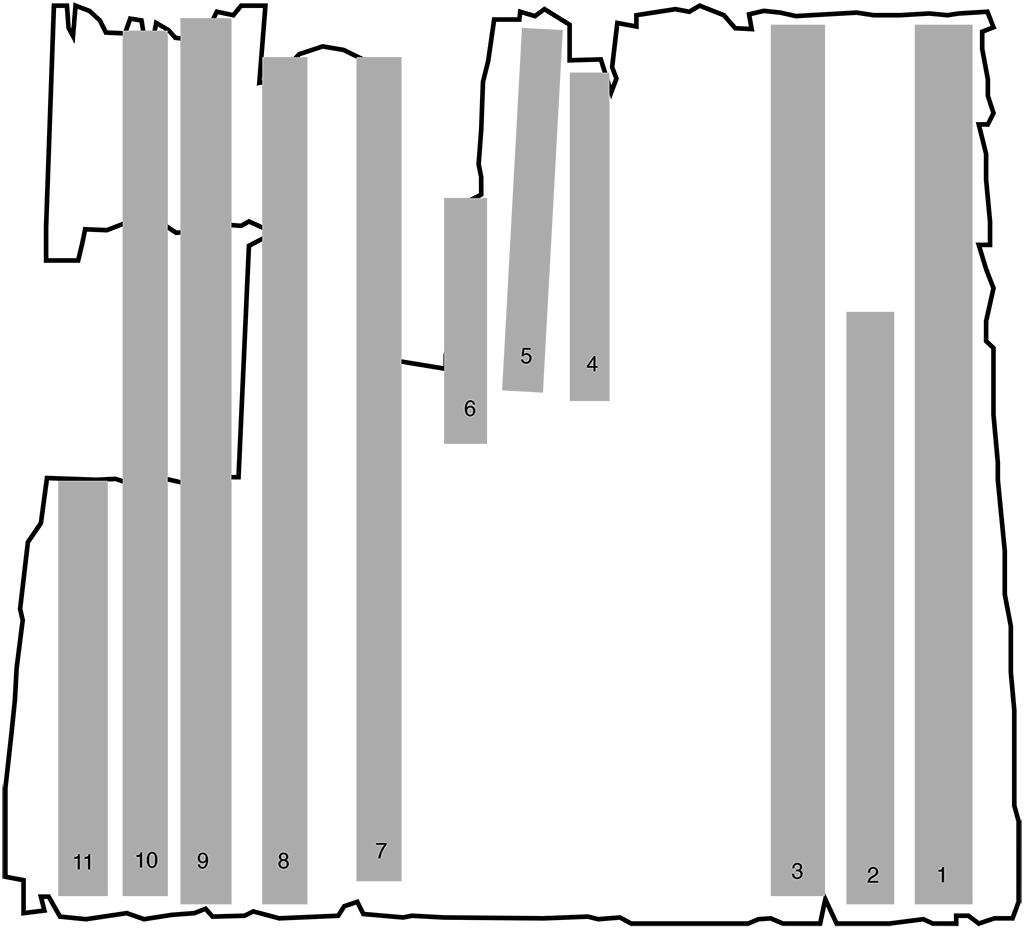
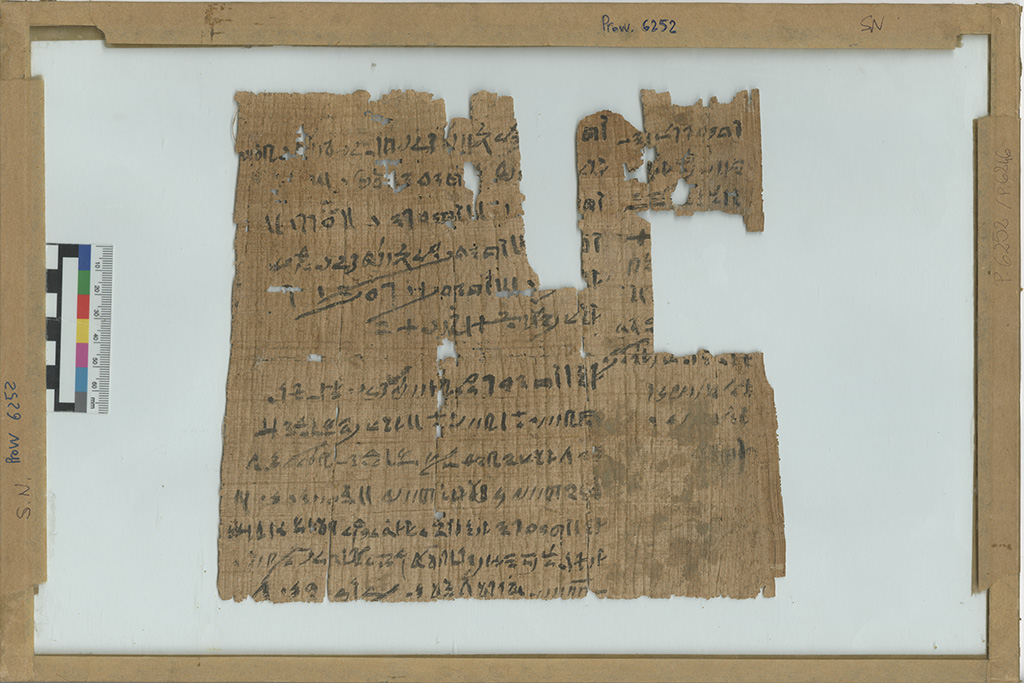
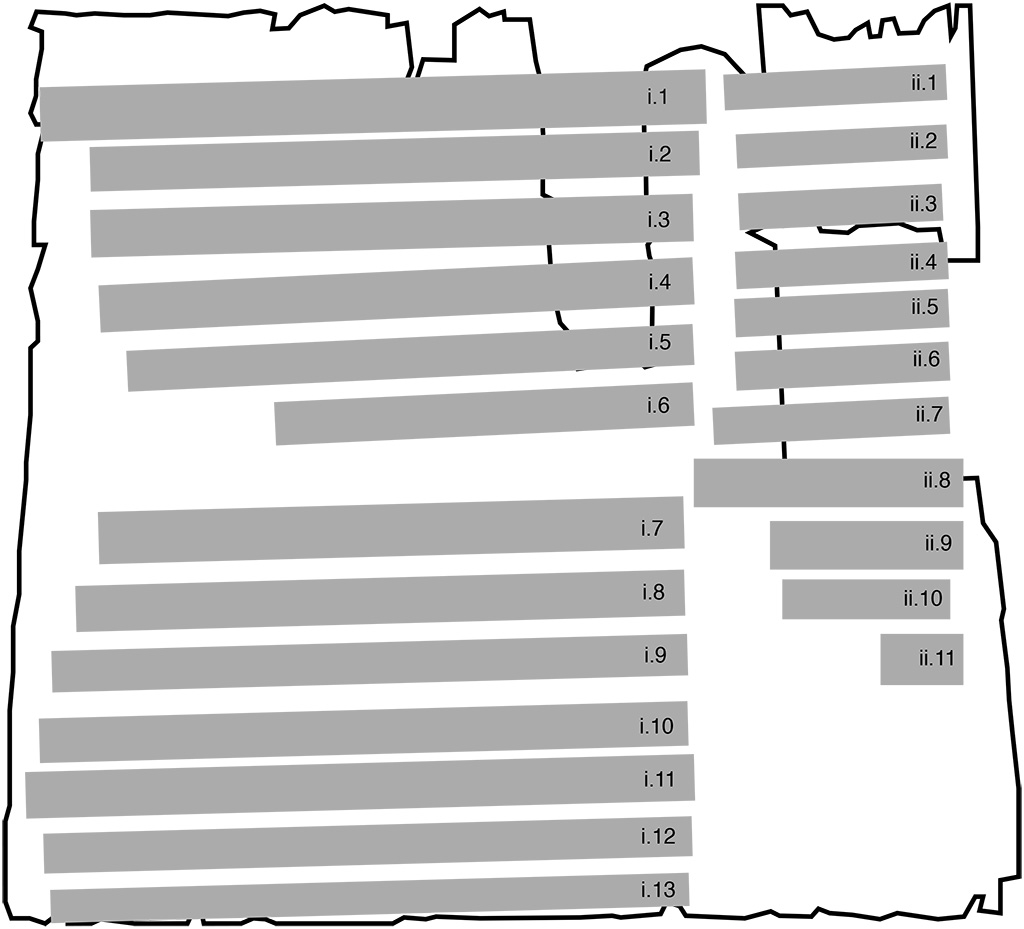
P. Turin Provv. 6252, outline sketch of reverse.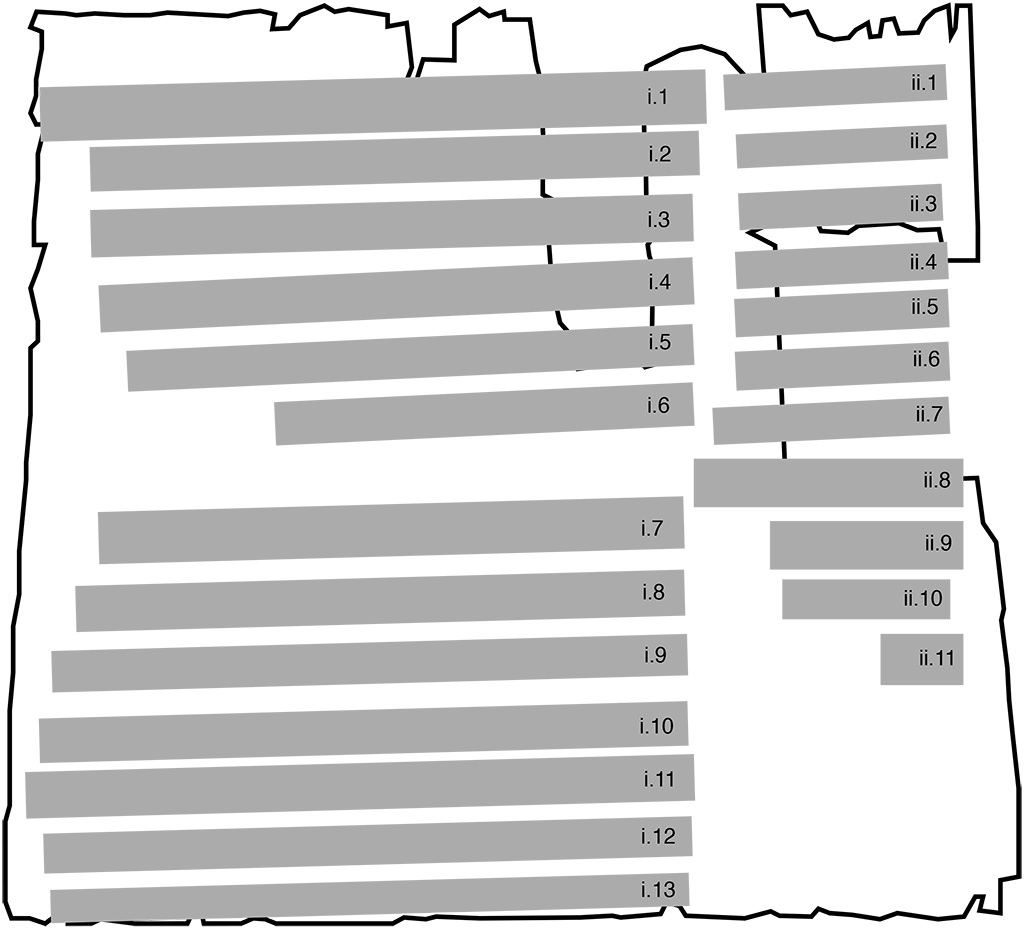
3. Date of the papyrus
Although some of the texts have specific dates within a regnal Year 1, none of them mentions the name of the ruling monarch. Almost all the dates fall within the time span of Year 1 I Shemu 4–12 (reverse) and I Shemu 14–15 (obverse Texts 3 and 4), with two outliers, III Akhet 27 and I Shemu 13 (obverse Text 2). As the latter is also dated to Year 1, it seems most likely it was the first entry made by our scribe on the obverse of the sheet.
The actual sequence of the texts, however, depends on which reign one should ascribe this Year 1 to. The mention of the scribe of the mat Hori points to a period around the reign of Ramesses IX.3 Ascribing our text to Year 1 of his reign makes the last text on the obverse — III Akhet 27 – the first dated one, because that monarch began his reign on I Akhet 21. In the same entry then follows the date I Shemu 13. We may hence assume that the scribe took a small sheet of papyrus which had texts on the obverse. He left the uppermost lines (Text 1, the oldest) and cleaned the remainder of the page – although palimpsest traces are still visible all over the papyrus. Afterwards, he wrote his note (Text 2) at the bottom of the page and realized he had more notes to write, so he turned to the other side. When that side (now called by us “reverse”) was full, he went back to the obverse and wrote Text 3 dated I Shemu 14, followed by Text 4 dated I Shemu 15.
We can therefore chart the sequence as follows:
Text obv 1
—
—
Text obv 2
Year 1
III Akhet 27, I Shemu 13
Text rev 1
ø
I Shemu 4–12
Text rev 2
Year 1
I Shemu 4
Text rev 3
ø
I Shemu 8–9
Text obv 3
ø
I Shemu 14
Text obv 4
ø
I Shemu 15–16
4. The scribe
The repeated use of “me” in the dated notes reveals the writer (just like “I” in the Strike Papyrus, rt. iii.12–13, reveals the author to be Amennakht son of Ipuy). Our present writer must be the chief draughtsman recorded in reverse i.8. In view of the date, we are most probably dealing with the well-known chief draughtsman Amenhotep son of Amennakht,4 who was responsible for the decoration of the tomb of Ramesses IX and quite possibly also of the tomb of Ramesses X. Although trained as a scribe, his main job was that of a draughtsman, and this might explain his struggling with hieratic sign shapes and common spellings of words, and apparently even grammar.
5. Texts
As explained above, the writer must have used a piece of papyrus that was probably cut from an already inscribed larger papyrus. It seems that he started to wipe out the existing text or texts one part at a time, whenever he felt the need to add more text. Under the assumption that the dates on both sides refer to the same year, Text 2 on the obverse precedes that on the reverse. Therefore, we labelled the sides as obverse (
5.1. Reverse (Fig. 2)
This side of the papyrus contains two columns. The dates of the larger column on the left precede those in the smaller column on the right. Therefore, we labelled the left one column i, and the right one column ii. We divided the text into subsections when these are clearly marked by a line break or spacing within the segments.
5.1.1. Text 1
The second enterprise ensues, where he received for the decoration of a specific coffin (
This kind of work for private people is part of the activities of the so-called informal workshop.5

i.1
Notes:
-
a) There is a curved stroke extending from the now lost part, which cannot be part of the date as the next readable date is Day 5. As all the ensuing dates follow more or less one after the other, a much earlier date in IV Akhet with a 10 digit seems not very likely. However, in rev. i.4 and i.7 below, the scribe has a similar
mḥ r-bꜢk right after the date. The restoration of a verbal prefix therefore does not seem likely either. We hence assume that stroke to be a palimpsest trace. -
b) Rather than referring to a nameless official, we assume a hitherto unattested personal name here. For personal names consisting of an article plus a title, cf. such names as
PꜢ-ꞽdnw ,PꜢ-ḥꜢtꞽ-Ꜥ ,PꜢ-ḥm-nṯr orPꜢ-mr-ꞽḥw . The titlewbꜢ has been extensively treated in Bartos, The Official TitleswbꜢ nswt “RoyalwbꜢ ” andwdpw nswt “Royalwdpw ”, 2023. -
c) We assume that
sš-qd (clumsily written) means here “to decorate” rather than “sketch”, likewise below in rev. i.7. -
d) The restoration of the verbal form follows the text in rev. i.6. In a first approach, we read here
ꞽ.dꞽ.w n=ꞽ , “What was given to me”, but the morphology of a passive participle would rather demand a form such as(r)d.yt n=ꞽ . - e) The traces visible before the small gap would suggest reading 1 only as the number of loaves received for the first day of work. However, on all other days, he received at least 2 loaves.
-
f) Even though the stroke looks almost like a 1, the context would call for a ditto marker to avoid repeating the word
Ꜥq.w . - g) The traces above the day sign must be the remains of the older text that was wiped off only imperfectly.
5.1.2. Text 2

i.7
Regnal year 1, I Shemu 4: occupied with paintworkh) on the boat of (the) vizier: chief draughtsman, 1 man, draughtsmen, 2 men; what he has given to me: blue pigment of very good quality, 10 deben; what the scribe of the mat Horii) has given to me: blue pigment for painting, 10 deben ochre, 10 hin, resin, 2 hin, green pigment, 3 deben.
Regnal year 1, I Shemu 7: The crew {will go} <went>j) to the city to report about the rations and (the) vizier gave them their garments, which are in exchange for the food provision of Pharaoh, l.h.p., tunics 20, yarn, 100 deben, lead, 20 deben.
Notes:
-
h) For
sš-qd – “painting, paintwork, decoration”, see Janssen, Commodity Prices, 1975, esp. pp. 190, 215 note 3 and p. 225 note 3. - i) For the scribe of the mat Hori, see Haring, in Demarée and Egberts (eds.), Deir el-Medina in the Third Millennium, 2000, p. 156. His tenure of office centres around the reign of Ramesses IX. This is confirmed by new attestations (such as P. Milan E 0.9.40126, O. M.H. 1985 in OIM Chicago and some fragments in the Turin collection).
- j) As it stands, the writer used a Future pattern here, which could be imagined, but is against the usual rather stereotype expression “the crew went…”. The easiest way to mend the text seems an emendation of the superfluous r, thereby turning it into a continuative clause (NIMS). The r might be a wrong representation of the preposition ḥr of the continuative, which had been reduced to a vowel at that phase of the language’s history.
5.1.3. Text 3 (col. ii, but to the right of col. i)

ii.1
I Shemu 8: Giving them to their masters andk) they gave the […] … [… … …] … [… … …] hut [… … …] 2 [… … …] …l) sack 1 ¼[+x|] what … gave … Nefer-… 11 meat … …
Notes:
-
k) The
iw- clause could be a circumstantial as well. - l) Apparently a name, but illegible.
- m) The scribe seems to have stopped here and continued on the other side.
5.2. Obverse (Fig. 1)
This text – or better, the beginning of it – sits somewhat athwart in the various accounts. The first two lines appear more like a general deliberation, or a quote of some spurious wisdom, rather than a description of the working condition of a draughtsman. Unless one is inclined to connect the isolated date from the last line of rev. i.11 with it – but that is in a different handwriting and the content does not appear to be documentary, i.e., something one expects to find in a journal entry. The easiest solution seems to be to assume that this is the only remainder of the previous text, which was not washed off when the writer started to re-use the papyrus. It might be from some unknown literary text. This raises the question of what linguistic system we are dealing with here. If the text is assumed to be Late Egyptian, certain grammatical issues present themselves. We are hence more inclined to regard the text to be in a variety of Middle Egyptian.
5.2.1. Text 1

1
Notes:
-
n) The traces at the beginning are that of the palimpsest. The expression
sꜤqꜢ ḏr.t , unattested otherwise, might be some technical expression. Assuming a misspelling forsꜤq , “to let enter,” does not seem to fit the semantic context. -
o) What exactly is meant is difficult to guess. Grammatically, several options would appear if the text was supposed to be in Late Egyptian, such as:
- 1) A negated Future (III): No magistrate will judge among his personnel. This would align only partly with the spellings. The absence of
r is no problem, as it is usually dropped after nominal subjects. One would, however, expectnn-ꞽrꞽ at the beginning. - 2) A negated adverbial sentence, with
wp being a participle: No judging magistrate is among the personnel. Semantically, this sounds slightly odd, however. In addition, participles are barely used as adjectives any longer that late. - 3) A negated cleft, which seems possible, despite the lack of participle morphemes in
wp . In this period, participles are usually past, as the function of imperfect participles has been taken over by relative clauses of the Present; see Winand, Etudes de néo-égyptien, 1992, §570.However, to express generic present, the periphrastic pattern ꞽ.ꞽr -verb is used; op. cit., §572. - 4) A cleft sentence marked as a question by the particle
n , which might be the smoothest solution. However, if the underlying grammatical system was Middle Egyptian, the clause could be a negated existential (its Late Egyptian counterpart would demandnn-wn ormn ). The following clause marked byꞽw would then have to be a main clause.
- 1) A negated Future (III): No magistrate will judge among his personnel. This would align only partly with the spellings. The absence of
-
p) We assume
pny to be a defective writing ofpnꜤy , cf.Wb I, p. 509,13 (“a dangerous place in a cataract”; i.e., a whirlpool or vortex). -
q) For the special form of the sign D2 (
ḥr ), see, e.g., pAbbott vi.4. - r) The last sentence must be a First Present with a stative.
5.2.2. Text 4

3
I Shemu 15: …s) 1, bundle (of vegetables) 1, jar 1. I Shemu 16: loaves 2, dried meat 2, bundles (of vegetables) 2
Notes:
-
s) The difference in the
ṯ compared to line 2 (dot vs no dot) is noteworthy. The position of the dot looks more like that in Y1, but this would not yield any sensible reading either. It might be a spelling ofds , “beer jar”, but what would the other jar at the end of that day’s entry denote then? Usually bread and meat precede vegetables, so it might be either of these.
5.2.3. Text 3

4
I Shemu 14: What he has given to me:
Notes:
-
t) At a first glance, the group looks like
ẖp , but as that reading yields no sense, we assume the word specifying the kind of meat here is(m)ẖt, “intestines”. -
u) A possibility would be to read here
bḥs – calf.
5.2.4. Text 2

7
Regnal year 1, III Akhet 27:v) offering for the … his … … his ox while the scribe Amunhotep is there with him. I Shemu 13: offering for Mut while the scribe of the […] Amunhotep is [… …]-nakht: what he has given to me: meat, thigh 2,
Notes:
- v) Note that the scribe used the normal form of the sign for 7, not the one usually employed in dates.
- w) The lacuna in line 10 would be sufficient for another date.
6. Acknowledgements
We would like to express our gratitude to Susanne Töpfer/Museo Egizio di Torino for enabling Rob to work on the papyrus in Turin. In addition, we are grateful to the two peer reviewers for their remarks, which improved the present paper. All remaining errors are ours.
Bibliography
Bartos, F., The Official Titles
Černý, J., A Community of Workmen at Thebes in the Ramesside Period (BdE 50), Cairo 20043.
Cooney, K.M., The Cost of Death: The Social and Economic Value of Ancient Egyptian Funerary Art in the Ramesside Period (EU 22), Leiden 2007.
Cooney, K.M., “An Informal Workshop: Textual Evidence for Private Funerary Art Production in the Ramesside Period”, in: A. Dorn and T. Hofmann (eds.), Living and Writing in Deir el-Medine: Socio-Historical Embodiment of Deir el-Medine Texts (AH 19), Basel 2006, pp. 43–55.
Davies, B., Who’s Who at Deir el-Medina: A Prosopographic Study of the Royal Workmen’s Community (EU 13), Leiden 1999.
Haring, B., “The Scribe of the Mat: From Agrarian Administration to Local Justice”, in: R.J. Demarée and A. Egberts (eds.), Deir el-Medina in the Third Millennium (EU 14), Leiden 2000, pp. 129–58.
Haring, B., “The Scribe of the Mat: An Update”, in: C.J. Martin, Evil Egyptian Scripts. Abnormal Hieratic, Demotic and Hieratic Texts and Studies in Honour of Koenraad Donker van Heel (P.L. Bat 43), Leiden and Boston 2026, pp. 116–24.
Janssen, J.J., Commodity Prices from the Ramesside Period, Leiden 1975.
Keller, C.A., “How Many Draughtsmen Named Amenhotep? A Study of Some Deir el-Medina Painters”, JARCE 21 (1984), pp. 119–29.
Krutzsch, M., “Einzelblatt und Rolle. Zur Anatomie von Papyrushandschriften”, in: F. Feder, G. Sperveslage and F. Steinborn (eds.), Ägypten begreifen. Erika Endesfelder in memoriam (IBAES 19), Berlin and London 2017, pp. 213–22.
Näser, C., Der Alltag des Todes. Funeräre Praktiken in Deir el-Medine im Neuen Reich (GHP Egyptology 35), London 2024.
Polis, S., K. Gabler, C. Greco, E. Hertel, A. Loprieno, M. Müller, R. Pietri, N. Sojic, S. Töpfer and S. Unter, “Crossing Boundaries: Understanding Complex Scribal Practices in Ancient Egypt (with a 2019 Progress Report)”, RiME 4 (2020). DOI: 10.29353/rime.2020.2952.
Wb I = Erman, A. and H. Grapow (ed.), Wörterbuch der aegyptischen Sprache, Vol. I, Leipzig 1926.
Winand, J., Études de néo-égyptien, 1 : La morphologie verbale (AegLeod 2), Liège 1992.
Note
- See Polis et al., <i>RiME</i> 4 (2020), <a href="https://doi.org/10.29353/rime.2020.2952">https://doi.org/10.29353/rime.2020.2952</a>.↑
- This kind of overlap is one of the techniques documented for concluding a papyrus roll; cf. Krutzsch, in Feder et al. (eds.), <i>Ägypten begreifen</i>, 2017, p. 219.↑
- For the scribe of the mat Hori, see Haring, in Demarée and Egberts (eds.), <i>Deir el-Medina in the Third Millennium</i>, 2000, pp. 129–58, with the list on p. 157; Haring, in Martin, <i>Evil Egyptian Scripts</i>, 2026, pp. 120–21. For the archive of the times of Ramesses IX, see the forthcoming PhD dissertation by Martina Landrino.↑
- On this individual, see Černý, <i>Community</i>, 2004<sup>3</sup>, pp. 197–98 and pp. 234–37, as one of the “four captains”; Keller, <i>JARCE</i> 21 (1984), pp. 119–29; Davies, <i>Who’s Who at Deir el-Medina</i>, 1999, pp. 105, 108, 112–13, 140, 169, 277 and chart 9.↑
- See Cooney, in Dorn and Hofmann (eds.), <i>Living and Writing in Deir el-Medine</i>, 2006, pp. 43–56 and Cooney, <i>The Cost of Death</i>, 2007, pp. 162–66 as well as Naeser, <i>Der Alltag des Todes</i>, 2024, pp. 274–76.↑