




Abstract
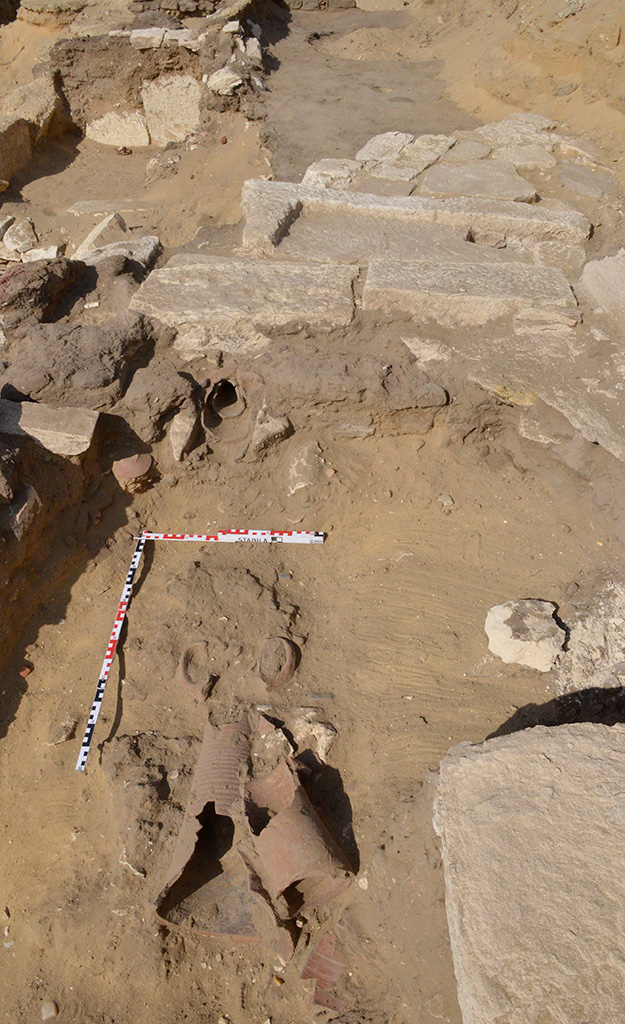
During fieldwork season 2023, the Leiden/Turin Expedition to the New Kingdom Necropolis at Saqqara discovered a remarkable example of amphorae reuse. Four Late Roman amphorae were reemployed as hydraulic pipes in a drainage system: two of them were deliberately laid in the ground and oriented towards another two deliberately inserted, one into the other, in a mudbrick wall. This archaeological feature is consistent with the layers previously investigated at the site by the Dutch/Italian Mission and dated to the transition between the Late Antique and the early Medieval phases. The installation discovered in 2023 should be dated no earlier than the second half of the seventh century AD. While Late Roman 7 (LR 7) amphorae are the best attested transport containers at the site, the drainage system analysed in this paper was made from an amphora type much less commonly found in Saqqara, consistent with type AE 3T-3.2. This paper focuses on both the Saqqara drainage system itself and the amphorae type it was made from, while providing an overview of the most frequent amphorae reuse patterns and strategies in Egypt and beyond across time.
1. Introduction
Amphora installation, context 571. Photo by Paolo Del Vesco/Museo Egizio.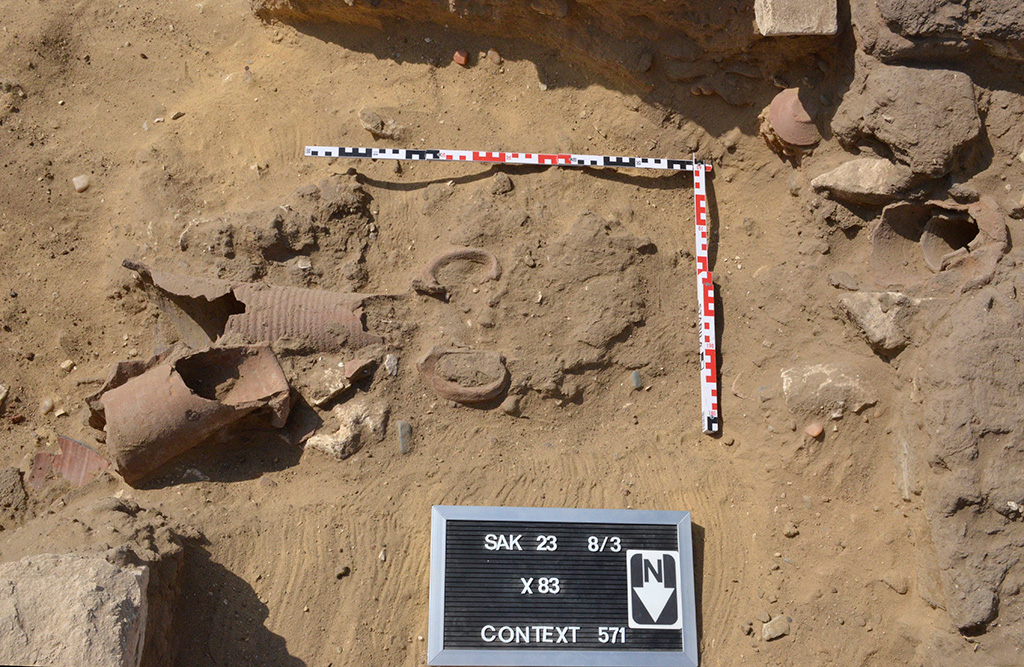
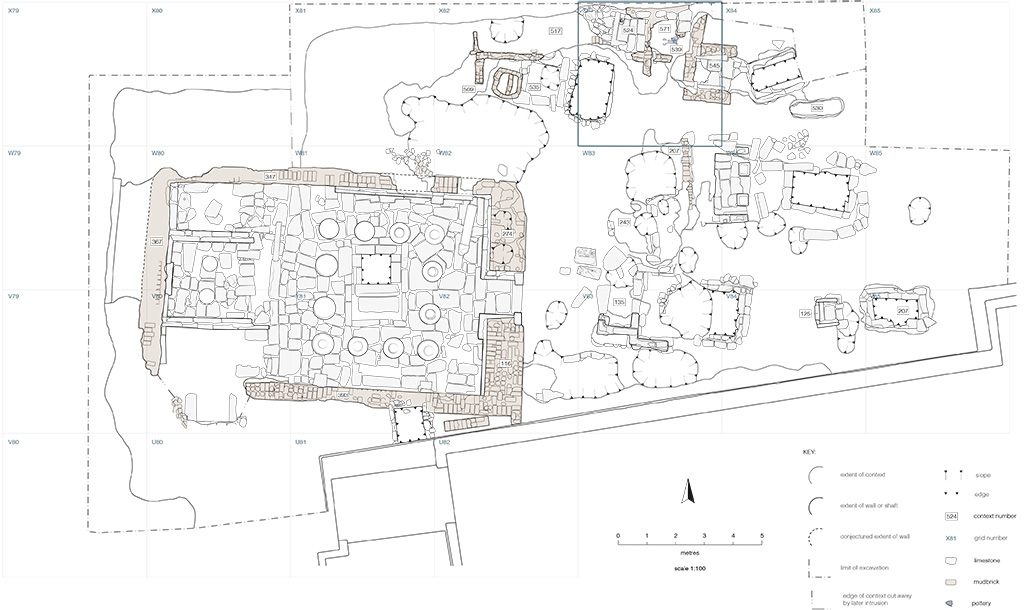
Map of the archaeological area excavated by the Leiden/Turin Expedition to Saqqara. Drawing by Paolo Del Vesco/Museo Egizio; inking by Alice Salvador.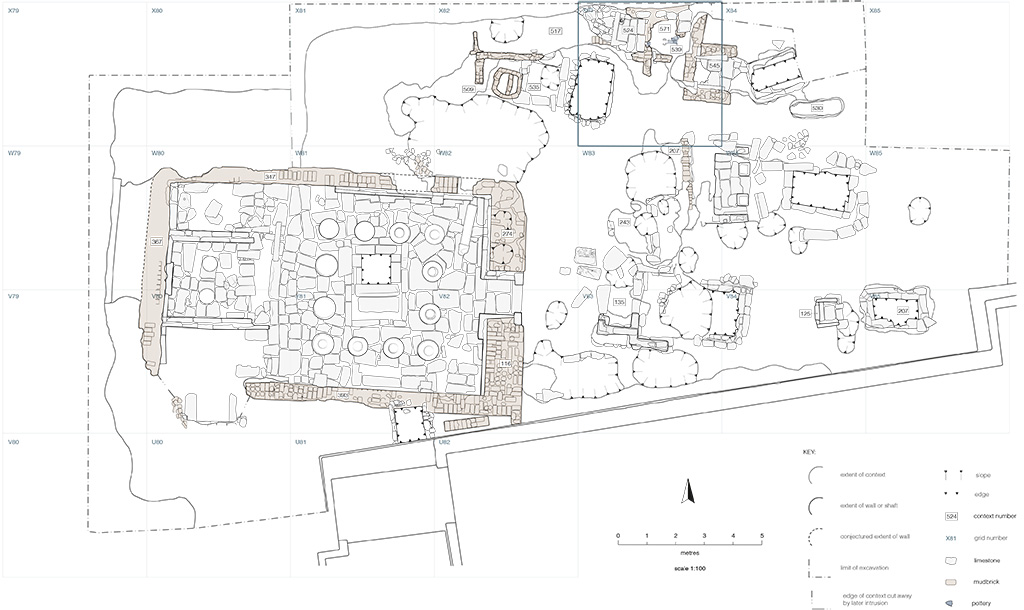
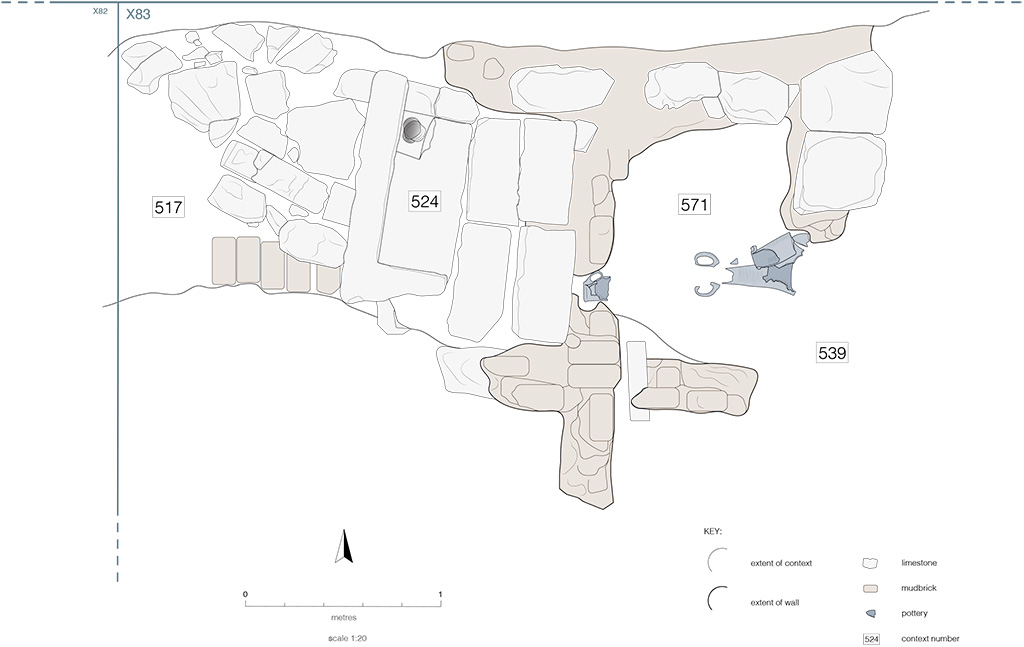
Detail of amphora installation, context 571; floor 524; mudbrick floor 517 and modern pit 539. Drawing by Paolo Del Vesco/Museo Egizio; inking by Alice Salvador.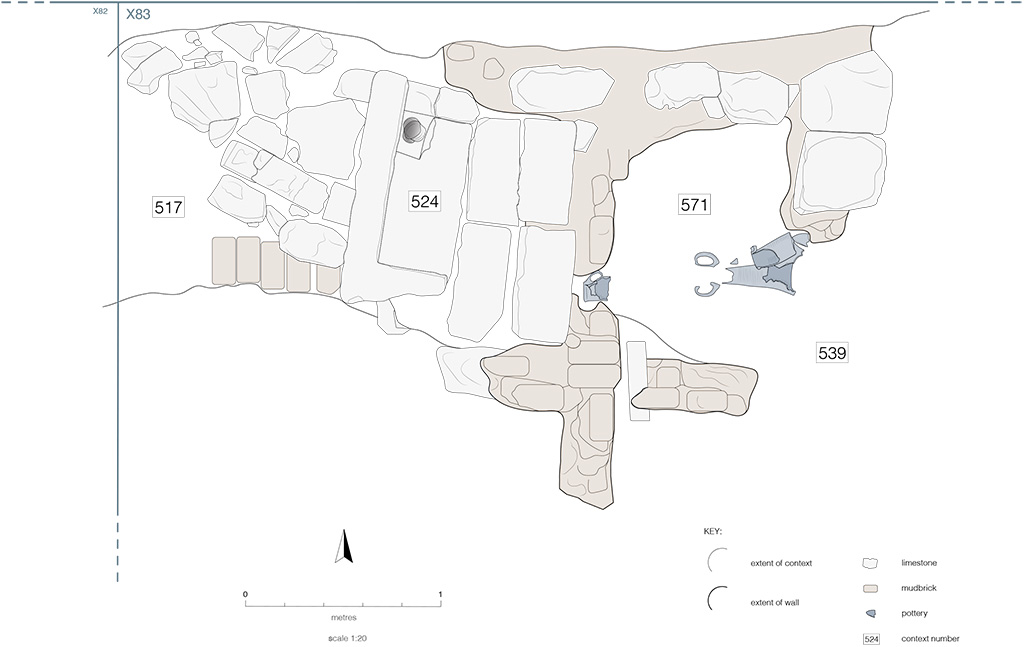
While working north-east of the recently discovered early Ramesside tomb of Panehsy,1 in a sector identified as X83 (see Figs. 2–3), the archaeologists of the Expedition uncovered four Late Roman amphorae
Detail of amphora installation, context 571. Photo by Paolo Del Vesco/Museo Egizio.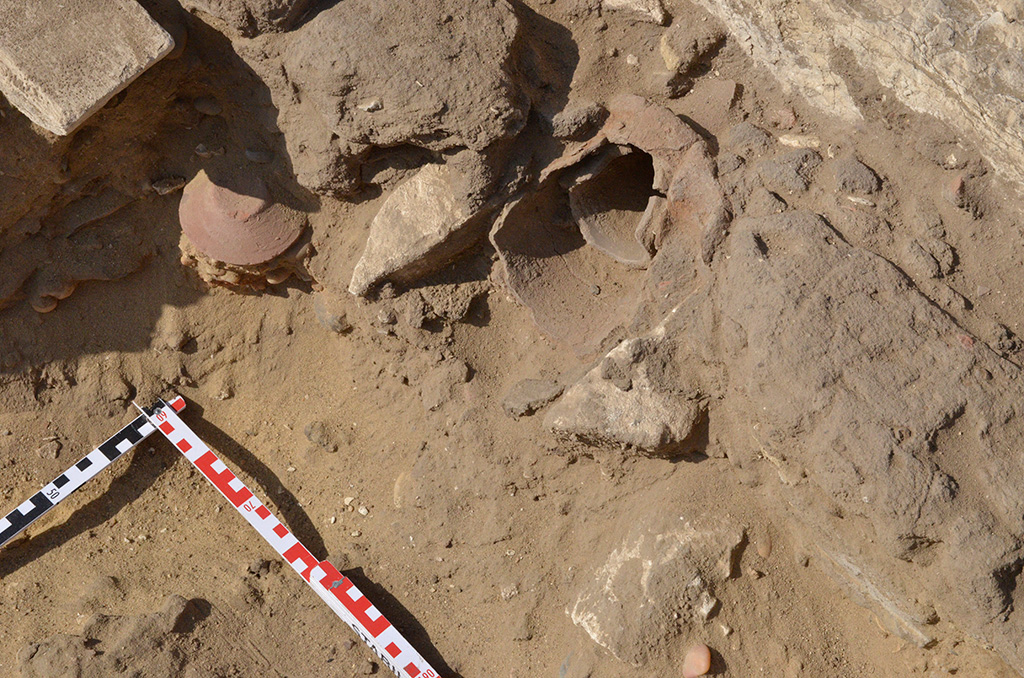
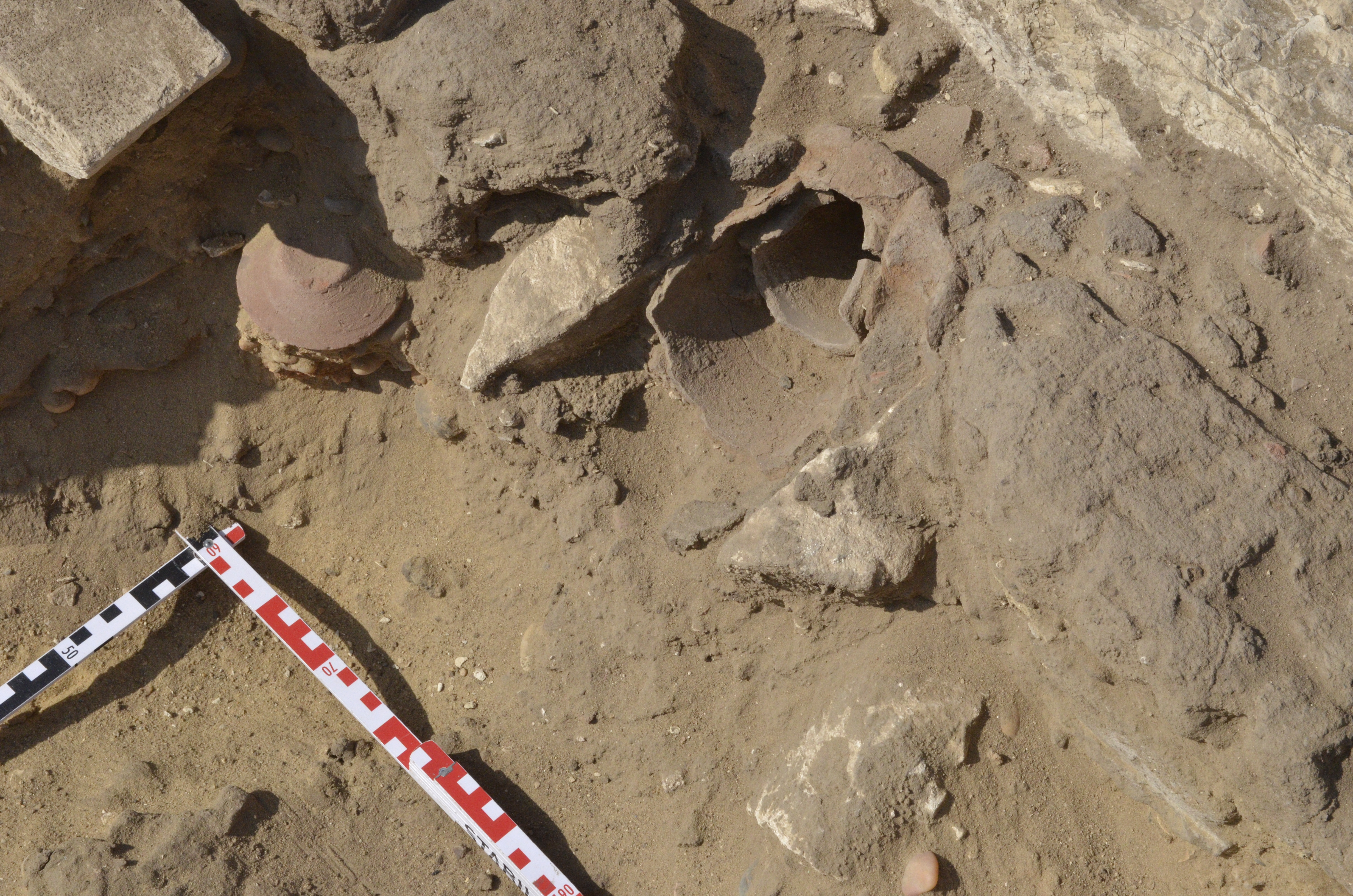
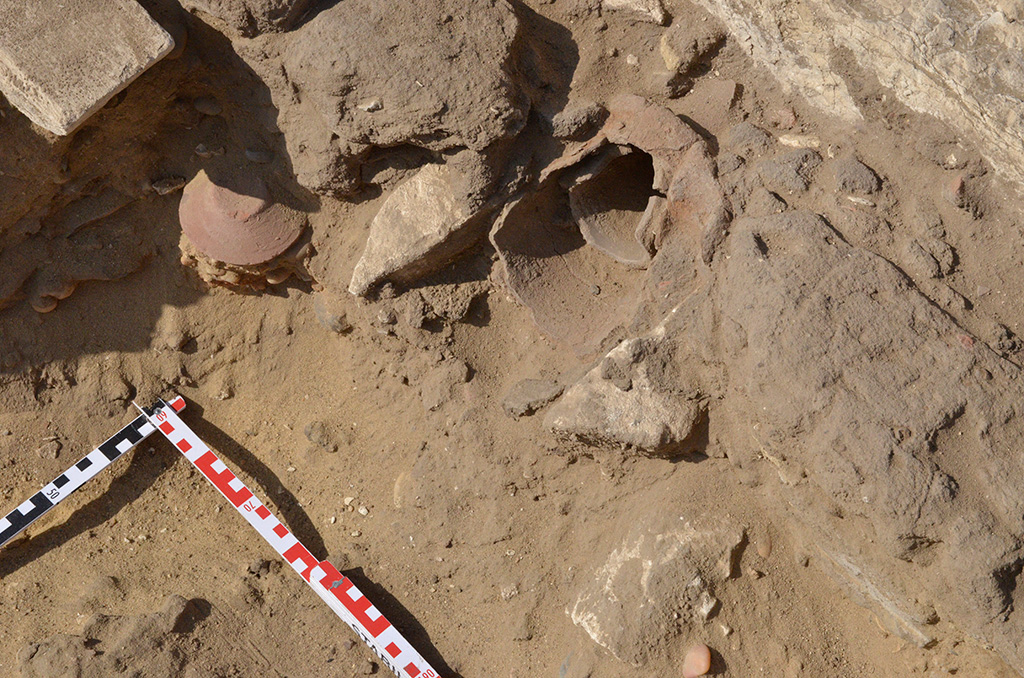
Amphora installation, context 571. Photo by Paolo Del Vesco/Museo Egizio.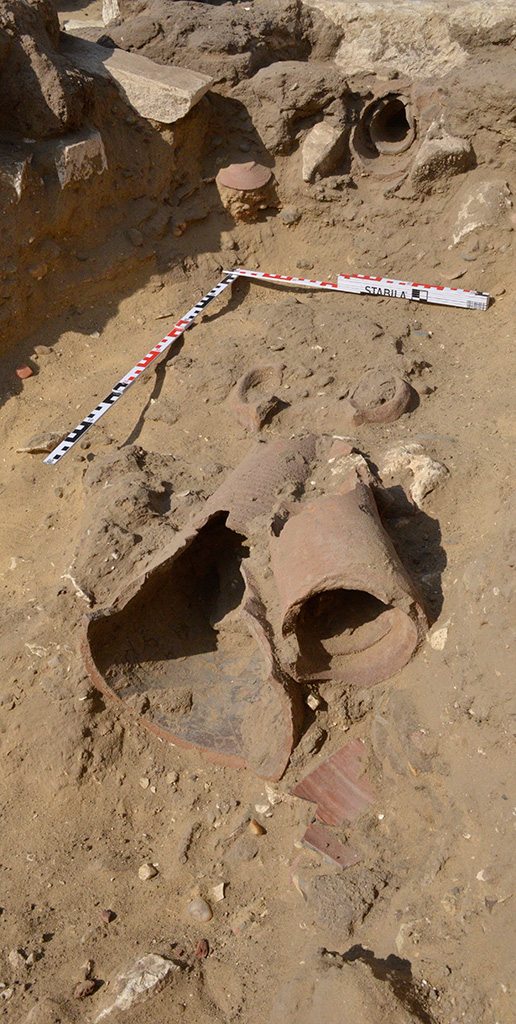

Unfortunately, sector X83 is located at the bottom of, and is also partially cut by, what has been recognised as a large modern pit (identified as context 539, see Figs. 2–3) excavated by antiquities hunters in the nineteenth or early twentieth century. When robber pit 539 was dug, the structures and/or layers which may have originally covered amphora installation 571 (see Fig. 1) were removed along with other materials (if any). Unfortunately, comparable digs by modern looters have been discovered in other sectors of the tomb of Panehsy, some of which have compromised the stratigraphy of some of the Ramesside layers.
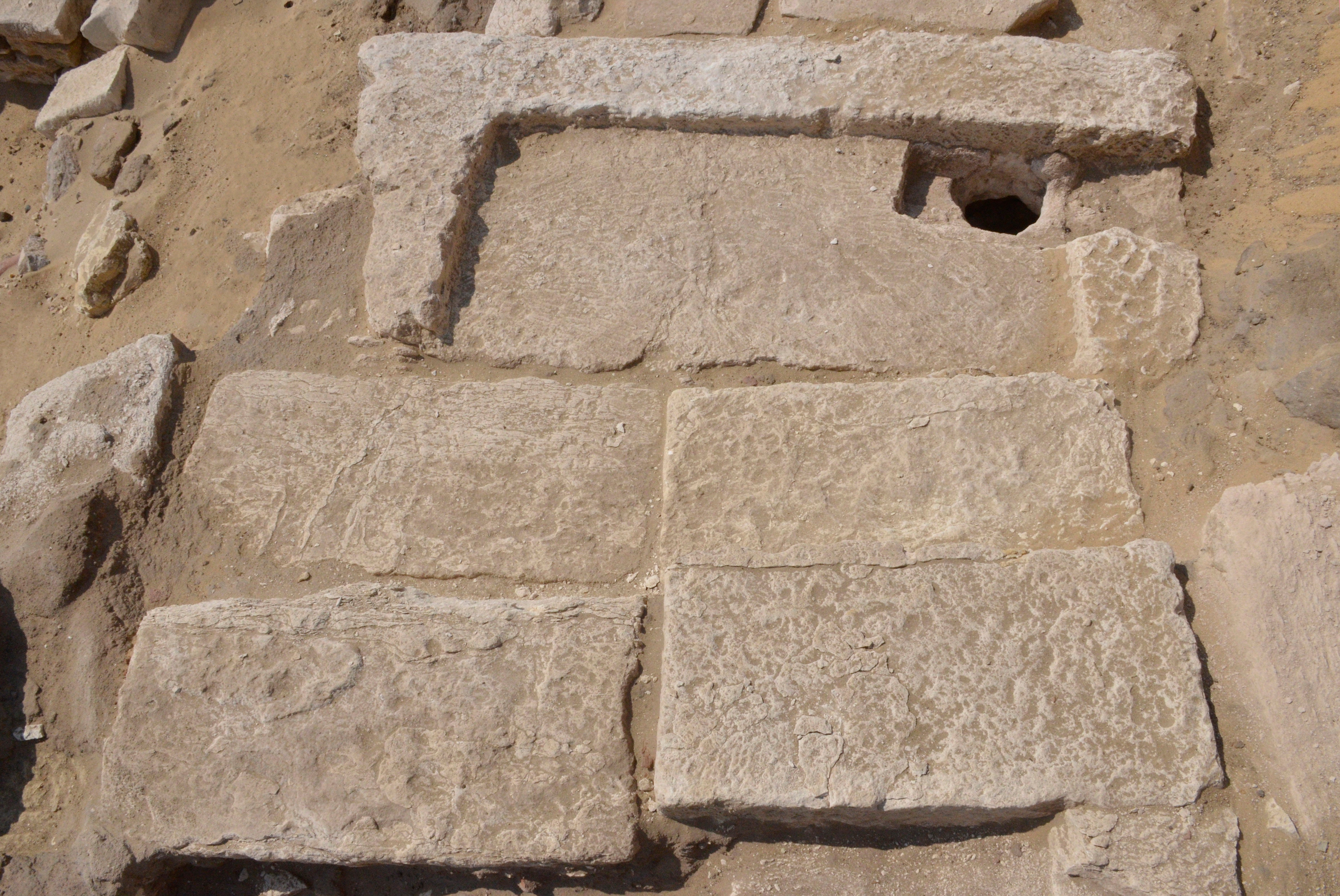
Amphora installation 571 may have played a role connected to other nearby still detectable architectural features. What remains of a limestone floor (context 524) was identified west of amphora installation 571 (Figs. 3, 6). A drainage hole (Fig. 6) is drilled through one of the stones of floor 524. Amphora installation 571 may have channelled the liquid(s) coming through this hole. Interestingly, however, at a later stage this drainage hole was deliberately and completely blocked; even if connected originally to this feature, at a certain point drainage system 571 was no longer functioning in relation to floor 524.
Another hypothesis is that amphora installation 571 was originally used in connection with a mudbrick floor (517: see Figs. 3, 7–8), built before the construction of stone floor 524. New archaeological data will hopefully shed new light on this important point. Was amphora installation 571 used in connection to stone floor 524 or to mudbrick floor 517? Or, perhaps, at an earlier stage with mudbrick floor 517 and later with stone floor 524? And what was its primary function?
Limestone floor 524. Photo by Paolo Del Vesco/Museo Egizio.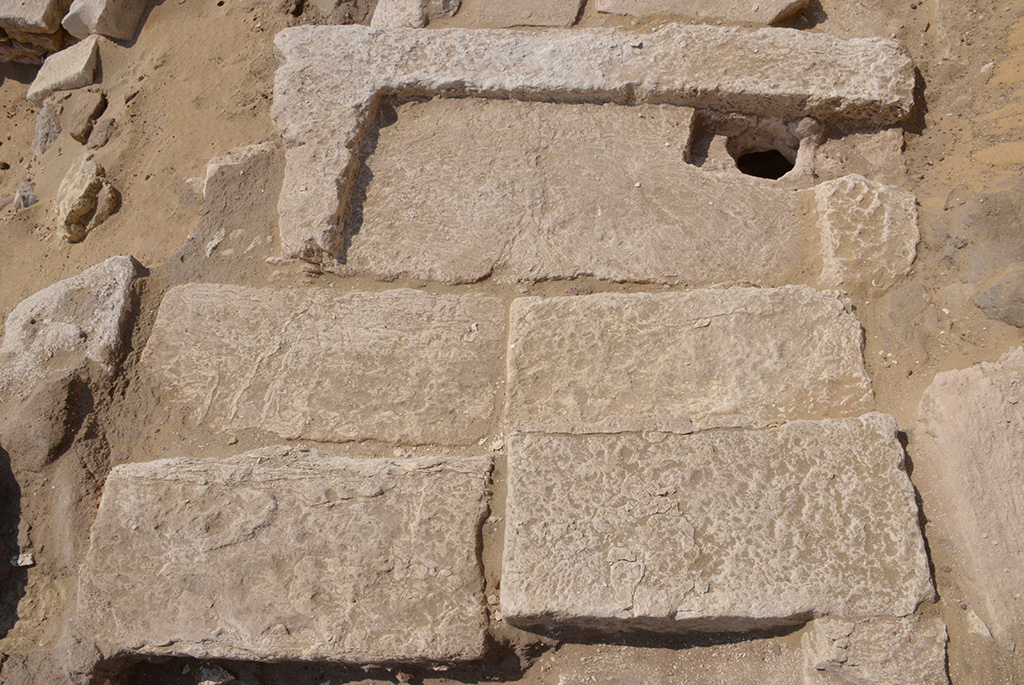

Orthophoto of context 571. Orthophoto by Paolo Del Vesco/Museo Egizio.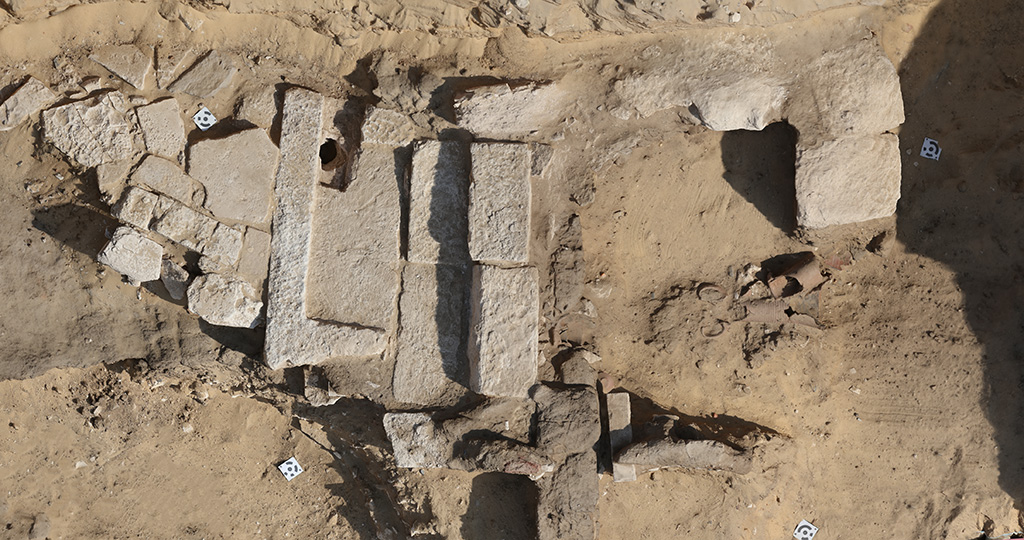
Amphora installation, context 571. Photo by Paolo Del Vesco/Museo Egizio.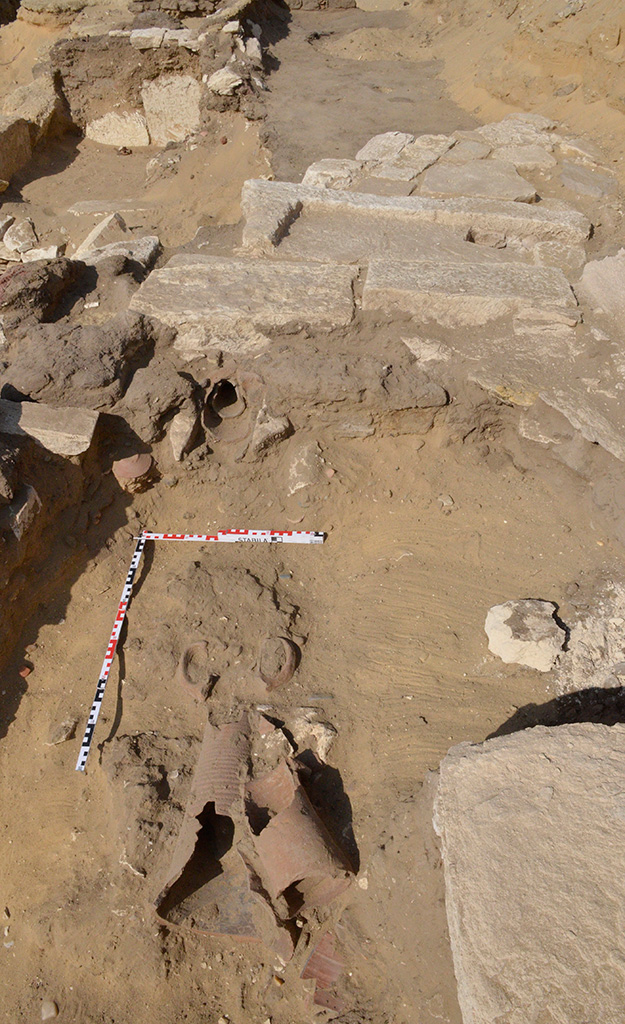
2. Amphorae and their many lives
As is well known, amphorae were very often reused as transport containers, meaning that they were repeatedly refilled, once emptied of their original contents. This was done during all of antiquity across the Mediterranean and beyond.4 Leaving aside this specific reuse strategy, these vessels could live many lives after their primary function as transport containers had ceased.5
The reasons why amphorae served the most diverse functions, once relieved of their primary/intended one, are many. Some amphorae, for example, may no longer have been suitable as product containers because of the substance(s) they previously held. Some of their products may have produced noxious odours from the residue of hard-to-clean substances.6 This could have negatively impacted the quality and preservation of the product(s) to be transported next. Thus, in certain cases amphora cleaning may have cost a great amount of effort and energy, counterbalanced by little profit or none at all.
Considering the huge number of amphorae available in the Roman period, amphorae no longer usable for the transport of commodities must have been easy to find, and cost-free or at a very low cost, making them quite valuable as recyclable material.7 As amphorae could be heavy and unwieldy, giving them away for reuse would have spared the owner the annoyance of having to dispose of them.
Among other uses, reused amphorae served as storage containers for food and other goods, tableware (when recut as beakers or bowls), incense burners, grinding palettes, strainers, boundary markers, libation conduits, urine containers, funnels, braziers or hearths, oven pieces, tokens, gaming pieces, weights, and, of course, writing supports – for example, as ostraca.8
Besides having this variety of second-life functions, amphorae were also reused as building and architectural elements. The reuse of amphorae for construction purposes is related to a series of morphological characteristics which made these vessels particularly suitable. Why amphorae? Size, rigidity, robustness, and light weight made them ideal for this purpose.9 In terms of overall shape, amphorae were versatile and easily remodelled. Their most often elongated bodies could be easily reduced. They could be perforated or effortlessly stripped of some of their parts to adapt them to their new use.10
When it came, more specifically, to buildings and hydraulic structures, as in the Saqqara case currently under discussion, amphorae were particularly useful because of their impermeability, as well as their other aforesaid characteristics. They were ideal for carrying water or, more in general, for liquid-related installations – their primary intended function being, indeed, holding liquids and unconsolidated solids.11
Many of the reuse strategies outlined above are also applicable and detectable in Egypt, where amphora reuse for non-transport purposes is well documented during both the Ptolemaic-to-Roman and the Late Antique-to-early Medieval periods.
An example of Ptolemaic amphora reuse in cooking installations is observable, for example, at Bi’r Samut, where amphora necks were employed in the construction of ovens. At the same site, amphora sherds were also reused in the paving of floors, and amphora bodies were embedded in floors and courtyards for the storage of foodstuffs.12 During early Roman times, amphora necks were reemployed for kiln ventilation systems at Buto.13
With regard to the Late Antique period, particularly intriguing is an example from Ashmunein,14 where amphorae belonging to the same types as the ones under discussion here were reused in a drainage system along and in association with tubular elements likely manufactured for that purpose.15
Further examples of Late Roman amphora reuse in Egypt are attested at the Monastery of John the Little in Wadi Natrun, where amphorae necks were reused for ventilation and in storage and cooking installations.16 Similar uses are observable at Kellia,17 Deir Anba Hadra,18 and Esna.19 Finally, reused amphorae were detected in walls at Fustat.20
3. Reused Late Roman amphorae from the New Kingdom necropolis at Saqqara
This subtype is attested between the first half of the seventh and the middle of the eighth century AD.26 AE 3T-3.2 amphorae were no longer manufactured after the mid-eighth century AD and, apparently, they were never found at Fustat, which may indicate a decline in their production and use by the seventh or first half of the eighth century AD.27 Manufactured from Nile silt, amphorae AE 3T-3.2 were meant for wine transport, as suggested by pitch residues still detectable inside some of them. This type of amphora is attested at several Egyptian sites and appears to have been distributed across the whole country.28
A possible reason for the short lifespan and the end of the production of AE 3T-3.2 amphorae may be found in their shapes. As previously pointed out,29 these transport containers were large and unwieldy compared to the coeval LR 7 amphorae, which were more elongated and slender. Additionally, a change in amphora sizes and shapes is well attested at the transition between the Late Antique and the early Medieval periods. Smaller amphorae with a rounded base (such as AE 5/6, for example)30 were gradually favoured over elongated ones with a pointed bottom. While the morphology of AE 3T-3.2 amphorae may have played a role in their discontinuance as transport vessels, it encouraged their reuse as building materials (see below).
AE 3T-3.2 amphorae are quite rare among the ceramic materials excavated in the Late Antique layers of the New Kingdom necropolis at Saqqara. For example, at the nearby Akhethetep mastaba, AE 3T-3.2 amphorae occur rarely among the Late Antique ceramic repertoire, which here, too, sees a prevalence of the LR 7 type.31
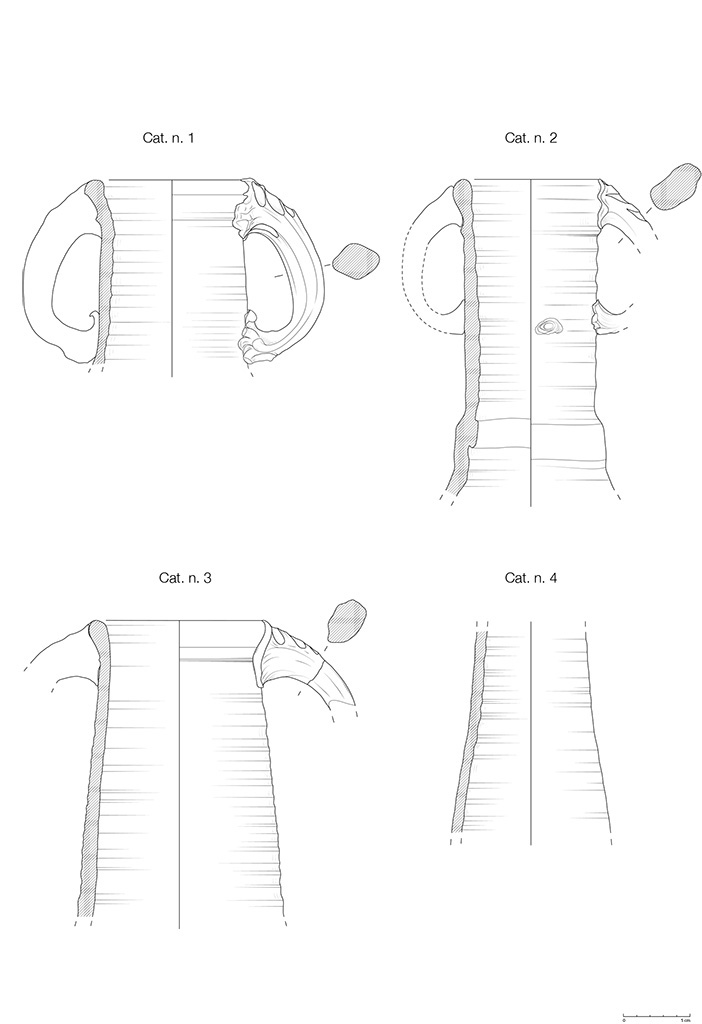
As mentioned above, the four amphorae (Cat. nos. 1–4) forming drainage system 571 all belong to the same type (AE 3T-3.2). This pattern of selecting amphorae of the same type for a specific reuse strategy has been observed in comparable features excavated across the Roman Empire32 (while earlier in date, they show highly similar reuse models). A Late Antique example from Egypt is attested at the Monastery of John the Little in Wadi Natrun, where only Egloff 167 and 187 complete necks and handles were carefully chosen to be reused in ventilation systems.33 The same has been observed in Ashmunein, where only AE 3T-3.2 amphora rims and necks were employed in the drainage system (see above). Clearly, in certain cases the size and shape of a specific amphora type was particularly suitable for a specific purpose.34
AE 3T-3.2 amphorae, as noted, rarely occurred in the ceramic records of the Saqqara Late Antique layers, yet were deliberately chosen as building elements in drainage system 571, instead of the more abundantly available LR 7. This most likely depends on their shape: their necks are more elongated and thicker than those of LR 7 amphorae. On average, LR 7 rim and neck diameters vary between (approximately) 5 and 10 cm, 6–7 cm being the most frequently attested measurement.35 AE 3T-3.2 amphorae have larger rim and neck diameters, between ca. 11 and 15 cm.36
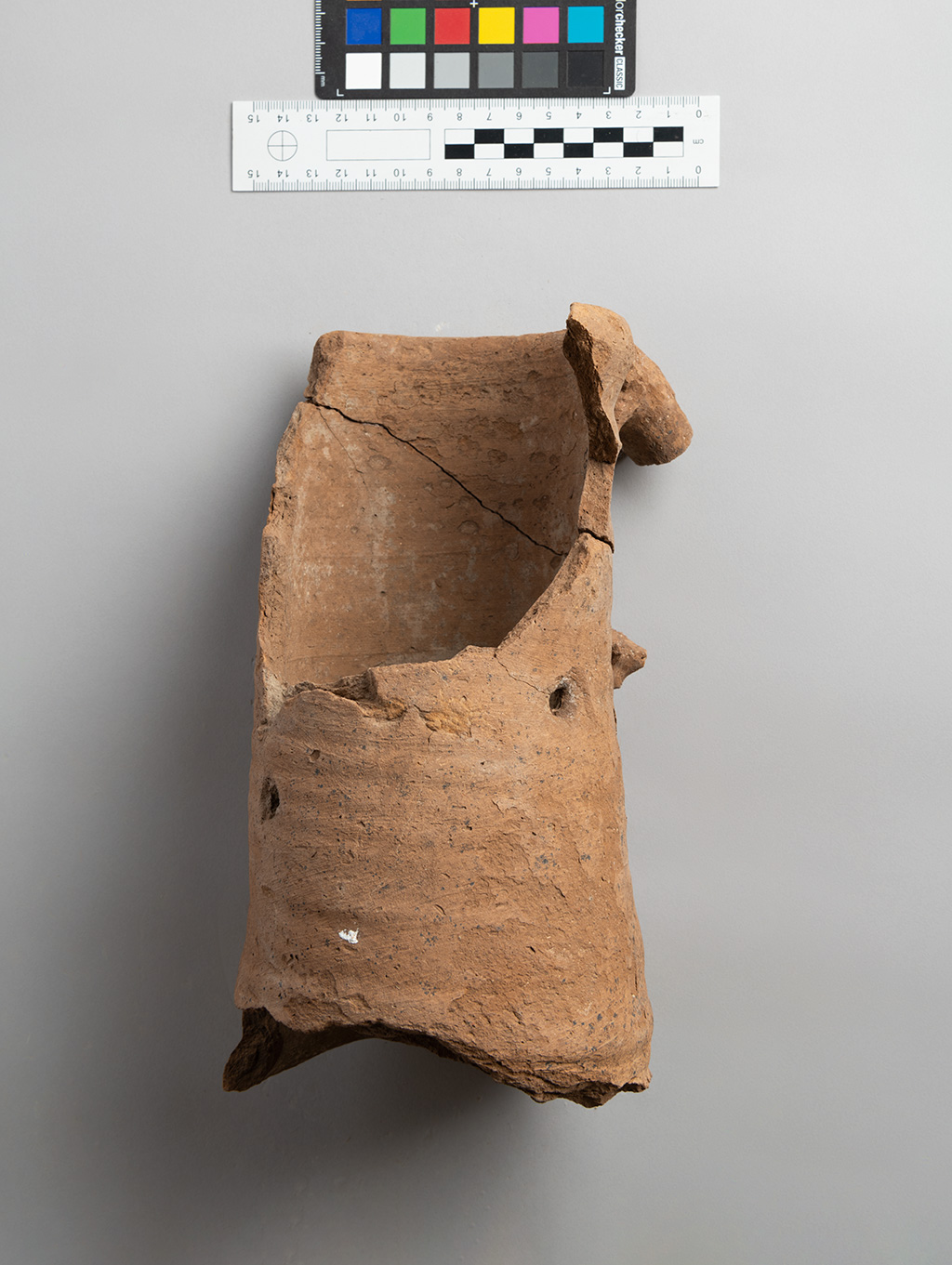
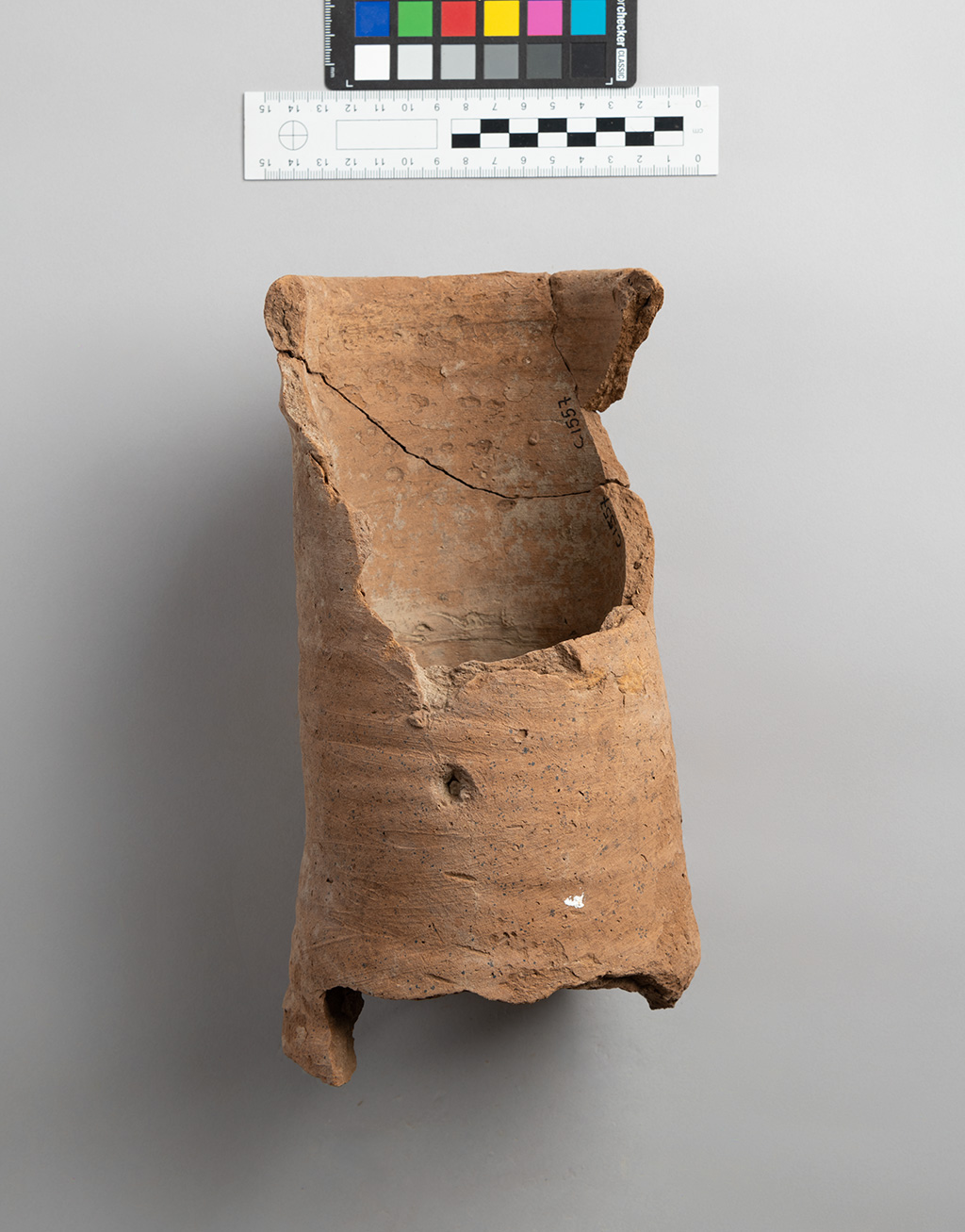
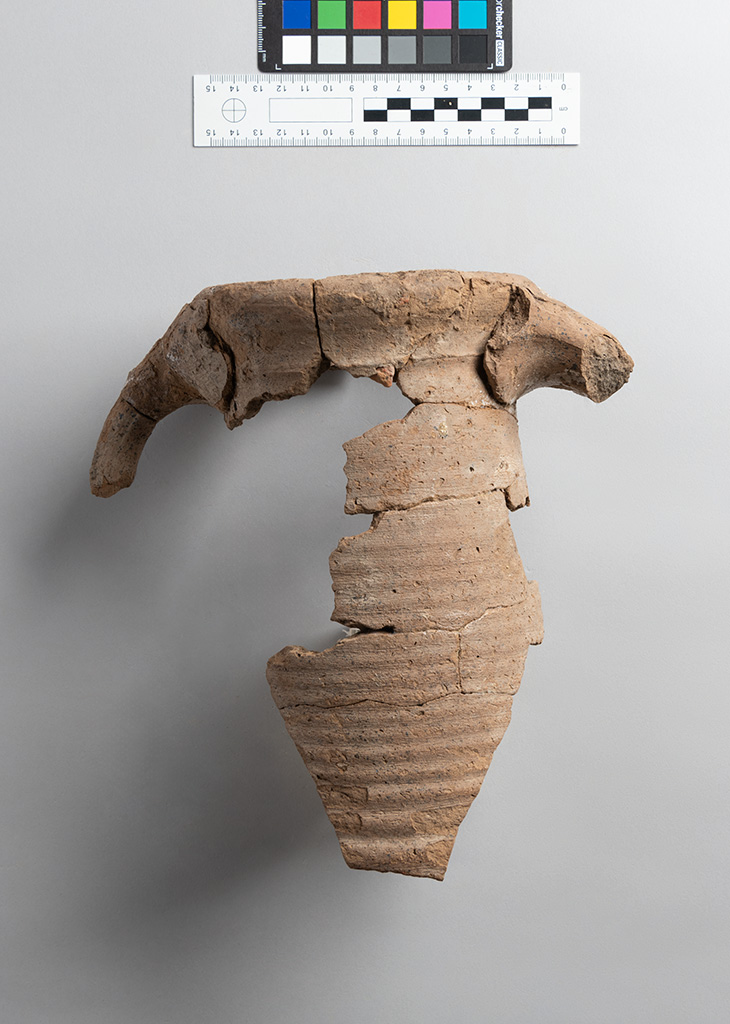
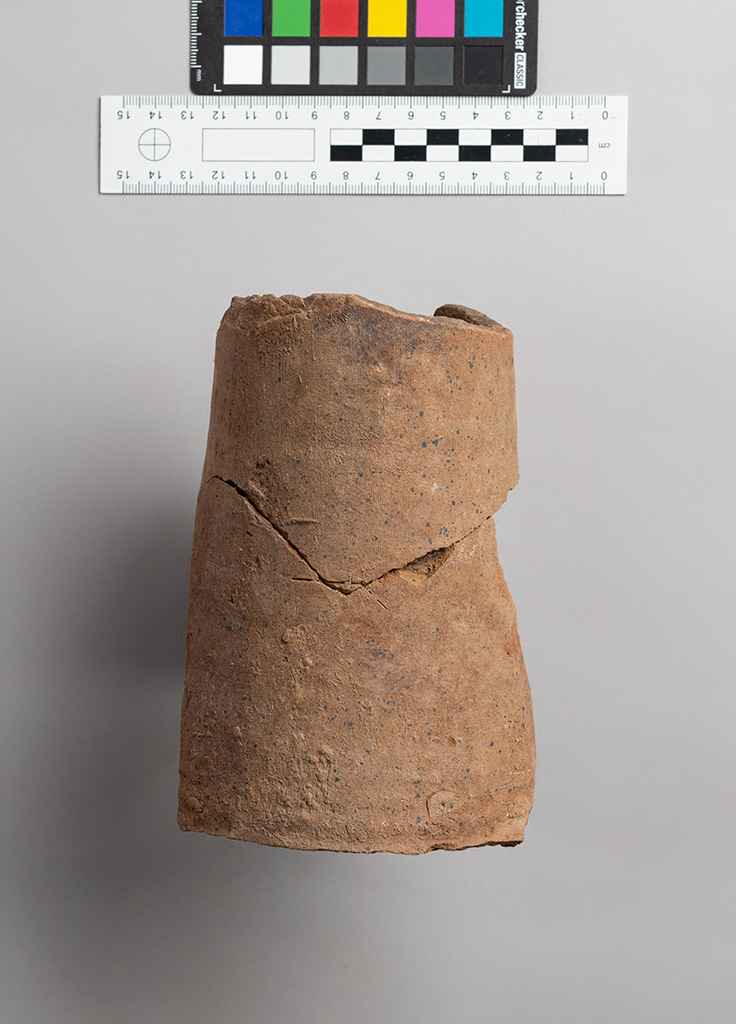
In the case of installation 571, an important question should be addressed: After having been decommissioned as transport containers, were these amphorae modified and recut, or were they recycled as drainage system elements because they were already broken? Based on the visual analysis of the breaks, at first glance it would seem that at least three out of four of the amphorae (Cat. nos. 1–3) were already broken before being re-employed. However, amphora Cat. no. 4 shows smooth, regular, and linear cuts on both edges (see Figs. 16–17), which may suggest that it was recut on purpose and according to predetermined measurements.
It should also be considered that different techniques were applied in the remodelling of amphorae,37 sawing and chipping being among the most frequent. Assuming the using of different recutting techniques for amphorae Cat. nos. 1–4, Cat. no. 4 could have been remodelled by sawing, the other three by chipping (Cat. nos. 1–3). This may explain why their breaks appear to be different. Remodelling by chipping appears to be highly likely for Cat. no. 2 after careful visual analysis of its breakage pattern (see Fig. 13); deliberate recutting seems indeed plausible in the light of the fact that this was a very specific amphora type, carefully chosen for its morphological characteristics.
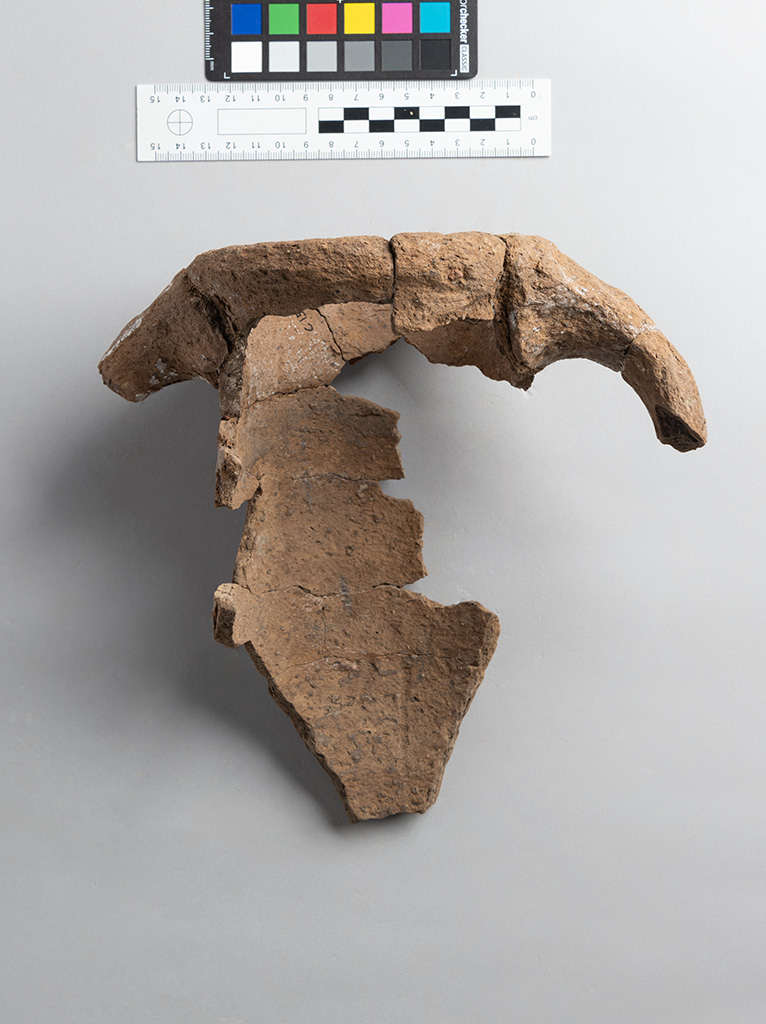
In discussing the remodelling and cutting of the amphorae (Cat. nos. 1–4) reemployed in drainage system 571, another aspect should be taken into consideration: the presence or absence of handles attached to their necks. Interestingly, at least in one case, handles were not removed prior to the amphora’s deposition (see Cat. no. 1). It is possible that handles were left attached to the neck to improve the drainage system’s stability in the ground. A similar pattern is observable in the amphorae drainage system discovered at Ashmunein.38
Finally, Cat. no. 2 had two post-firing holes, drilled through the neck, likely to be interpreted as fermentation holes. One of them appears to have been “restored” in antiquity, as it was roughly sealed with a little stone. The other was left untouched, indicating that its presence was irrelevant and did not cause any misfunctioning to this drainage system. It is possible that the second fermentation hole was not restored, being either filled in with solidified sand or earth, or because of the neck’s position in the ground. For example, it is possible that Cat. no. 2 was rotated with the second fermentation hole pressed against the ground.
4. Conclusions
Amphorae of different types, both imported and locally produced, were easily and abundantly available at the New Kingdom necropolis area during its Late Antique and early Medieval phases. Following on from the previous discussion, once decommissioned from their primary intended function of transport containers, these vessels were easily reemployed for completely different purposes, including construction, as in context 571. The same reuse pattern is easily traceable both at other Egyptian sites and all over the Mediterranean, particularly during the Roman and Late Antique periods.
While amphorae AE 3T-3.2 rarely occur in the Late Antique ceramic repertoire at Saqqara, they are attested both in the New Kingdom necropolis and at the Akhethetep mastaba.39 Their morphology (particularly their rim and neck dimensions) made them particularly suitable for specific building installations. A drainage system made from the same type of reused amphorae and highly comparable with the Saqqara one was identified at Ashmunein (see above). Due to these specific morphological characteristics, it is possible that AE 3T-3.2 amphorae were recut for reuse in architectural contexts.
Based on the chronology of AE 3T-3.2 production, installation 571 should not date earlier than the seventh and early-to-mid eighth century AD. Amphorae tended to have quite a long life and could have been kept in use as transport containers for up to twenty to twenty-five years.40 These considerations may suggest a date for the construction of installation 571 in the early eighth rather than the seventh century AD, or at the transition between the seventh and the eighth century.
Installation 571 has been interpreted as a drainage system, as suggested by the drainage hole in stone floor 524 immediately west of it and the presence of two amphorae in the masonry and the alignment of another amphora neck with this pipe, as well as the limited number of vessels occurring in this context. Archaeological evidence from the Roman period suggests that the use of a larger number of reused amphorae usually goes with much more complex hydrogeological features, including programs of land reclamation;41 which is clearly not the case in the Saqqara context under examination.
If drainage system 571 worked in connection with stone floor 524, a few more possibilities should be mentioned. Limestone floor 524 has slightly raised edges (see Fig. 6), indicating that it could have served as a shallow basin, where water was collected for a specific purpose, depending on the function of the building to which it was originally connected. For example, if the original Late Antique/early Medieval structures built there had a religious purpose, might it be possible that this shallow basin played a role in cultic practices? Only the resumption of excavations may provide more evidence about daily life activities (and what is left of them in the archaeological record) at Saqqara at the transition between the Late Antique and the early Medieval period.
5. Catalogue
Cat. no. 1 (Pl. 1 and Figs. 9–10)
Cat. no. 2 (Pl. 1 and Figs. 11–13)
Cat. no. 3 (Pl. 1 and Figs. 14–15)
Cat. no. 4 (Pl. 1 and Figs. 16–17)
Acknowledgments
All the image credits belong to the Leiden/Turin Expedition to Saqqara.
Cat. nos. 1–4: the four AE 3T-3.2 amphorae composing installation 571. Drawing and inking by Alice Salvador.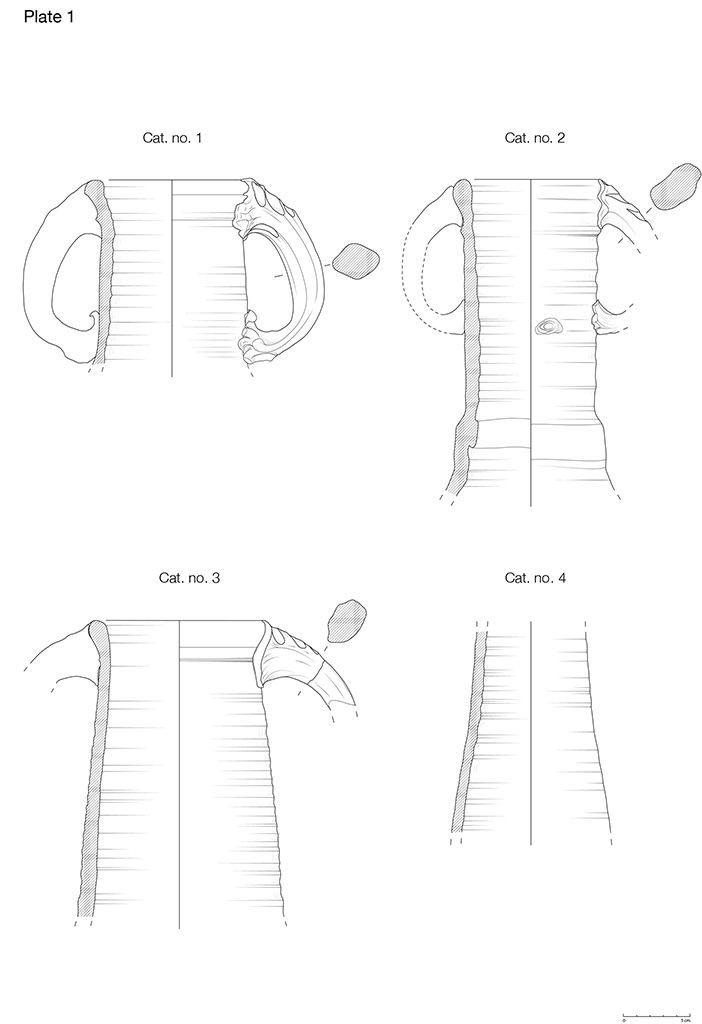
Amphora Cat. no. 1. Photo by Nicola Dell’Aquila/Museo Egizio.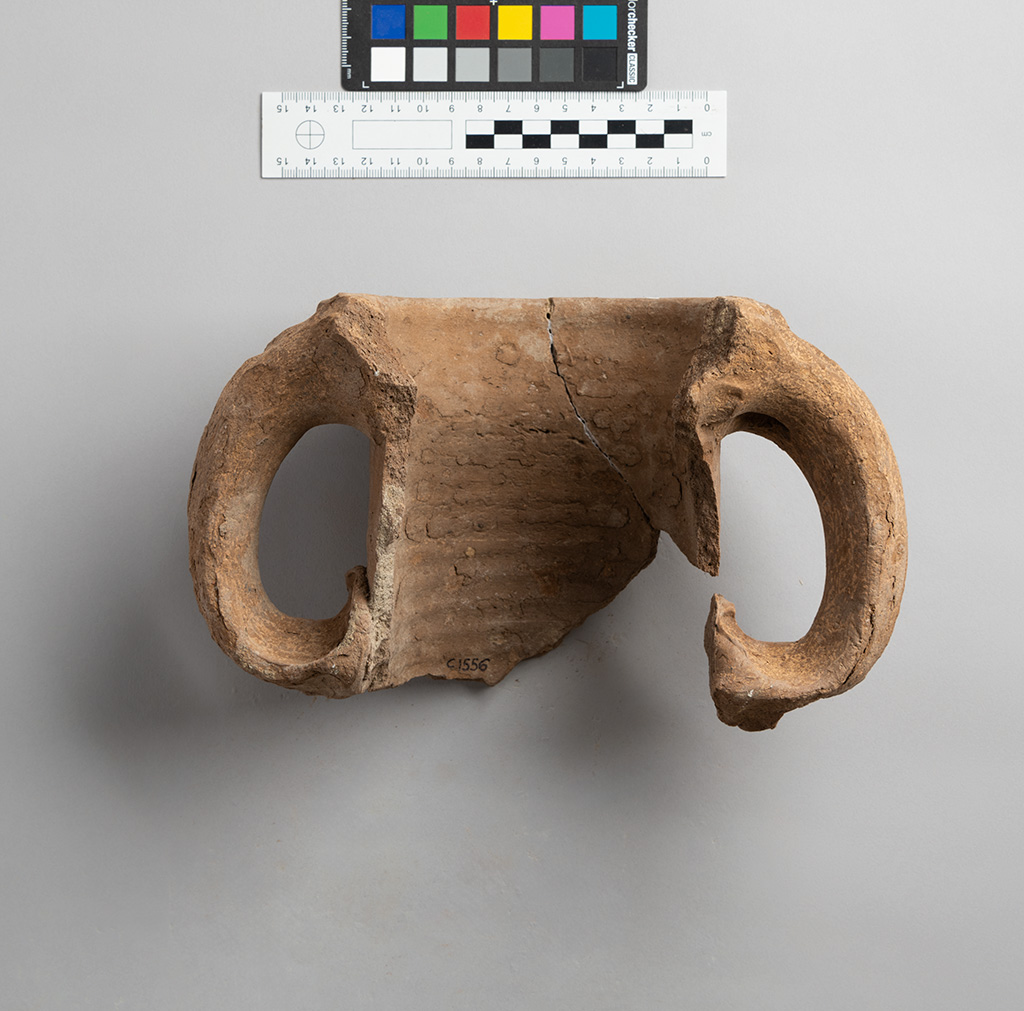
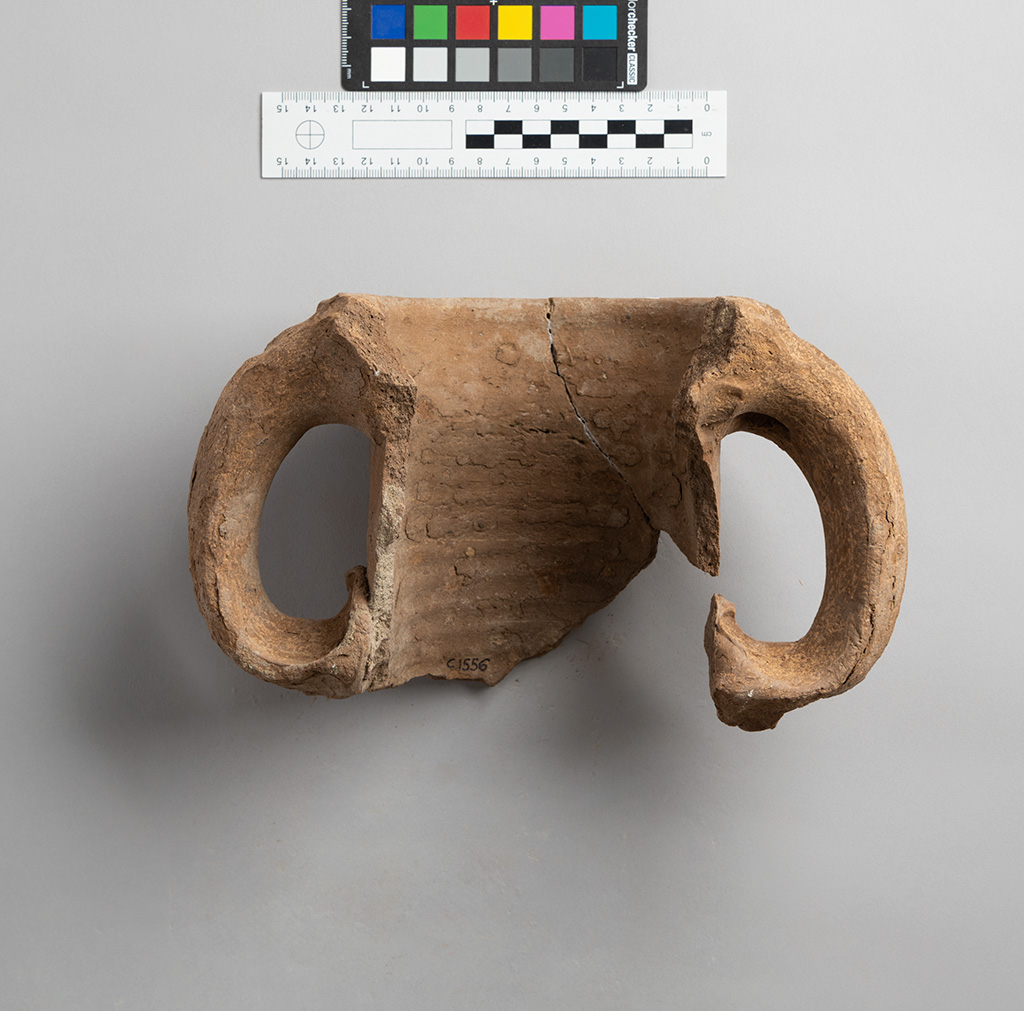
Amphora Cat. no. 1. Photo by Nicola Dell’Aquila/Museo Egizio.

Amphora Cat. no. 2. Photo by Nicola Dell’Aquila/Museo Egizio.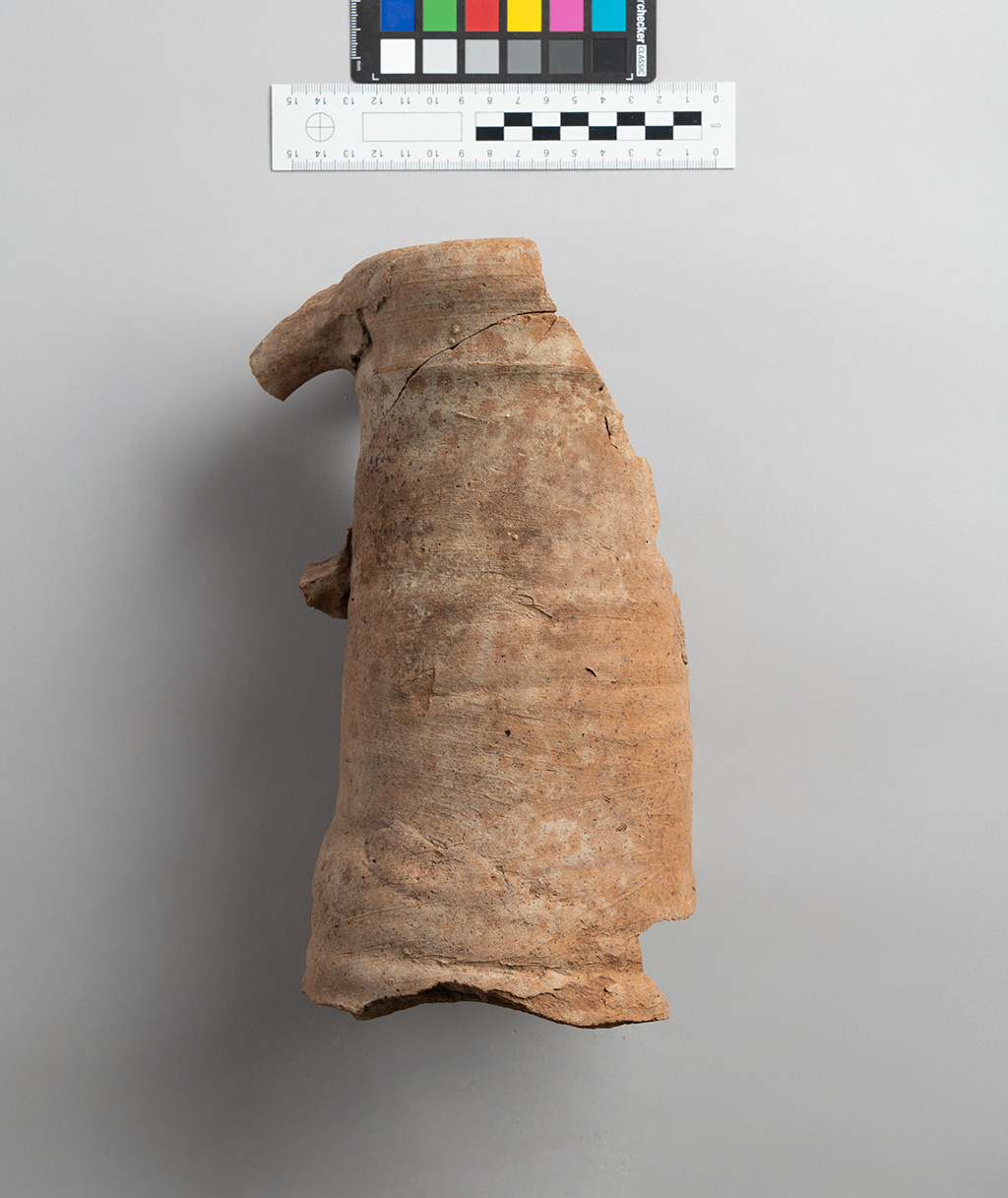

Amphora Cat. no. 2. Photo by Nicola Dell’Aquila/Museo Egizio.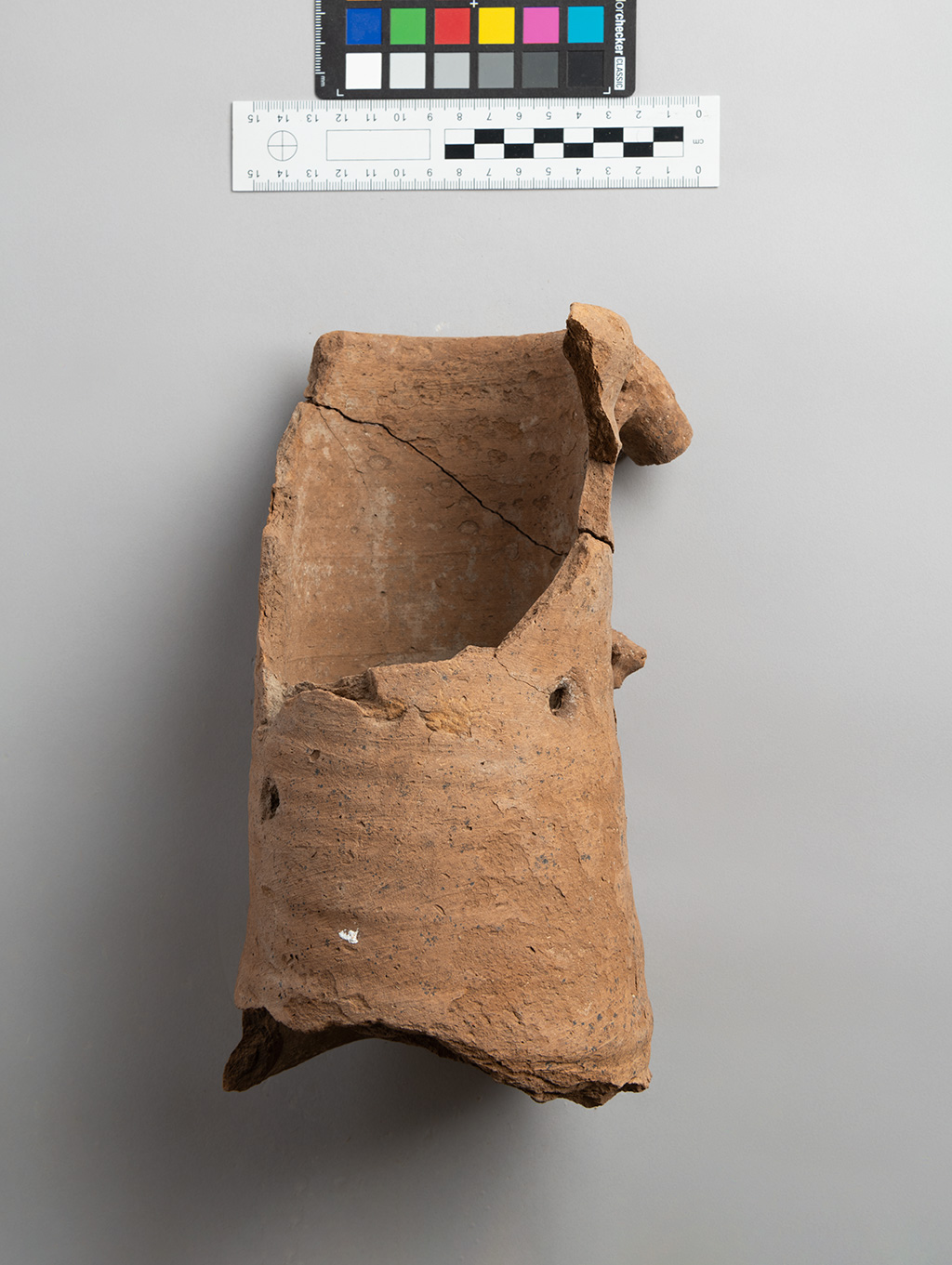
Amphora Cat. no. 2. Photo by Nicola Dell’Aquila/Museo Egizio.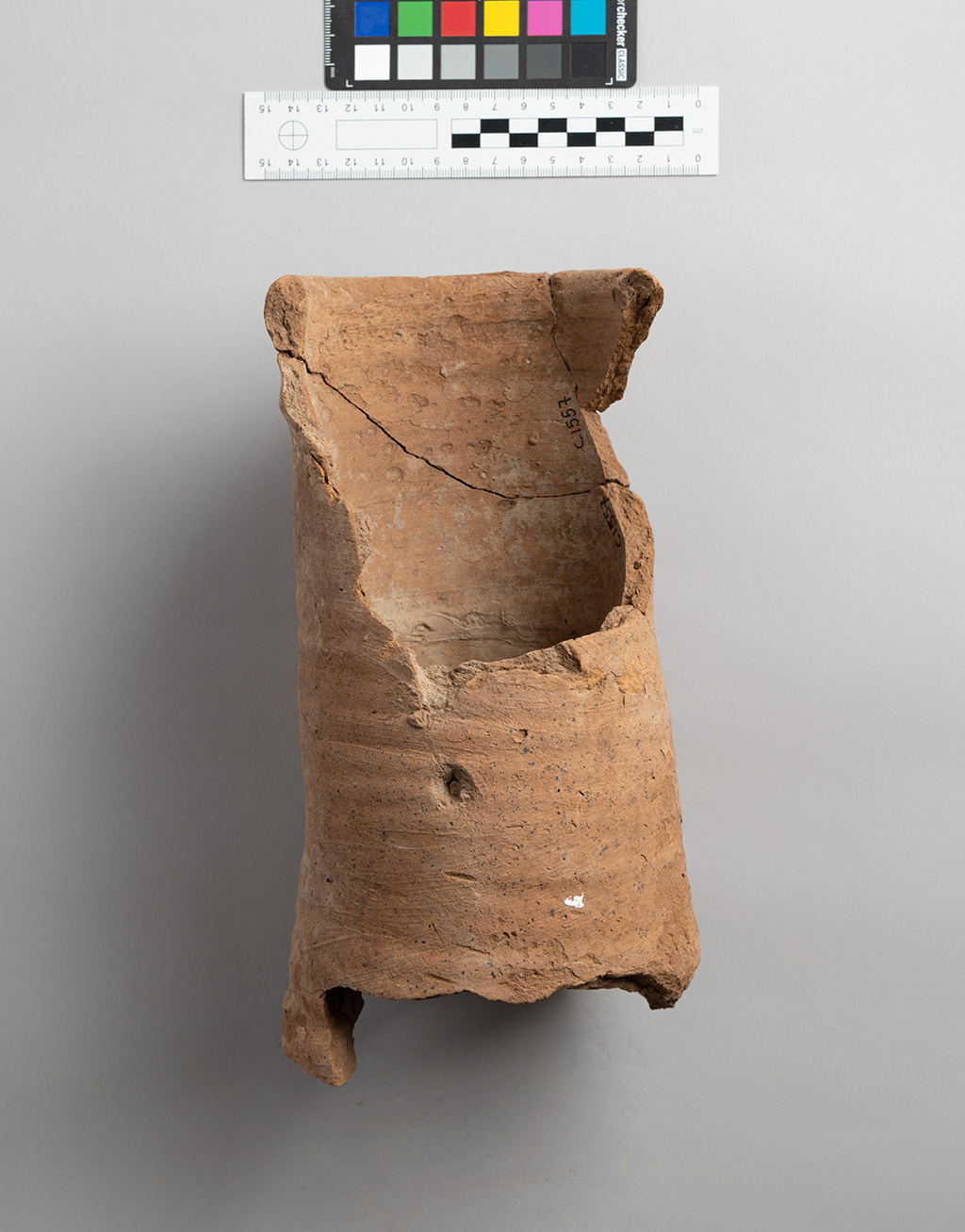
Amphora Cat. no. 3. Photo by Nicola Dell’Aquila/Museo Egizio.
Amphora Cat. no. 3. Photo by Nicola Dell’Aquila/Museo Egizio.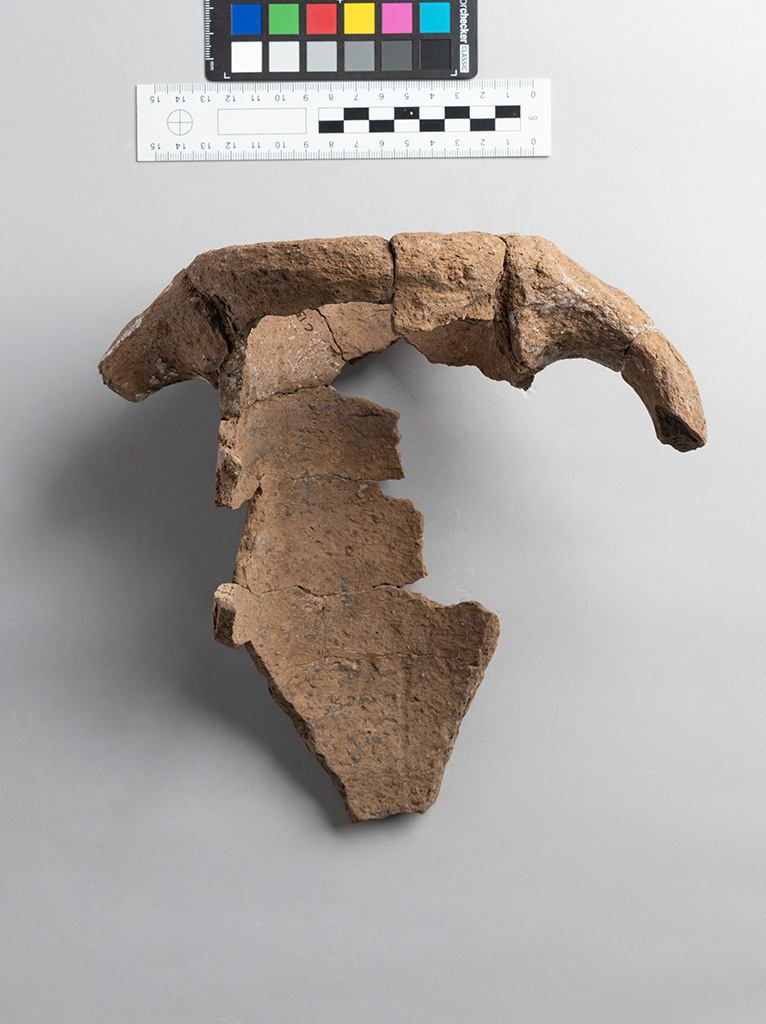
Amphora Cat. no. 3. Photo by Nicola Dell’Aquila/Museo Egizio.
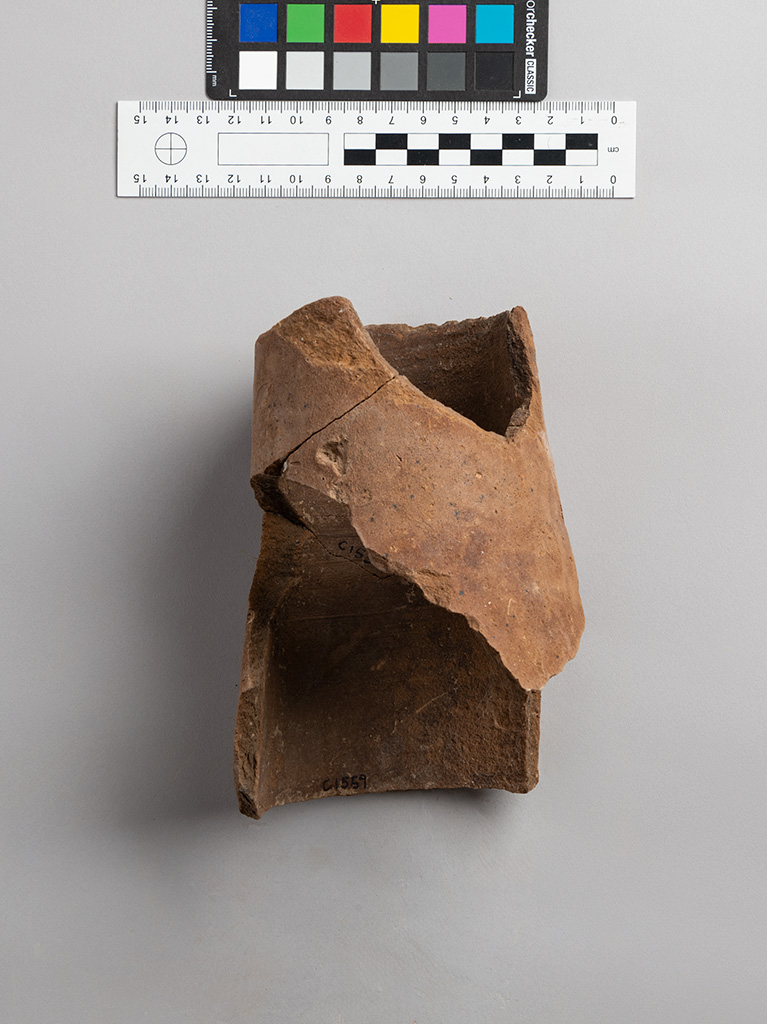
Amphora Cat. no. 3. Photo by Nicola Dell’Aquila/Museo Egizio.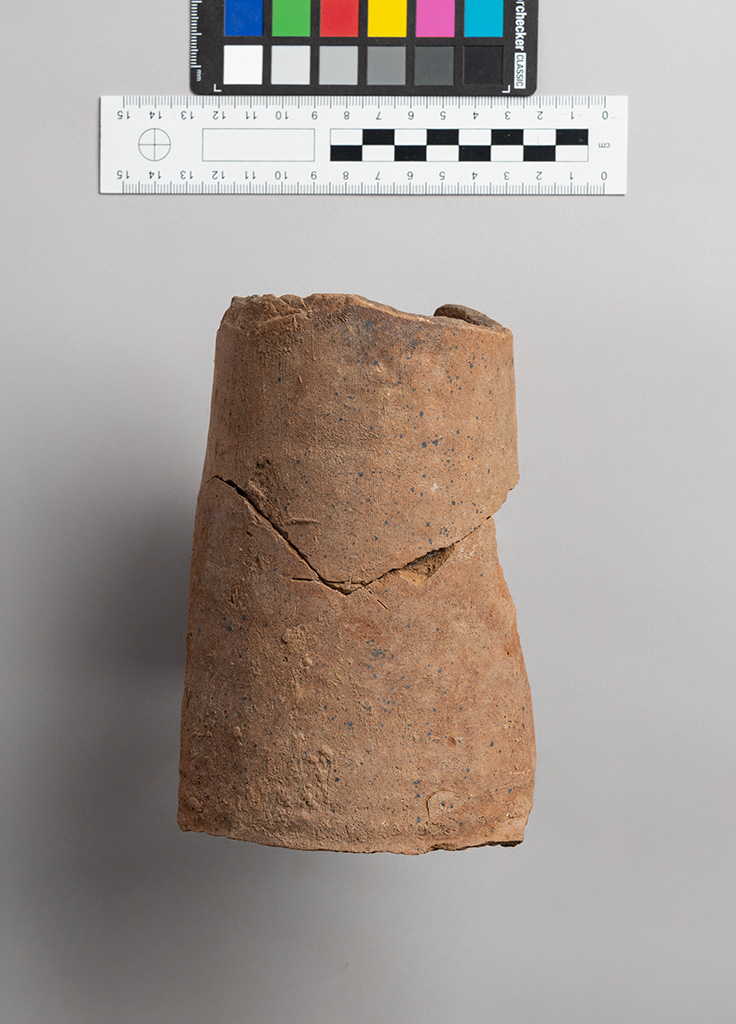
Bibliography
Abdelhamid, S., “Against the Throw-Away-Mentality: The Reuse of Amphoras in Ancient Maritime Transport”, in: H.P. Hahn and H. Weiss (eds.), Mobility, Meaning and Transformations of Things, Oxford 2013, pp. 91–106.
Antico Gallina, M., “Strutture ad anfore. Un sistema di bonifica dei suoli. Qualche esempio dalle Provinciae Hispanicae”, AEArq 84 (2011), pp. 179–205.
Bailey, D.M., Excavations at el-Ashmunein V: Pottery, Lamps and Glass of the Late Roman and Early Arab Periods, London 1998.
Ballet, P., F. Béguin, G. Lecuyot, and A. Schmitt, Tell el-Faraʻîn – Buto VI : Recherches sur les ateliers romains de Bouto. Prospections et sondages (2001–2006), Wiesbaden 2019.
Ballet, P., L. Mazou, M.-A. El Dorry, A. Dupont-Delaleuf, P. Georges-Zimmermann, G. Lecuyot, N. Morand, and M. Pesenti, “Bouto (2021). Vivre, produire et mourir à Bouto (Tell el-Fara‘in). Une lecture archéologique de la ville à la période romaine d’Octavien à Dioclétien”, BAEFE (2022), pp. 1–61.
Del Vesco, P., C. Greco, M. Müller, N. Staring, and L. Weiss, “Current Research of the Leiden-Turin Archaeological Mission in Saqqara. A Preliminary Report on the 2018 Season”, RiME 3 (2019), pp. 22–46. https://doi.org/10.29353/rime.2019.2236.
Del Vesco, P., C. Greco, D. Soliman, N. Staring, and L. Weiss, “The Leiden-Turin Archaeological Expedition to Saqqara: Preliminary Results of the 2019 Fieldwork Season”, RiME 4 (2020), pp. 62–93. https://doi.org/10.29353/rime.2020.3214.
Del Vesco, P., C. Greco, D. Soliman, N. Staring, and L. Weiss, “The Leiden-Turin Archaeological Expedition to Saqqara: Preliminary Results of the 2022–2023 Fieldwork Seasons”, RiME 9 (2025), pp. 139–206. https://doi.org/10.29353/rime..7206.
Dixneuf, D., Amphores égyptiennes. Production, typologie, contenu et diffusion (IIIe siècle avant J.-C. – IXe siècle après J.-C.), Alexandrie 2011.
Faiers, J., Late Roman Pottery at Amarna and Related Studies, London 2005.
Gasperini, V. and A. Salvador, “Preliminary Report on the Pottery from the 2018 Excavation”, in: P. Del Vesco, C. Greco, M. Müller, N. Staring, and L. Weiss, “Current Research of the Leiden-Turin Archaeological Mission in Saqqara. A Preliminary Report on the 2018 Season”, RiME 3 (2019), pp. 35–38. https://doi.org/10.29353/rime.2019.2236.
Gasperini, V. and A. Salvador, “Preliminary Report on Pottery”, in: P. Del Vesco, C. Greco, D. Soliman, N. Staring, and L. Weiss, “The Leiden-Turin Archaeological Expedition to Saqqara: Preliminary Results of the 2019 Fieldwork Season”, RiME 4 (2020), pp. 80–83. https://doi.org/10.29353/rime.2020.3214.
Gasperini, V. and A. Salvador, “Ceramic Studies: Seasons 2022–2023”, in: P. Del Vesco, C. Greco, D. Soliman, N. Staring, and L. Weiss, “The Leiden-Turin Archaeological Expedition to Saqqara: Preliminary Results of the 2022–2023 Fieldwork Seasons”, RiME 9 (2025), pp. 167–73.
Gates-Foster, J., “Third Century BCE Supply Networks and Ptolemaic Transport Amphoras from ‘Abbad and Bi’r Samut in Egypt’s Eastern Desert”, in: C. Durand, J. Marchand, B. Redon, and P. Schneider (eds.), Networked Spaces: The Spatiality of Networks in the Red Sea and Western Indian Ocean, Lyon 2022, pp. 347–64.
Gayraud, R.-P., “Quand l’amphore fait le mur…”, CCE 8 (2007), pp. 721–25.
Górka, K. and S. Rzepka, “Infant Burials or Infant Sacrifices? New Discoveries from Tell el-Retaba”, MDAIK 67 (2011), pp. 99–106.
Henein, N.H. and M. Wuttmann, Kellia, l’ermitage copte QR 195, I : Archeologie et architecture (FIFAO 41), Le Caire 2000.
Lecuyot, G., “Amphores de la Basse Époque à l’Époque Copte provenant de Saqqara”, CCE 8 (2007), pp. 199–206.
Peacock, D.P.S., Pottery in the Roman World: An Ethnoarchaeological Approach, Boston 1983.
Peña, J.T., Roman Pottery in the Archaeological Record, Cambridge 2007.
Pyke, G. and D. Brooks Hedstrom, “The Afterlife of Sherds: Architectural Re-Use Strategies at the Monastery of John the Little, Wadi Natrun”, in: B. Bader and M.F. Ownby (eds.), Functional Aspects of Egyptian Ceramics in Their Archaeological Contexts. Proceedings of a Conference Held at the McDonald Institute for Archaeological Research, Cambridge, July 24th – July 25th, 2009, Leuven 2013, pp. 307–26.
Raven, M.J., The Tomb of Maya and Meryt, II: Objects and Skeletal Remains, London and Leiden 2001.
Sauneron, S. and J. Jacquet, Les Ermitages chrétiens du désert d’Esna, I : Archéologie et inscriptions (FIFAO 29), Le Caire 1972.
Tristant, Y., “Les enterrements d’enfants dans l’Égypte prédynastique et pharaonique”, in: M.-D. Nenna (ed.), L’Enfant et la mort dans l’Antiquité II : Types de tombes et traitement du corps des enfants dans l’antiquité gréco-romaine, Alexandrie 2012, pp. 15–59.
Note
- Del Vesco et al., <i>RiME</i> 3 (2019); Del Vesco et al., <i>RiME</i> 4 (2020); Del Vesco et al., <i>RiME</i> 9 (2025).↑
- Del Vesco et al., <i>RiME</i> 3 (2019), pp. 26–28. For a comparable installation, made from Late Antique amphorae and discovered at the nearby tomb of Maya and Merit, see Raven, <i>Maya and Merit II</i>, 2001, p. 15; pl. 12c.↑
- See, for example: Górka and Rzepka, <i>MDAIK</i> 67 (2011); Tristant, in Nenna (ed.), <i>L’Enfant et la mort dans l’Antiquité II</i>, 2012, pp. 30–32, with previous bibliography.↑
- See Abdelhamid, in Hahn and Weiss (eds.), <i>Mobility, Meaning and Transformations of Things</i>, 2013.↑
- See Peña, <i>Roman Pottery</i>, 2007; see also Peacock, <i>Pottery in the Roman World</i>, 1983.↑
- On this explanation see Peña, <i>Roman Pottery</i>, 2007, p. 119.↑
- Peña, <i>Roman Pottery</i>, 2007, p. 119.↑
- For a very detailed description of all the possible identified amphora reuses, see Peña, <i>Roman Pottery</i>, 2007, pp. 123–92.↑
- Peña, <i>Roman Pottery</i>, 2007, p. 181.↑
- Peña, <i>Roman Pottery</i>, 2007, p. 119.↑
- Peña, <i>Roman Pottery</i>, 2007, p. 119.↑
- Gates-Foster, in Durand et al. (eds.), <i>Networked Spaces</i>, 2022, pp. 352–53, fig. 6.↑
- Ballet et al., <i>Tell el-Faraʻîn – Buto VI</i>, 2019, pp. 194–96; Ballet et al., <i>BAEFE</i> (2022), p. 37.↑
- Bailey, <i>Excavations at el-Ashmunein V</i>, 1998, pp. 110–11, p. 129, pl. 78, pl. 111: U 3–6.↑
- Bailey, <i>Excavations at el-Ashmunein V</i>, 1998, pl. 78, pl. 111: U 3–6.↑
- Pyke and Brooks Hedstrom, in Bader and Ownby (eds.), <i>Functional Aspects of Egyptian Ceramics in Their Archaeological Contexts</i>, 2013.↑
- For reused amphorae as components of ventilation systems: Henein and Wuttmann, <i>Kellia</i>, 2000, p. 123, fig. 162; for reused amphorae in cooking installations: Henein and Wuttman, <i>Kellia</i>, 2000, p. 213, fig. 229; p. 209, Table J.↑
- For ventilation and lighting features: Pyke and Brooks Hedstrom, in Bader and Ownby (eds.), <i>Functional Aspects of Egyptian Ceramics in Their Archaeological Contexts</i>, 2013, p. 311.↑
- For amphora reuse in cooking installation: Sauneron and Jacquet, <i>Esna I</i>, 1972, p. 19, fig. 3.↑
- Gayraud, <i>CCE</i> 8 (2007).↑
- Gasperini and Salvador, <i>RiME</i> 3 (2019), p. 37; <i>RiME</i> 4 (2020), p. 84; <i>RiME</i> 9 (2025), pp. 170–71.↑
- For a description of this type, see Dixneuf, <i>Amphores</i>, 2011, pp. 141–42; figs. 128–30.↑
- Dixneuf, <i>Amphores</i>, 2011, p. 141.↑
- Dixneuf, <i>Amphores</i>, 2011, pp. 97–128.↑
- Dixneuf, <i>Amphores</i>, 2011, pp. 138–42.↑
- Dixneuf, <i>Amphores</i>, 2011, p. 141.↑
- Dixneuf, <i>Amphores</i>, 2011, p. 141.↑
- Dixneuf, <i>Amphores</i>, 2011, p. 141.↑
- Dixneuf, <i>Amphores</i>, 2011, p. 142.↑
- See Dixneuf, <i>Amphores</i>, 2011, pp. 142–53.↑
- Lecuyot, <i>CCE</i> 8 (2007), p. 200.↑
- See Peña, <i>Roman Pottery</i>, 2007, p. 183.↑
- See Pyke and Brooks Hedstrom, in Bader and Ownby (eds.), <i>Functional Aspects of Egyptian Ceramics in their Archaeological Contexts</i>, 2013, p. 310.↑
- On this point, see also Peña, <i>Roman Pottery</i>, 2007, p. 183.↑
- For the measurement range of LR 7, see Dixneuf, <i>Amphores</i>, 2011, pp. 163–72.↑
- For the measurement range of AE 3T-3.2, see Dixneuf, <i>Amphores</i>, 2011, p. 141, and below, Cat. nos. 1–4.↑
- On this point, see Peña, <i>Roman Pottery</i>, 2007, pp. 121–23.↑
- See Bailey, <i>Excavations at el-Ashmunein V</i>, 1998, pl. 78, “Q 77–8 and U 3–6 in situ”.↑
- Lecuyot, <i>CCE</i> 8 (2007), p. 200.↑
- See Abdelhamid, in Hahn and Weiss (eds.), <i>Mobility, Meaning and the Transformations of Things</i>, 2013, p. 94.↑
- Peña, <i>Roman Pottery</i>, 2007, pp. 188–92; see also Antico Gallina, <i>AEArq</i> 84 (2011).↑
- On this point see Peña, <i>Roman Pottery</i>, 2007, p. 181.↑
- The code “M3” is adopted from the fabric classification system established by Janine Bourriau at Saqqara, and still applied for ceramics processing at this site. M3: “A soft, fairly rough, sandy, micaceous, dull brown (10YR 4/4) in colour” fabric; see: Faiers, <i>Late Roman Pottery at Amarna</i>, 2005, p. 61.↑