




Abstract
The article offers a comprehensive catalogue of the collection of 22 (Ptah-Sokar-)Osiris statues currently housed in the Bologna Museo Civico Archeologico. This catalogue is preceded by a concise overview of the latest research and knowledge regarding these fascinating figures, accompanied by a detailed study of their collecting history. Bologna boasts a long-standing museum tradition, reflecting a growing interest in Egyptian antiquities since the late 16th century. The statues of Ptah-Sokar-Osiris have enriched Bologna’s Egyptian collections from the 17th through the end of the 19th centuries, accompanying and reflecting their gradual growth.
Part 1. The Ptah-Sokar-Osiris Statues in Bologna: History of a Collection
(Daniela Picchi)
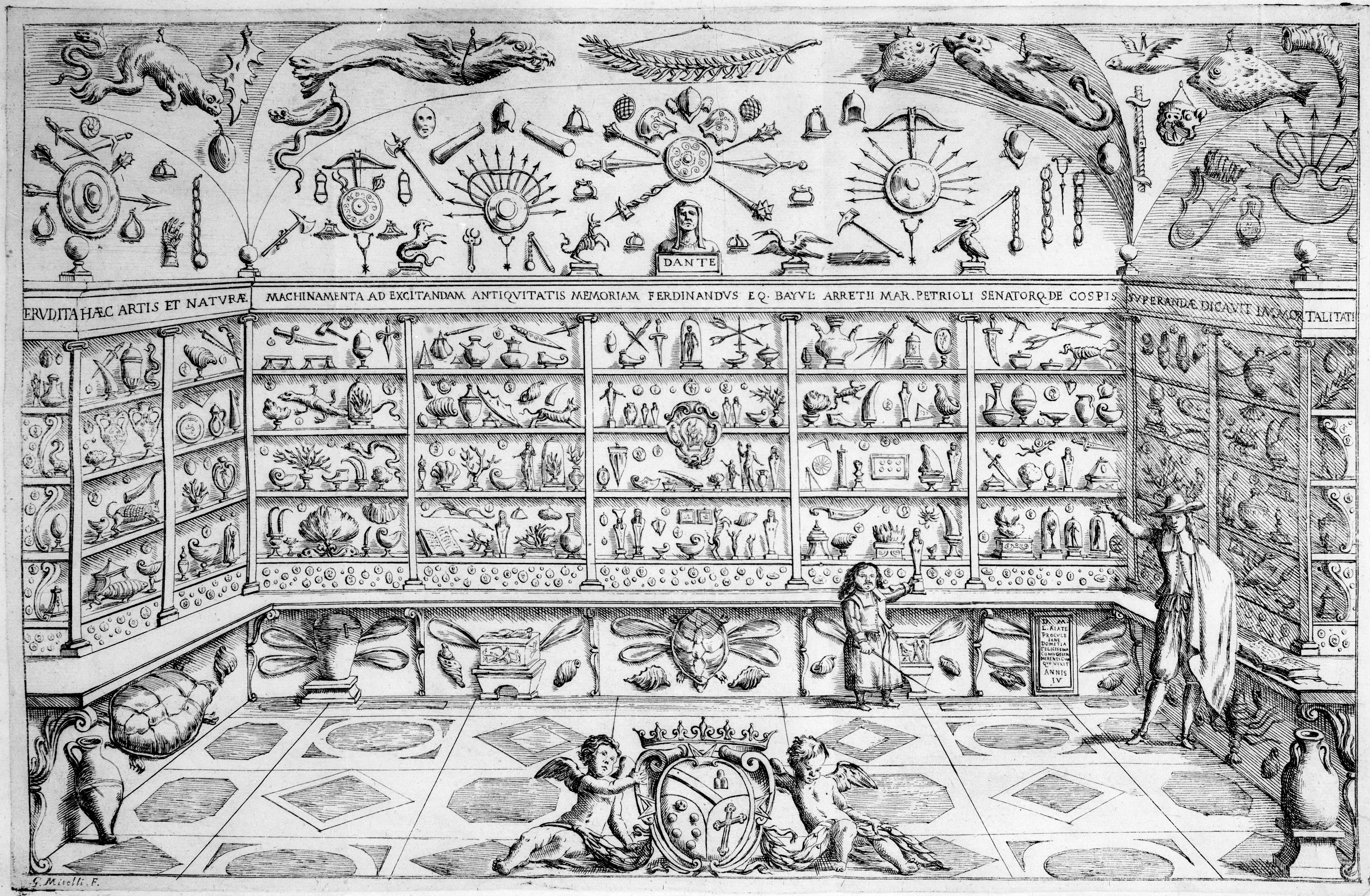
Etching showing Cospi’s statues of Ptah-Sokar-Osiris, in L. Legati, Museo Cospiano annesso a quello del famoso Ulisse Aldrovandi e donato alla sua Patria dall’Illustrissimo Signor Ferdinando Cospi Patrizio di Bologna e Senatore, Bologna 1677, p. 459.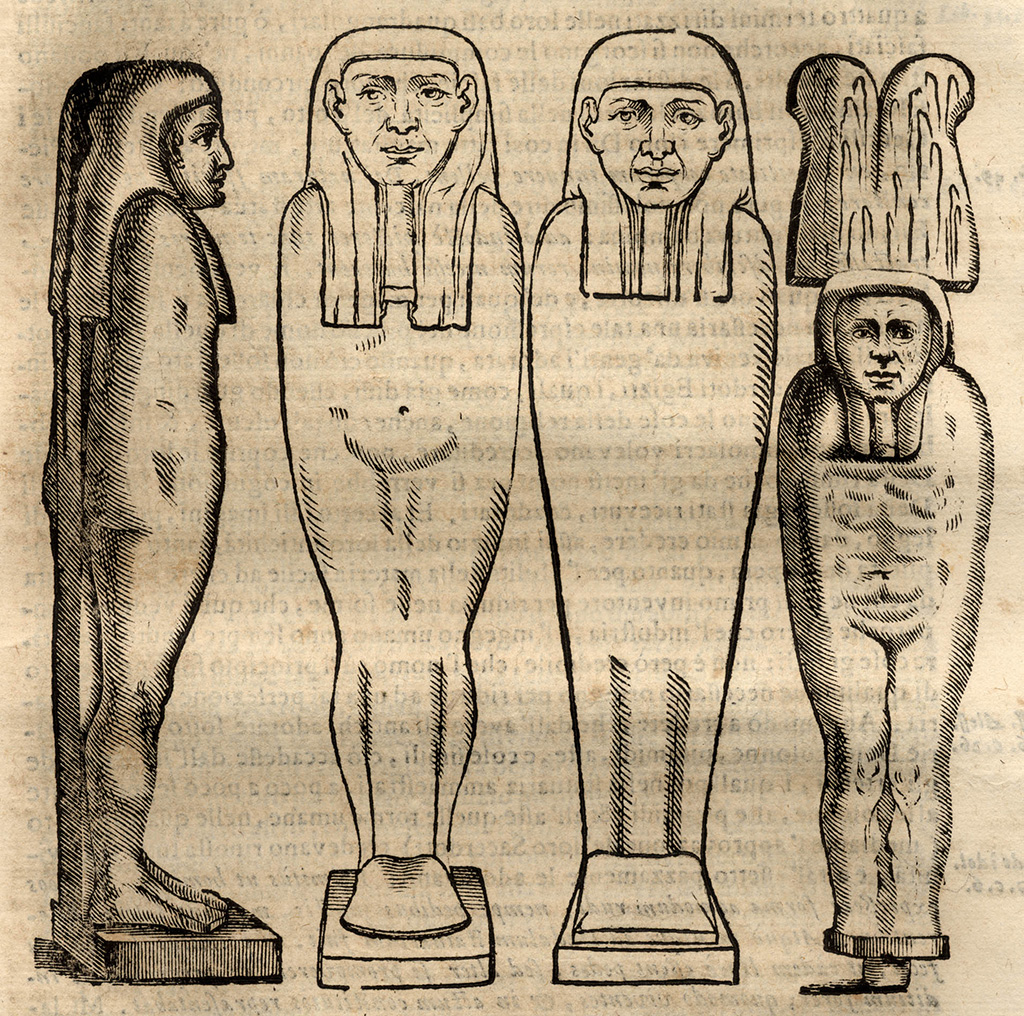
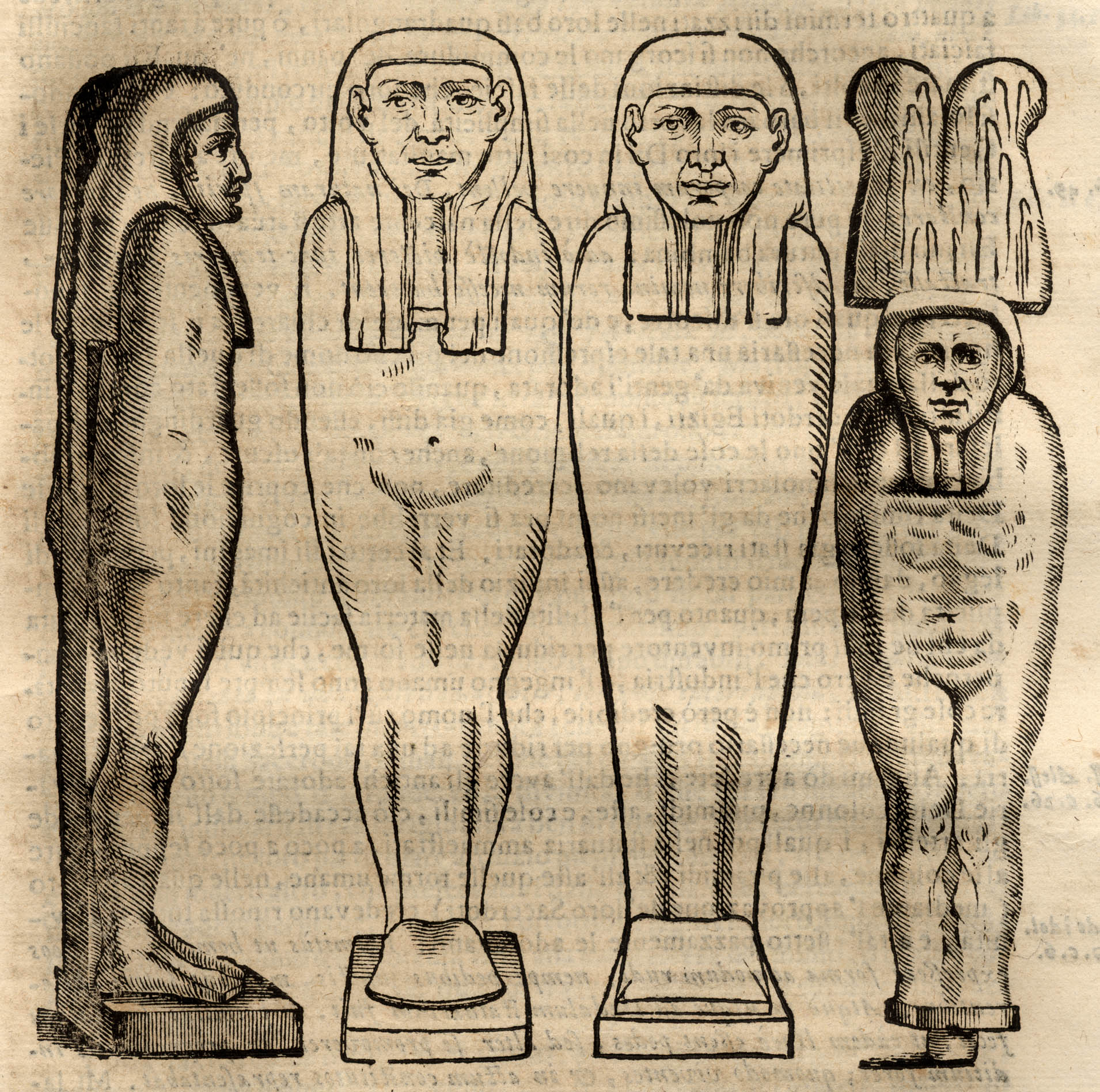
Cospi’s statues of Ptah-Sokar-Osiris, MCABo EG 2078, 345, 343, 341. ©Museo Civico Archeologico, Bologna.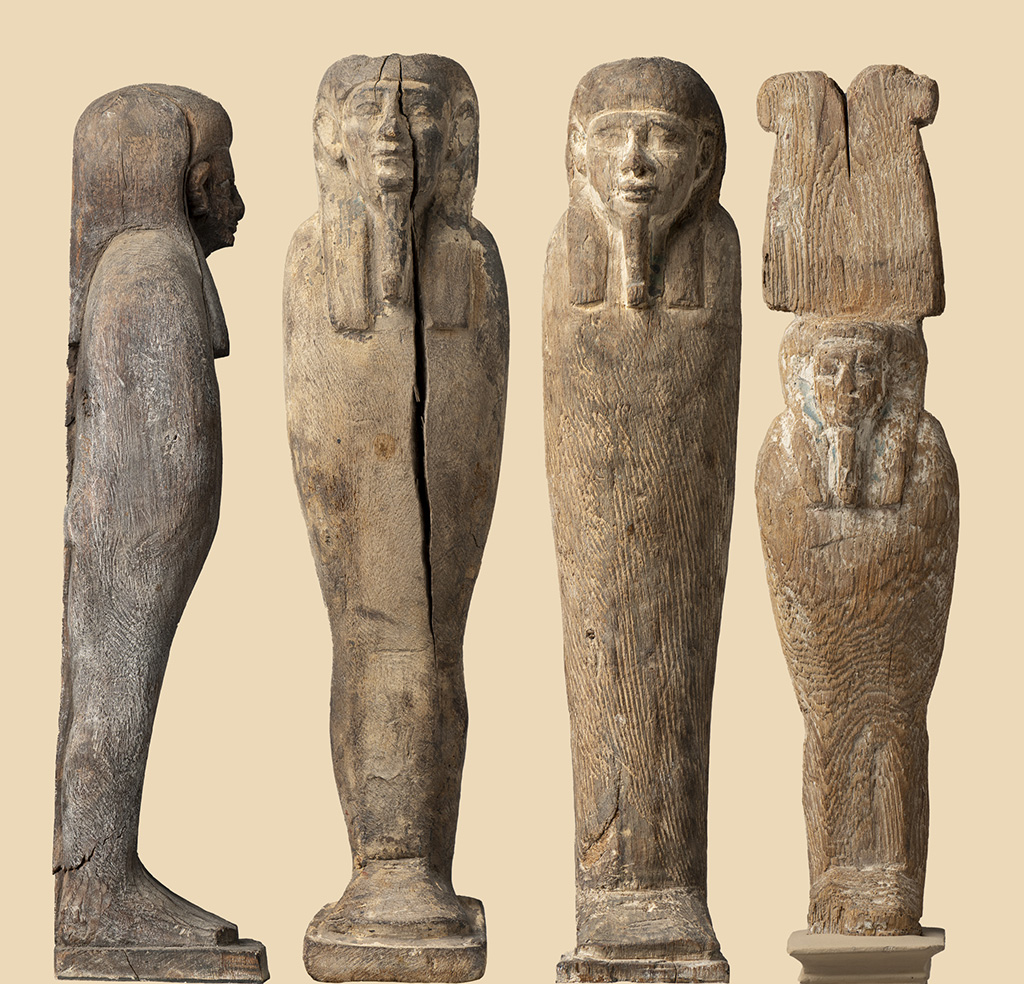
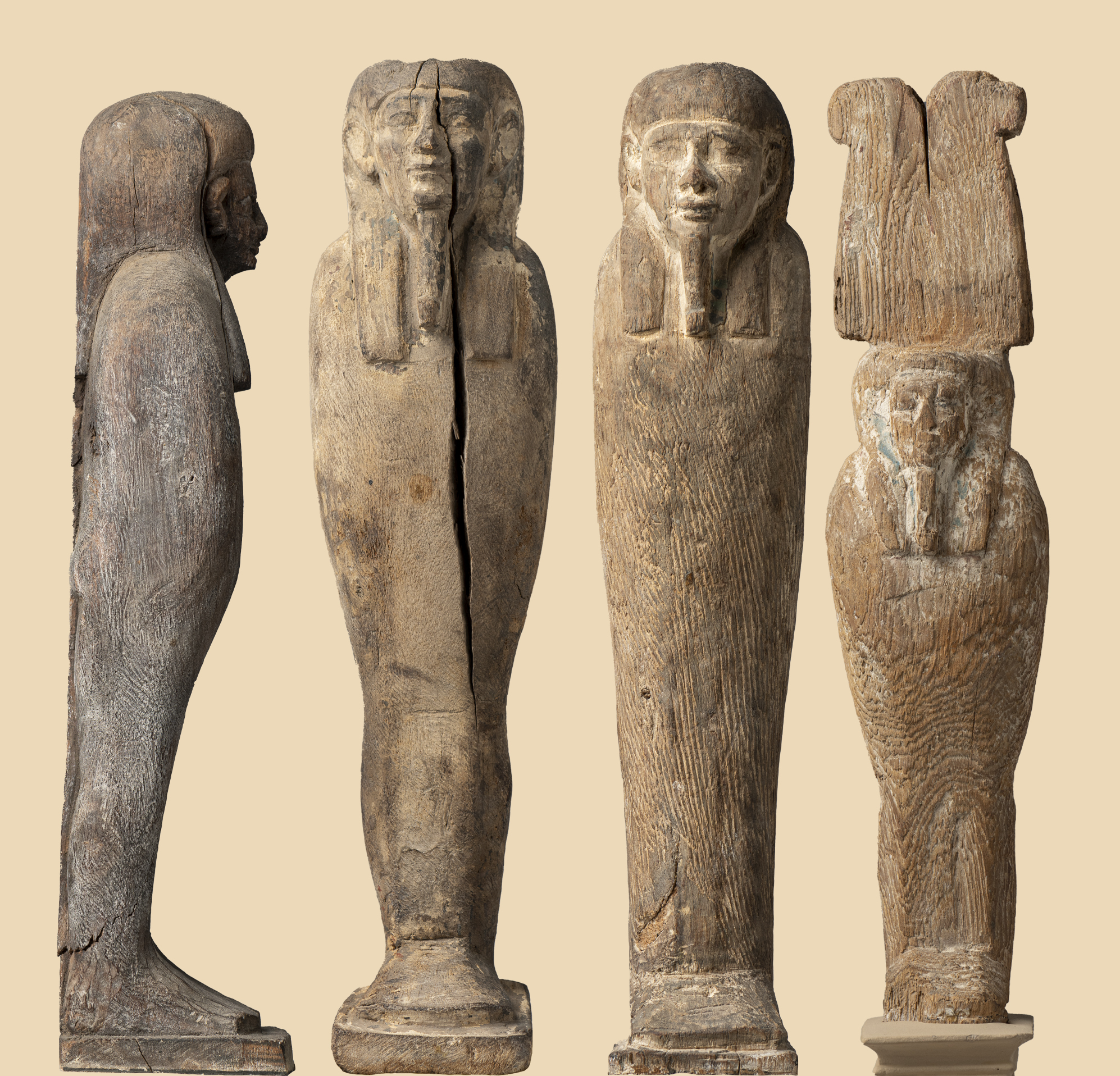
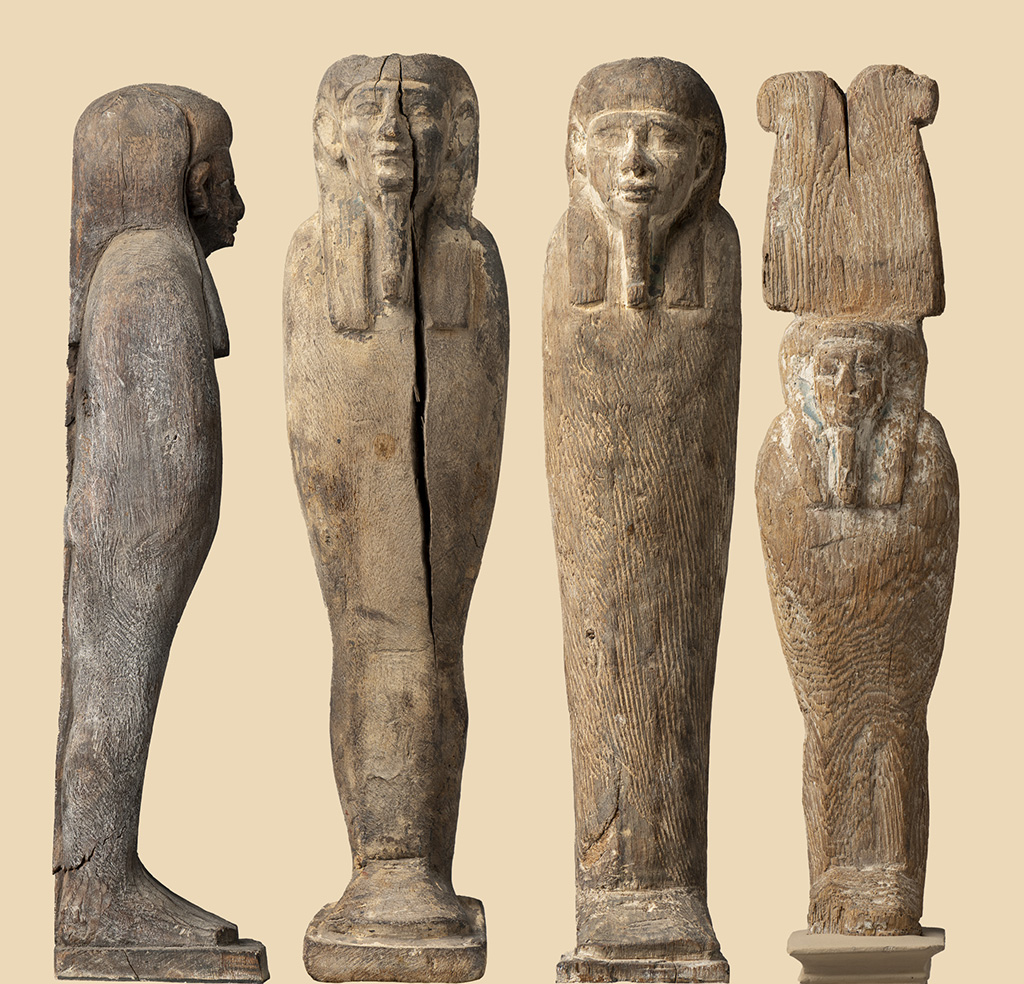
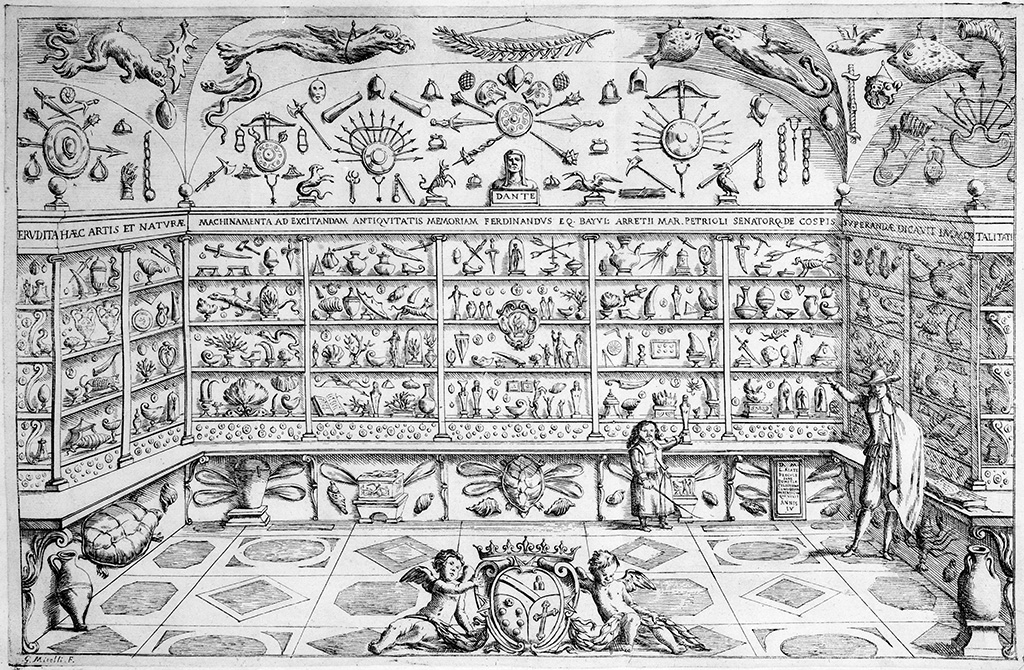
A few decades later, Marquis Ferdinando Cospi (1606–1686) emulated Aldrovandi’s example by creating one of the best-known Wunderkammern of the time in the Palazzo Pubblico. This Wunderkammer included approximately 30 Egyptian objects, among which were the first four statues of Ptah-Sokar-Osiris to come to Bologna, along with various mummy parts.3 The identification of these statues – currently catalogued as EG 341, EG 343, EG 345, and EG 2078 in the Museo Civico Archeologico of Bologna – was made possible by an etching published by Lorenzo Legati in the volume Museo Cospiano annesso a quello del famoso Ulisse Aldrovandi (Figs. 1–2).4 At least one of them is also recognizable in an etching by Giuseppe Maria Mitelli (1634–1718) that opens the volume (Fig. 3), depicting the Museo Cospiano in the Palazzo Pubblico.5 The statue with the ostrich-feather crown (EG 341) is visible on the lower, central shelf. The other Ptah-Sokar-Osiris statues resemble the shabti figures in the collection too closely to allow for definitive identification.
Etching by Giuseppe Maria Mitelli (1634–1718) in L. Legati, Museo Cospiano annesso a quello del famoso Ulisse Aldrovandi e donato alla sua Patria dall’Illustrissimo Signor Ferdinando Cospi Patrizio di Bologna e Senatore, Bologna 1677.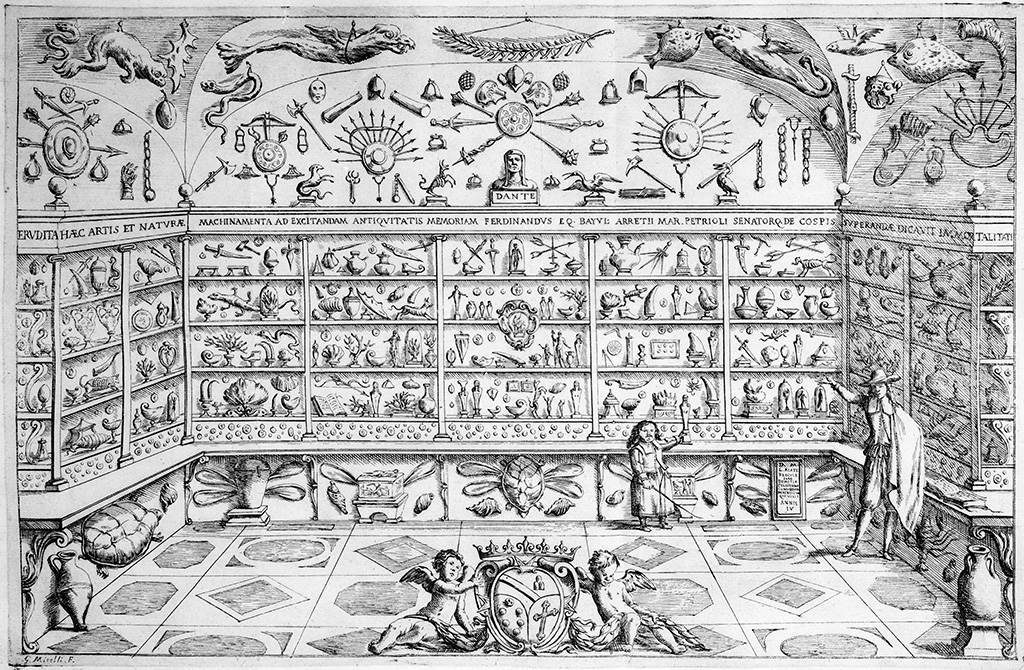
At the end of the 18th century, the Danish scholar Georg Zoëga (1755–1809) noted the existence of a fifth statue of Ptah-Sokar-Osiris in the Bolognese collections, currently inventoried under number EG 335.11 In July 1789, the scholar visited the Istituto delle Scienze, founded by Earl Ferdinando Marsili (1658–1730) in 1711–1712 in Palazzo Poggi,12 to which the Aldrovandi and Cospi materials
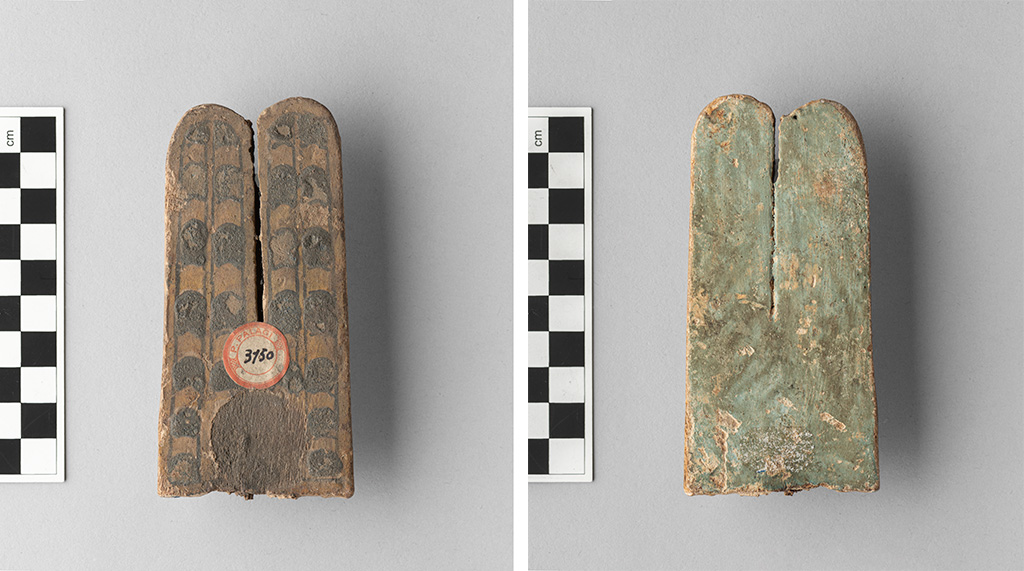
The largest number of statues of Ptah-Sokar-Osiris in the collection came to Bologna in the 1800s after the death of the painter Pelagio Palagi (1775–1860). In 1861, the City of Bologna acquired his extensive estate, which included over three thousand Egyptian antiquities.16 The Palagi Egyptian collection includes sixteen statues of Ptah-Sokar-Osiris and two crowns, one with falcon feathers and the other with ostrich feathers. Seven of the statues can be ascribed to the collections of Egyptian antiquities Palagi purchased in 1831 and 1832 from the former chancellor at the Austrian consulate in Egypt, Giuseppe Nizzoli (1792–1858), shortly after Nizzoli’s return from Egypt in 1828.17 Three statues – currently inventoried as EG 337,18 EG 327,19 and EG 336 + EG 415 + EG 314820 – belong to the first collection, the largest and most important one. Nizzoli published its contents in the Catalogo Dettagliato della Raccolta di Antichità Egizie riunite da Giuseppe Nizzoli (1827).21 I was able to identify them through the descriptions and dimensions of the objects provided in the catalogue. In addition to this primary collection, a smaller one sold to Palagi in 1832 is documented in a handwritten list entitled Catalogo d’una raccoltina di antichità egizie. This list is more concise in its descriptions and lacks the objects’ dimensions.22 The list is, in fact, a topographical inventory of the materials then stored at Nizzoli’s home. Two statues of Ptah-Sokar-Osiris were placed “above the cupboard to the left of the stove” and two more “above the cupboard to the right of the stove”.23 Of these statues, two are clearly recognisable as the current inventory numbers EG 33924 and EG 326,25 while the other two presumably correspond to inventory numbers EG 33126 and EG 329.27 Although Nizzoli does not specify the places where these statues were found in his catalogues, it is known that many of the materials he sold to Palagi came from the excavations conducted at Saqqara in the spring of 1825 by his young wife, Amalia Sola.28 This does not rule out the possibility of further purchases or exchanges of materials by Nizzoli, one of the key figures of the time in Egypt’s bustling antiquities market. For the remaining nine statues of Ptah-Sokar-Osiris – EG 328, EG 330, EG 332, EG 334, EG 338, EG 340, EG 341 ½, EG 344, and EG 2076 –29 and the two feather crowns – EG 3149–3150 (Figs. 4–5) –30 nothing is known so far about their archaeological or market provenance. The documents examined thus far have not provided any relevant information. However, they have further highlighted Palagi’s extensive network of relations and the numerous intermediaries and antiquarians who assisted him in building up his vast collection during the key period of the arrival of Egyptian antiquities in Europe.
Front and back of a double feather crown, MCABo EG 3149. ©Museo Civico Archeologico, Bologna/Photo F. Taverni.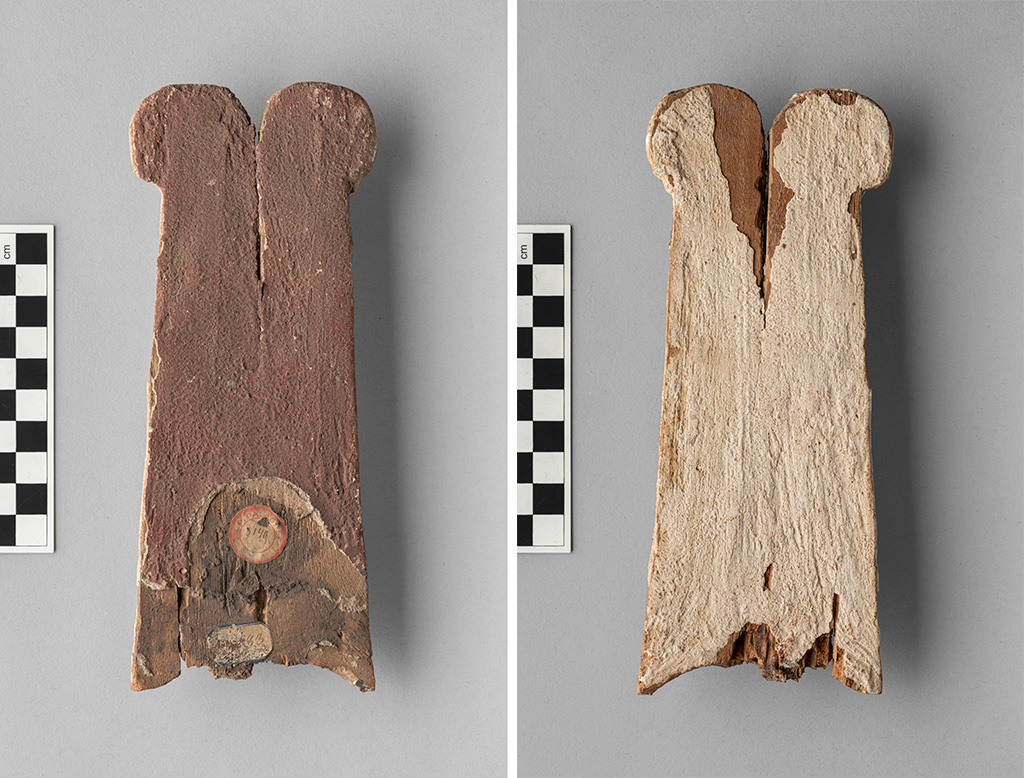
Front and back of a double feather crown, MCABo EG 3150. ©Museo Civico Archeologico, Bologna/Photo F. Taverni.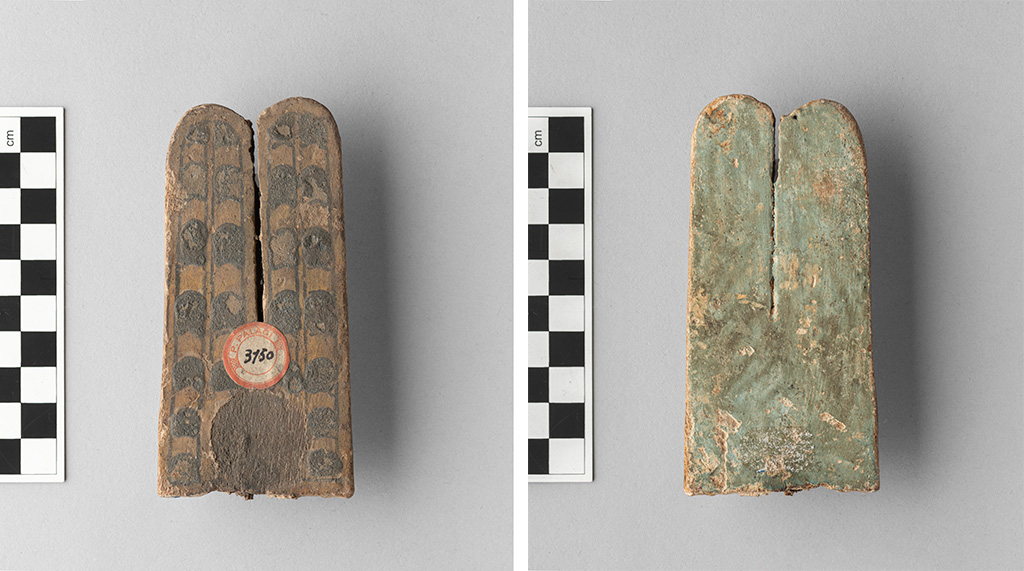
The arrival of the Palagi collections in the city was an important step in the long process that led to the opening of the Museo Civico in Palazzo Galvani on 25 September 1881. This new Museum brought together the archaeological materials collected in Bologna since the late 1500s, including all the Egyptian artefacts.31 The last statue of Ptah-Sokar-Osiris, identified by the current inventory number EG 333,32 entered the collection of Egyptian antiquities in
This was not to be the last donation of Egyptian antiquities to the Museum. Before and after the publication in 1895 of the Catalogo di Antichità Egizie by the Egyptologist Giovanni Kminek-Szedlo (1828–1896), several other citizens of Bologna demonstrated their interest in Egyptian civilization and Egypt by donating antiquities or bequeathing them to the museum. But these included no additional statue of Ptah-Sokar-Osiris.
Over the centuries, these Ptah-Sokar-Osiris statues passed from private to public ownership, from one collection or museum to another. The synoptic table below compares the key texts and inventories documenting the history of the Ptah-Sokar-Osiris statues in the Palagi collection. Many still bear labels with the numbers assigned to them in the inventory Sub-Allegato Collezione Palagi, which dates to the 1870s and is kept at the Museo Civico Archeologico. The (certain, although unmentioned) author of the section of this manuscript relative to the Egyptian collection, the Egyptologist Francesco Rossi (1827–1912), drew up the inventory entries for the Egyptian objects in anticipation of their display in Bologna.38 These texts (but without the catalogue numbers) are identical to those published by Rossi in the volume Cenni storici, relazioni e cataloghi del Museo Civico di Bologna per la inaugurazione fatta il 2 ottobre 1871 in occasione del I Congresso Internazionale di Antropologia e Archeologia Preistoriche, edited by Edoardo Brizio.39 Later, the same descriptive entries were partially transcribed in the volume Catalogo di antichità egizie published by Kminek-Szedlo in 1895, the current inventory of the Bologna collection. By cross-checking these data, I managed to identify all the statues of Ptah-Sokar-Osiris (see Table I), even in the Sub-Allegato Collezione Palagi manuscript, where they had been inventoried by lumping together two (nos. 2127–28 = EG 334 and EG 340),40 five (nos. 2082–86 = EG 332,41 EG 338,42 EG 341 ½,43 EG 344,44 and EG 2076),45 or nineteen objects (nos. 2088–2106, which includes EG 337). Additionally, this cross-check highlighted several conservation issues that require further investigation through multidisciplinary diagnostic research and conservation treatments – for instance, some feather crowns associated with the statues EG 329,46 EG 336,47 and EG 337 had been detached or broken and were later rejoined.48 Of the five crowns inventoried under no. 2194 in the Sub-Allegato Collezione Palagi, only two do not seem to relate to any of the statues (EG 3149–3150).49 The content of the two statues EG 327 and EG 328 also remains to be thoroughly investigated.
It is also worth mentioning that labels outlined in blue on the statues bear numbers from the manuscript list Note degli oggetti Egizi spettanti all’Università, which includes objects that became part of the City’s museum holdings between 1878 and 1881.50 Moreover, a sequence of letters and numbers, written in black ink on the statues from the Cospi collection, likely indicates their original display locations in the second room of the Museo delle Antichità della Regia Università before they were moved to the Museo Civico in Palazzo Galvani: S.II A.1 S.2 n.6 on EG 341; S.II A.1 S.2 n.1 on EG 343, S.II A.1 S.3 n.4 on EG 345; II A.1 S.2 n.3 on EG 2078).51 Inaugurated in 1810, this university museum had inherited the collections of Marsili’s Istituto delle Scienze.
Inventories and catalogues of the Ptah-Sokar-Osiris statues in the Palagi collection.
Kminek-Szedlo 1895 MCABo EG inv. no
Pernigotti
Nizzoli Catalogue 1827
326
2120
109
p. 81 cf.
//
327
2121
110
//
no. II.20
328
2122
111
//
//
329 statue with crown
2123 statue without crown
112 statue without crown
p. 82 cf.
//
330
2126
115
//
//
331
2124
113
p. 82 cf.
//
332
2082 or 2084
71–75
//
//
334
2127
116–117
//
//
336 statue
2125 statue
144 statue
//
III.7
337 statue without crown
2091 + 1 of 5 crowns = 2194 (?)
77–95
//
II.19
338
2083
71–75
//
//
339
2081
70
p. 81 cf.
//
340
2128
116–117
//
//
341 ½
2086
71–75
//
//
344
2085
71–75
//
//
2076
2082 or 2084
71–75
//
//
3149 feather-crown
1 of 5 crowns = 2194
+ 1 of 5 crowns = 183
//
//
3150 feather-crown
1 of 5 crowns = 2194
+ 1 of 5 crowns = 183
//
//
Part 2. The Ptah-Sokar-Osiris Statues in Bologna: Classification and Catalogue
(Maarten J. Raven)
Introduction
In 2011, the National Museum of Antiquities (Rijksmuseum van Oudheden) in Leiden and the Museo Civico Archeologico in Bologna signed a five-year agreement with the objective of sharing research, exchanging loans of objects, and jointly organising workshops, conferences and exhibitions.52 As part of this agreement, the present author was invited to come to Bologna in order to present a number of public lectures.53 One of these visits, in October 2011, also provided the opportunity for a study of the Bologna collection of Ptah-Sokar-Osiris figures, a subject which still had my interest in spite of a lapse of almost thirty years since my first research on this
History of Research on Ptah-Sokar-Osiris Statues
Almost 45 years ago, I started my Egyptological career with the publication of an article entitled “Papyrus-Sheaths and Ptah-Sokar-Osiris Statues”, which was based on my master’s thesis at Leiden University.54 This study deals with a characteristic kind of wooden Osiris statues which can be found in private burials ranging in date between the late New Kingdom and the end of the Ptolemaic Period. Most statues are characterised by the presence of a cavity in the statue’s body or its base, though solid figures occur as well. For the hollow figures, two distinct main groups can be distinguished: an earlier one which often contains a rolled funerary papyrus, and a later type where the cavity holds a miniature corn-mummy containing grains of barley. This distinction was already well known to the earliest explorers of such tombs, who were always looking for valuable papyri in order to sell them for a good price on the art market. In fact, the papyri were all that interested these
After the pioneer age of Egyptology, even this meagre interest in these statues rather dwindled. Even when no less than 77 of them were discovered in the Deir el-Bahri cachette of the priests (1891), these items never received more than just a passing reference in the reports.57 Handbooks of funerary archaeology hardly went into any more detail,58 and museums rarely bothered to publish their full collections.59 Thus, my own comparative study was the first of its kind, combining a chronological, typological and iconographical study with a full analysis of the inscriptions occurring on these statues and a study of their provenance and archaeological context. Although it is marked by a number of methodological flaws and beginner’s mistakes, I am happy to say it raised new interest in these intriguing objects and is still being used as a starting point by all colleagues working on these objects.
My original article proposed a classification consisting of four major types: I – black-varnished statues; II – polychrome Osiris statues; III – Ptah-Sokar-Osiris statues with green face; and IV – Ptah-Sokar-Osiris statues with gilded face (sometimes painted white or yellow in imitation of gilding). Types I, II, and IV were each found to comprise a number of subtypes, whereas type III appeared to be more homogeneous. There is a considerable number of statues which do not fit into one of these main types, which I relegated to a “miscellaneous class” instead. I regarded Types I and II as belonging to the New Kingdom and Third Intermediate Period, and datable between roughly 1300 and 700 BC; these items I interpreted as statues of Osiris-Khentimentet on the basis of epigraphic evidence. For Types III and IV, I proposed a Late Period to Ptolemaic date instead, and identified them as depictions of the god of resurrection Ptah-Sokar-Osiris, again on the basis of the texts occurring on the statues themselves. My initial article was later integrated into my dissertation, which I defended at Leiden University on 22 February 1984.60
In 1991, David Aston published a brief article on two Osiris figures of divergent types,61 one a Ramesses II shabti later converted to a black-varnished Osiris figure, the other a white figure with a green face. Since the latter did not fit in my original classification, he proposed to classify this object, which has a number of close parallels, as a fifth type, datable to c. 750–675 BC on epigraphic evidence. This led Aston to a very convincing revision of the typology for Third Intermediate Period figures. He argues that Type II (polychrome Osiris figures with hedjet or atef crown) occurred between 1300 and 1000 BC, and regards my Type IC as a black-varnished alternative datable between 1025 and 925 BC. All these figures have squat bodies holding a rolled papyrus. From 975 BC onwards, some black-varnished figures (my Types IA and IB) already wore feather-crowns (shuty) and had solid and therefore slimmer bodies, occasionally still holding a papyrus in a cavity in the base. These figures are not attested after c. 900 BC,62 although they may well continue until the introduction of the new Types III and IV, of which they are the precursors. This is also suggested by the new transitional Type V, likewise consisting of slim figures with feather crowns, but lacking a cavity in the trunk or base. The transition to the proper Ptah-Sokar-Osiris figures (usually holding corn-mummies in their trunk or base) therefore seems to take place around 750–700 BC, with Types III and IVB with their red bodies overlapping with Type V and occurring until about 600 BC. Aston’s revised typology and chronology are also included in his handbook on burial assemblages of the Third Intermediate Period, which is the published version of his PhD research.63 We may summarize these findings in the following typological schedule (see Table II).
Summary classification of types.
Type I
Type II
Type III
Type IV
Type V
crown
A/B:
wig
black
(blue)
blue
blue/black
blue
face
black
green/red
green
gilt/yellow
green/red
collar
–
concentric
concentric
falcon collar
concentric
hands
A: –
crossed
–
-/rarely crossed
crossed
body
black
polychrome
red
red/black
white
back pillar
–
–
+
+
–
cavity
A/B: -/base
body
base (casket)
base/casket
–
contents
-/papyrus
papyrus
corn-mummy
corn-mummy
–
date
1025–900 BC
1300–1000 BC
700–600 BC
720–30 BC
750–625 BC
In 2012, Carlo Rindi Nuzzolo presented a thesis at Pisa University on Ptah-Sokar-Osiris statues.64 This was based on a detailed study of 33 of the 58 figures now in the Museo Archeologico Nazionale di Firenze, Sezione “Museo Egizio”,65 as well as on a personal inspection of numerous other museum collections. The catalogue proper is preceded by a
Altogether, these studies have now incited other scholars to give more attention to these hitherto rather neglected objects and integrate them in other research projects.69 We can only hope that these communal efforts will help to elucidate some of the more problematic aspects of this particular kind of Osiris figures. The present study of the Ptah-Sokar-Osiris figures in Bologna may be another contribution towards this goal.
The Bologna Collection of Ptah-Sokar-Osiris Statues: Classification and Catalogue
The earliest catalogue of the Bologna Egyptian collection was compiled in 1895 by the Czech Giovanni Kminek-Szedlo, lecturer at Bologna University and inspector of the museum.70 Here we find brief descriptions of the wooden Osiris statues under catalogue numbers EG 326–346.71 However, it should be noted that EG 342 is not a Ptah-Sokar-Osiris statue but a corn-mummy,72 whereas EG 346 with its height of 14 cm cannot be a regular Ptah-Sokar-Osiris statue. On the other hand, there is a double number EG 341, now registered as EG 341 ½, and EG 2076 and EG 2078 were ranged with the category of shabtis but seem to be Ptah-Sokar-Osiris figures as well.73 This adds up to 22 items,74 the third largest collection of such statues in Italy after Florence (58) and Turin (31).75 The Florence items were published by Botti and Rindi,76 some of the Turin ones can be found on the internet database of the museum.77 Thus, a proper analysis of the Bologna specimens may be a useful addition.
Unfortunately, due to their acquisition from former private collections, information about the original provenance or archaeological context of these statues is not always available.78 Nizzoli states that his collection of wooden figures sold to the grand Duke of Tuscany in 1824 came from his explorations
The catalogue numbers used in the following are those of Kminek-Szedlo, which correspond to the current inventory of the museum. He mentions the previous owner of these statues at the end of his entries, and in general our archive research has corroborated this attribution.
Another problem with the Bologna statues is their state of preservation. Many have lost their original feather crowns or bases, and the painted decoration has often fallen off, thereby robbing us of a lot of typological and epigraphical information. This is actually rather common with this particular class of statues, which often suffered from dampness already in the subterranean tombs where they were originally placed on the rock floor next to the coffin of their owner.
In spite of these shortcomings, this corpus of statues still provides some useful data. Of the 22 items, 11 can still be identified as belonging to well-known types. The oldest one seems to be EG 326, a typical example of Type IID datable between 1300 and 1000 BC. This is followed in age by EG 337, belonging to Type IB and therefore to be dated between 975 and 900 BC. Catalogue numbers EG 332, EG 338, and EG 2076, with their white bodies, green faces (not clear on EG 332), and lack of back-pillars, appear to conform to Aston’s Type V and accordingly should be dated between 750 and 600 BC. Catalogue numbers EG 327, EG 330, EG 334, EG 340, EG 343, and EG 345 seem to belong to Type IV because of their red bodies, in combination with gilded faces and various other iconographical details. These must date to the Late or Ptolemaic Periods, or c. 700–30 BC.
No less than eight statues show details not compatible with any of the usual types (EG 328–329, EG 331, EG 335–336, EG 339, EG 341 and EG 2078). Some of these divergent types are highly original, such as EG 341 (where the feather crown is cut from the same piece of wood as the rest of the figure) and EG 336, which is carved in limestone. Others, such as EG 328 and EG 335 with their gilt masks, or EG 333 with its red face and black body, are not so different from the usual Type IV specimens. On the remaining three figures (EG 333, EG 341 ½ and EG 344) the coat of paint is too far decayed to allow a typological assessment. All of them show the proportions of the Late to Ptolemaic Periods.
A special interest of the Ptah-Sokar-Osiris statues are of course the texts inscribed on them. These may specify the identity of the original owner of the statues in question. On the Bologna statues we find the following names and titles:
- the god’s father (?) … Nakhtdjehuty, son of (?) Horbauemma‘at (?) (EG 328);
- the god’s father Senbef (EG 329);
- Her(em)ma‘akheru… (EG 331);
- the musician of Amun-Re, Irtyru, daughter of Ankhpakhered and the housewife Taremtjenbastet (EG 334);
- Horwedja, son of Pashery(wesir?) (EG 335);
- the musician (?) … (EG 336);
- the chief libation priest Amenhotep, son of Nesmin and the housewife Tasherytmin (EG 339).
All names are characteristic of the Late or Ptolemaic Periods, but only the individuals of EG 334 have been recognised from other sources, namely, the tomb of Ankhhor at Thebes (TT 414). The names on EG 339 with their reference to the god Min might indicate a provenance of this statue from the Akhmim area, but for the other items we lack such a clear indication. Catalogue numbers EG 326 and EG 337 seem to represent common Theban types.
Several types of inscriptions may occur.80 Rather common are texts starting with
Catalogue
Note: all catalogue entries are presented here in a format corresponding to a registration sheet for Ptah-Sokar-Osiris statues first conceived by me in the 1970s. All photographs were made for the purpose of the present article by Federico Taverni (Museo Egizio, Turin), whom we thank for his excellent work. Daniela Picchi checked all the museum numbers and provided the full bibliography.
EG 326 (ex-coll. Palagi no. 2120; formerly Nizzoli 1832)
TYPE IID
Ptah-Sokar-Osiris of an anonymous individual, MCABo EG 326. ©Museo Civico Archeologico, Bologna/Photo F. Taverni.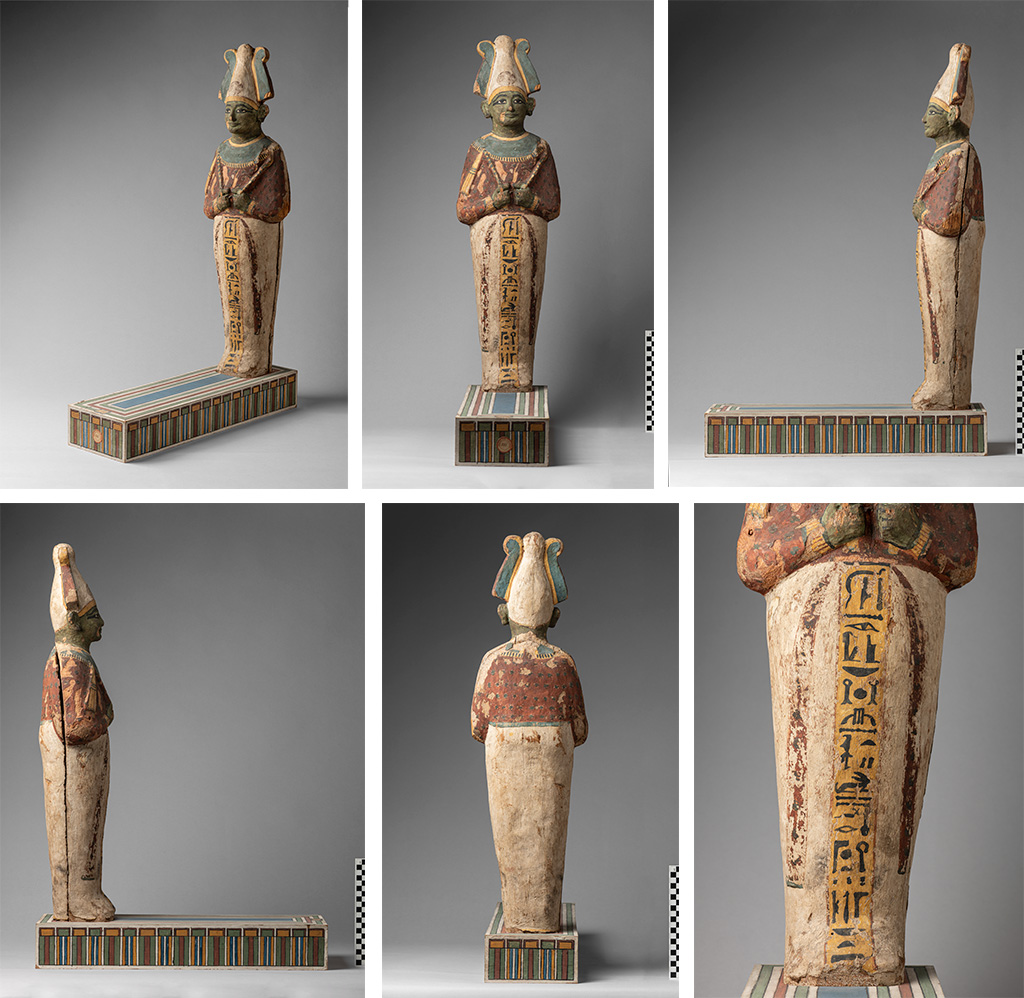
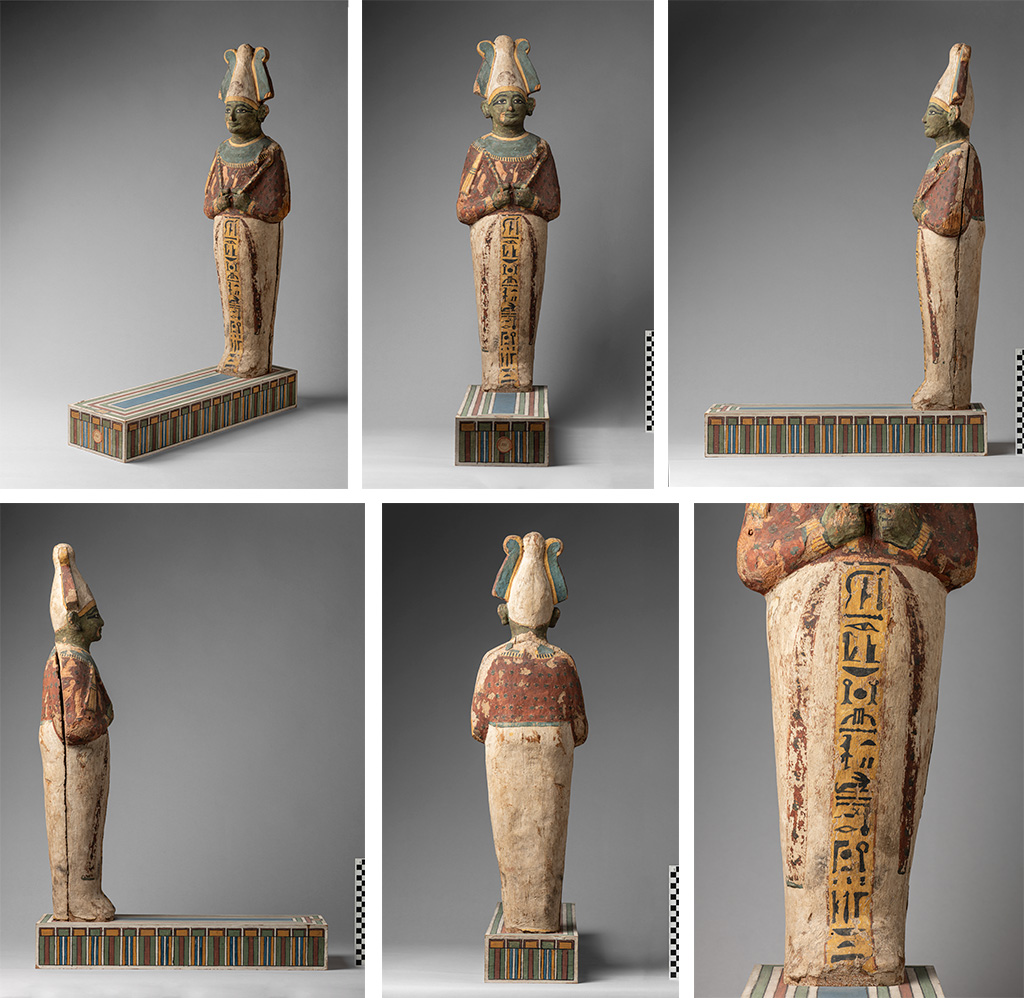
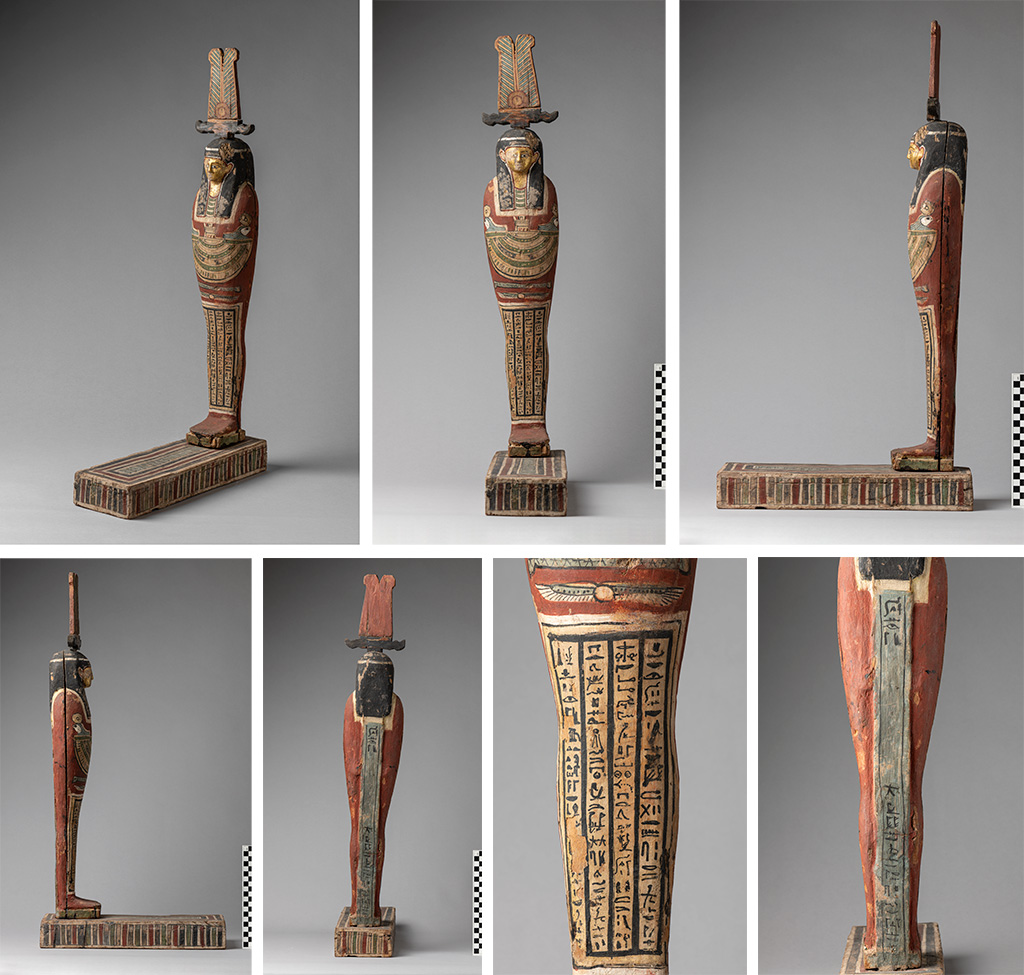
TYPE IVC
Ptah-Sokar-Osiris with blank space for name/title, MCABo EG 327. ©Museo Civico Archeologico, Bologna/Photo F. Taverni.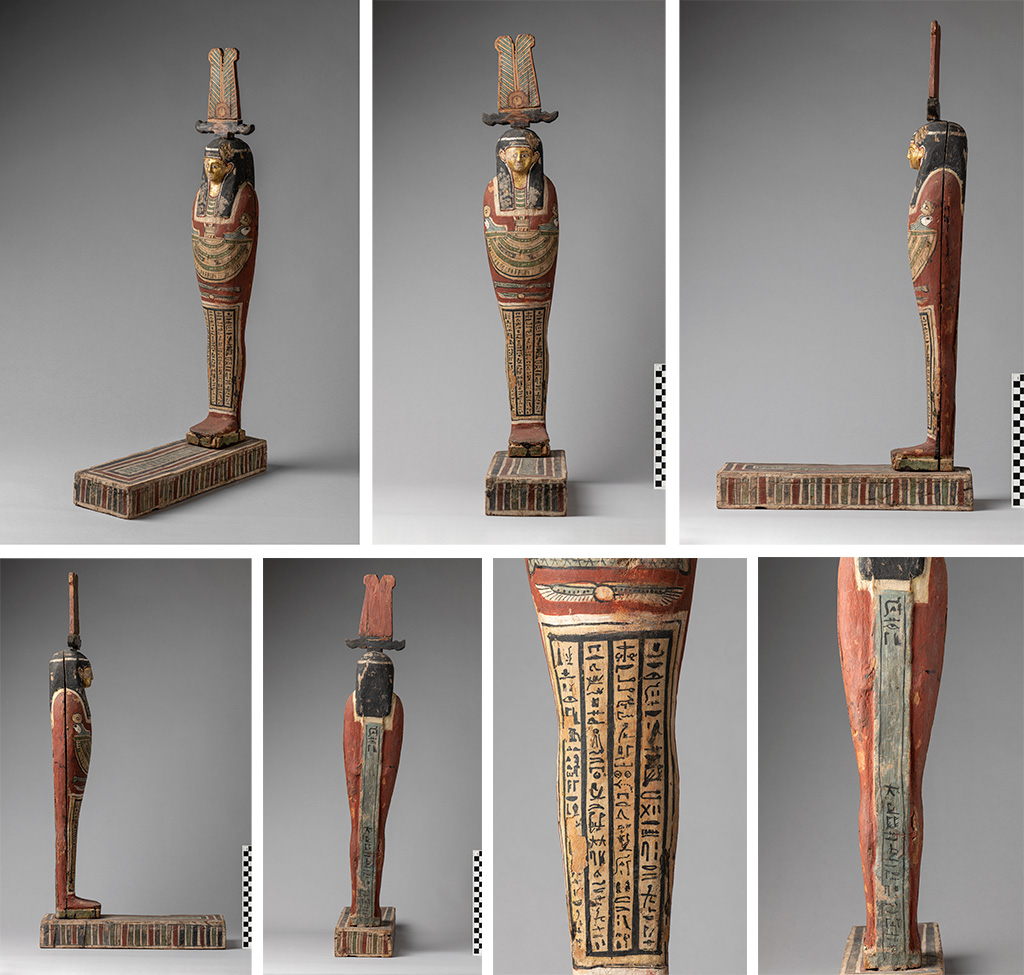
TYPE VAR.
Ptah-Sokar-Osiris of Nakhtdjehuty, MCABo EG 328. ©Museo Civico Archeologico, Bologna/Photo F. Taverni.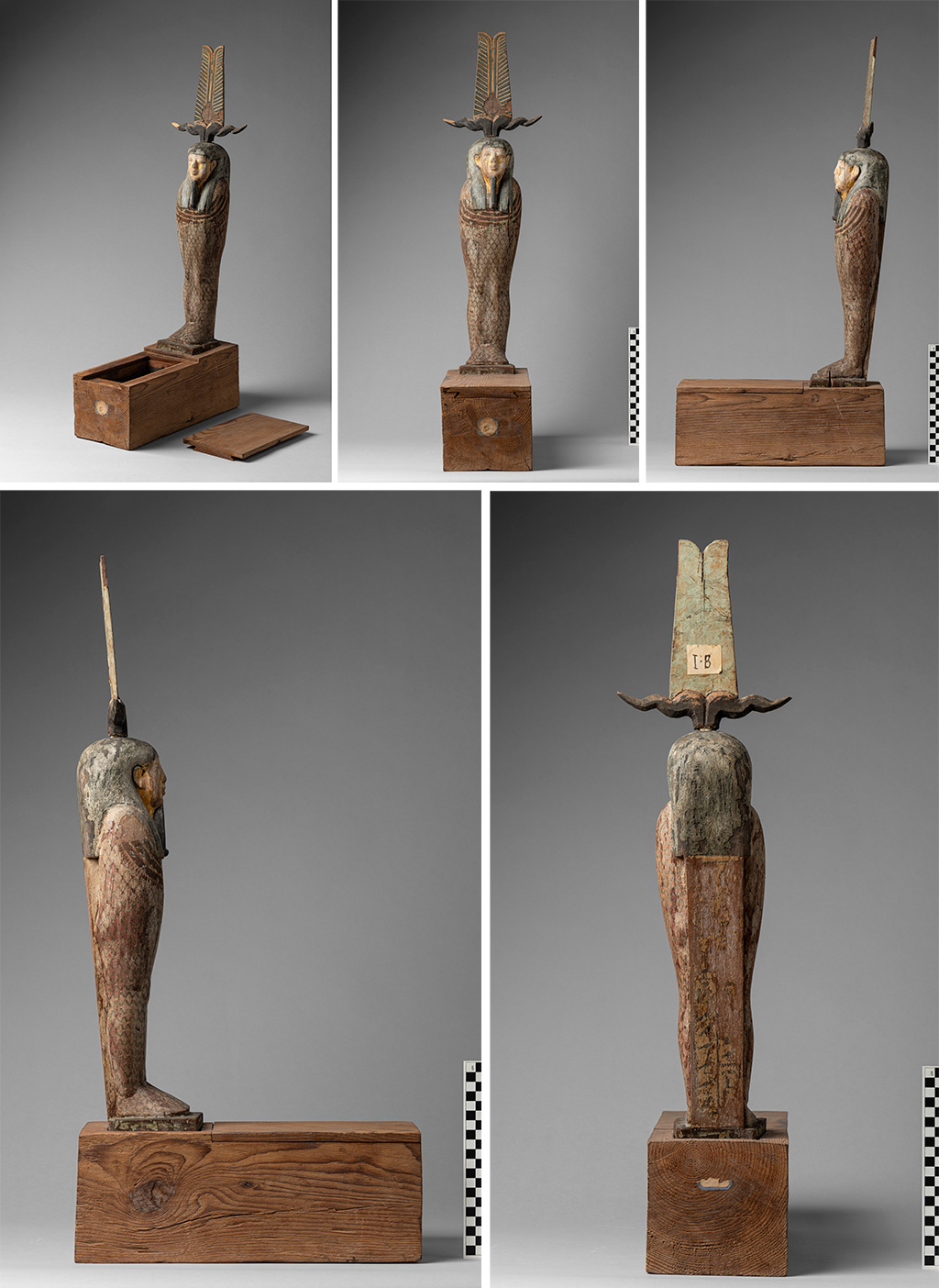
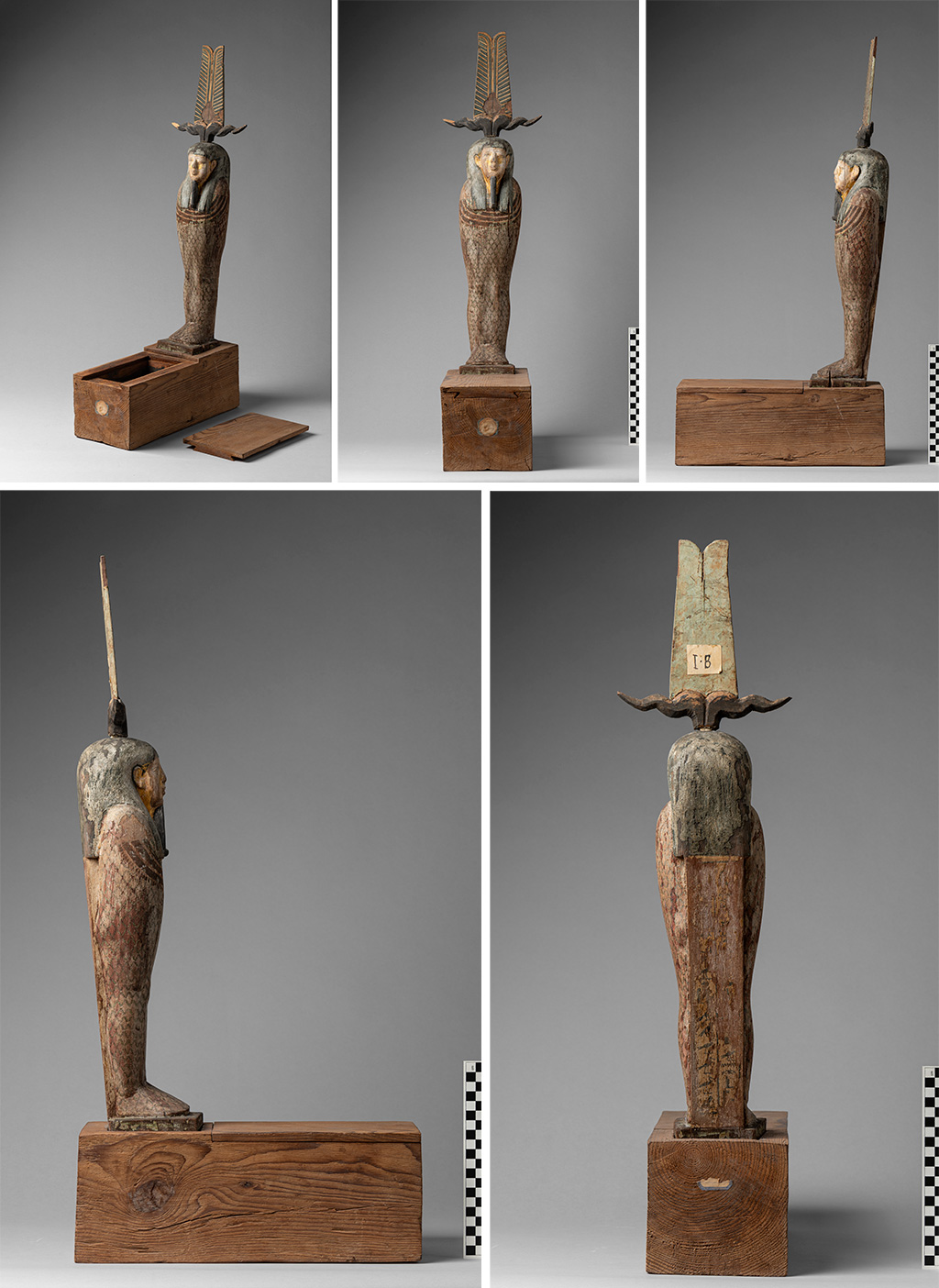
TYPE VAR.
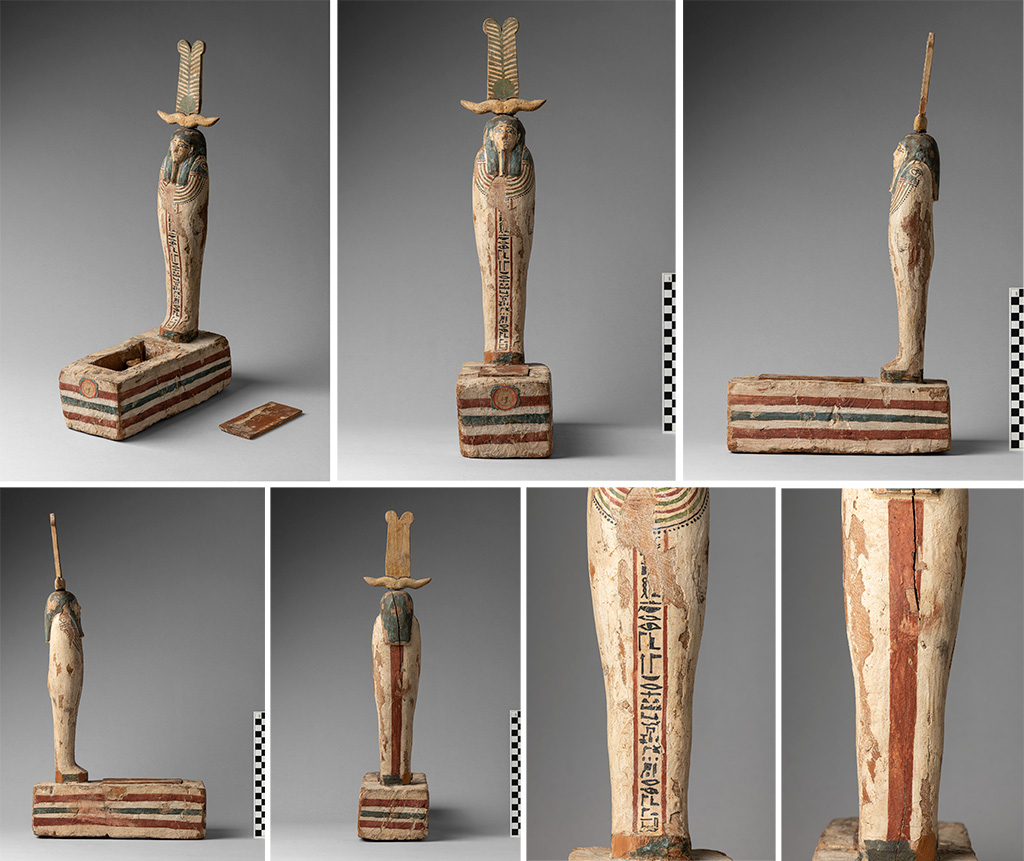
Ptah-Sokar-Osiris of Senbef, MCABo EG 329. ©Museo Civico Archeologico, Bologna/Photo F. Taverni.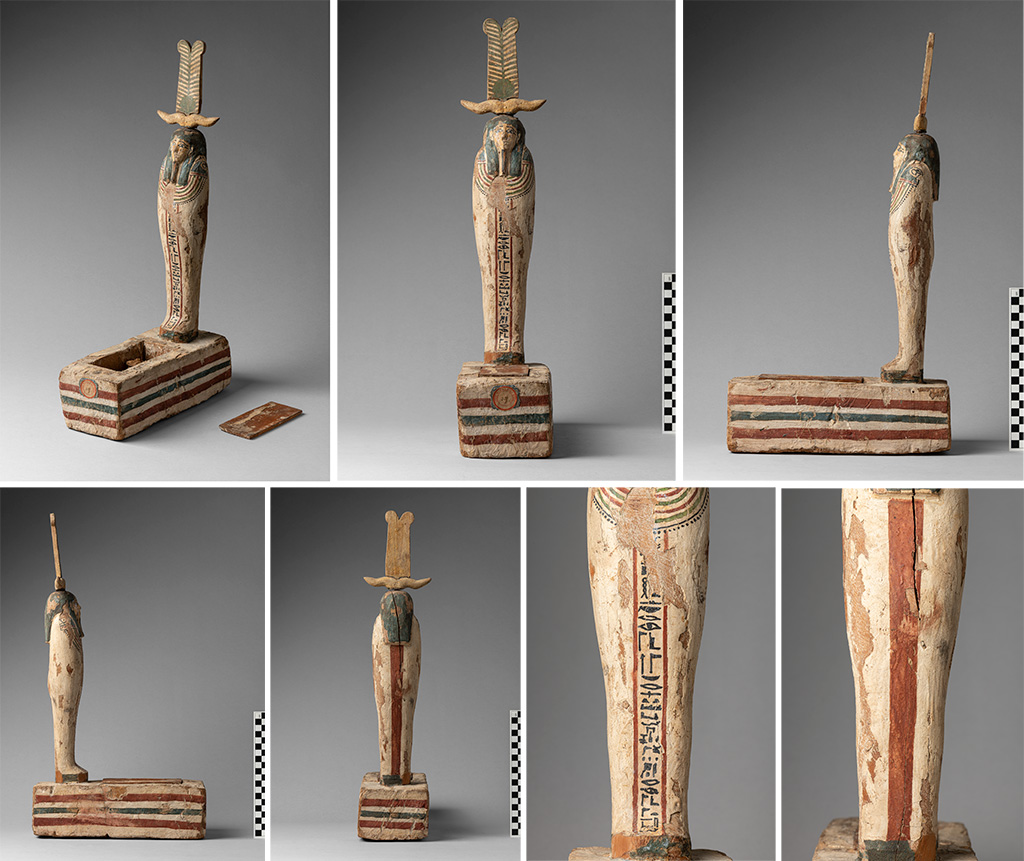
TYPE IVC
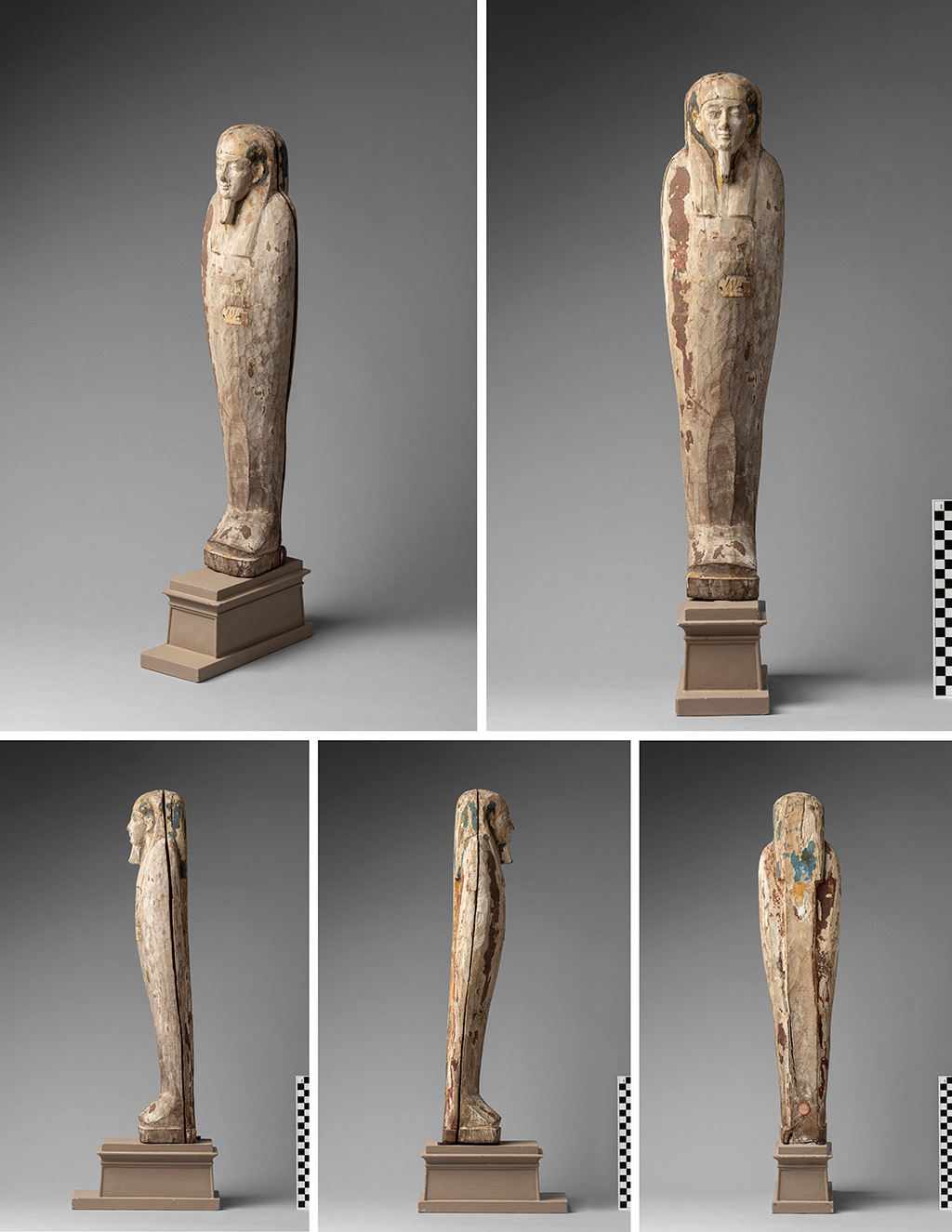
Ptah-Sokar-Osiris of an anonymous individual, MCABo EG 330. ©Museo Civico Archeologico, Bologna/Photo F. Taverni.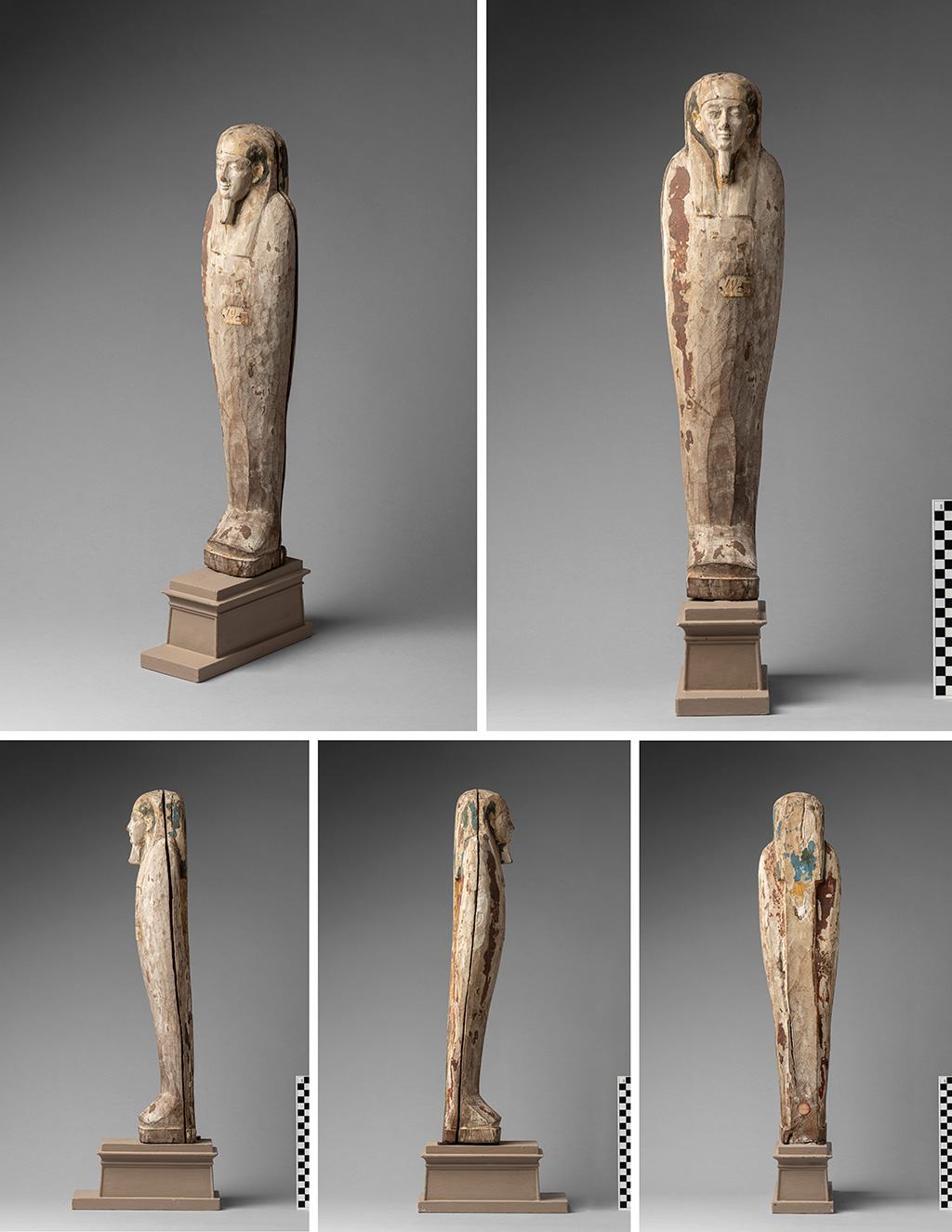
TYPE VAR.
Ptah-Sokar-Osiris of Her(em)ma‘akheru, MCABo EG 331. ©Museo Civico Archeologico, Bologna/Photo F. Taverni.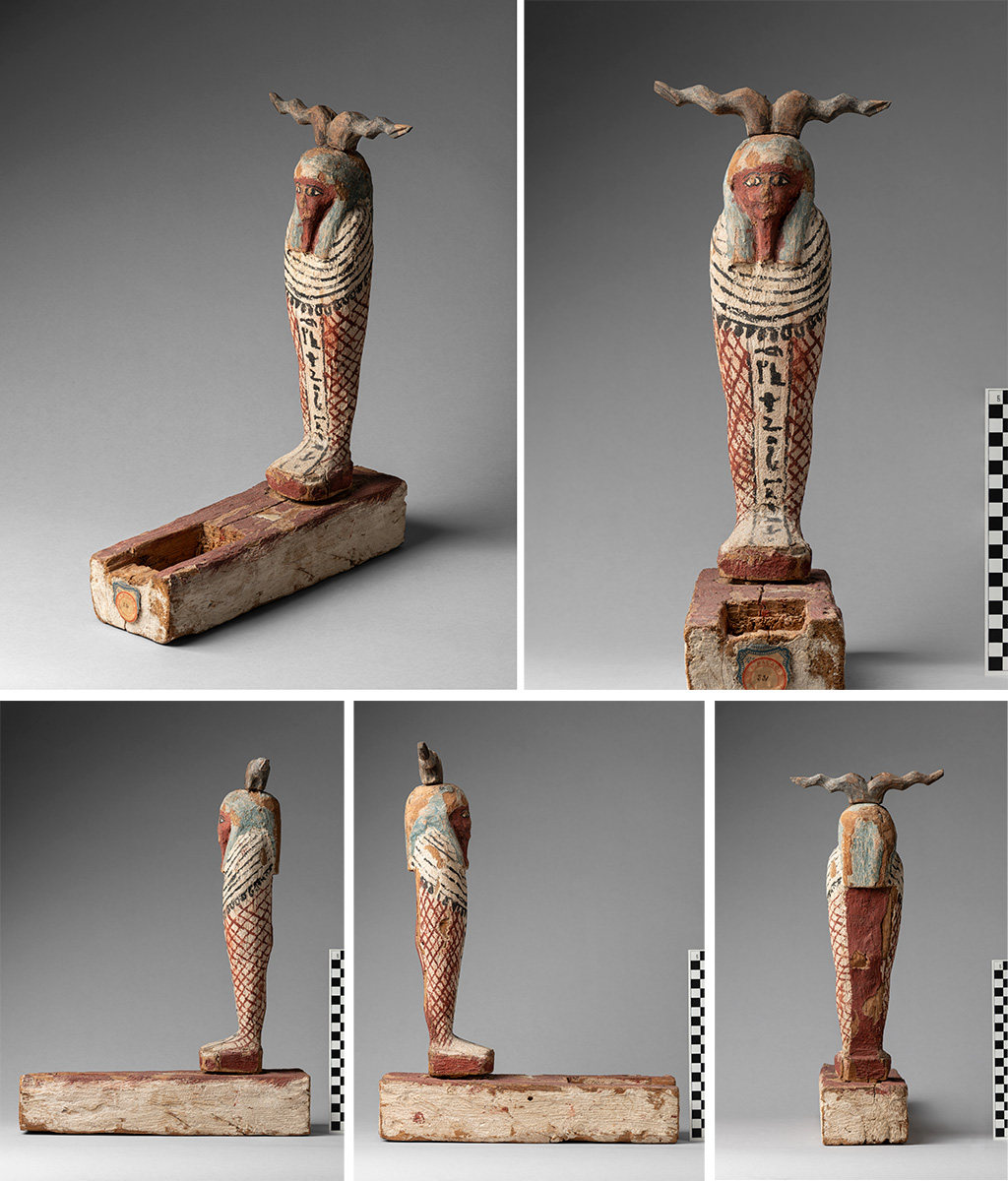
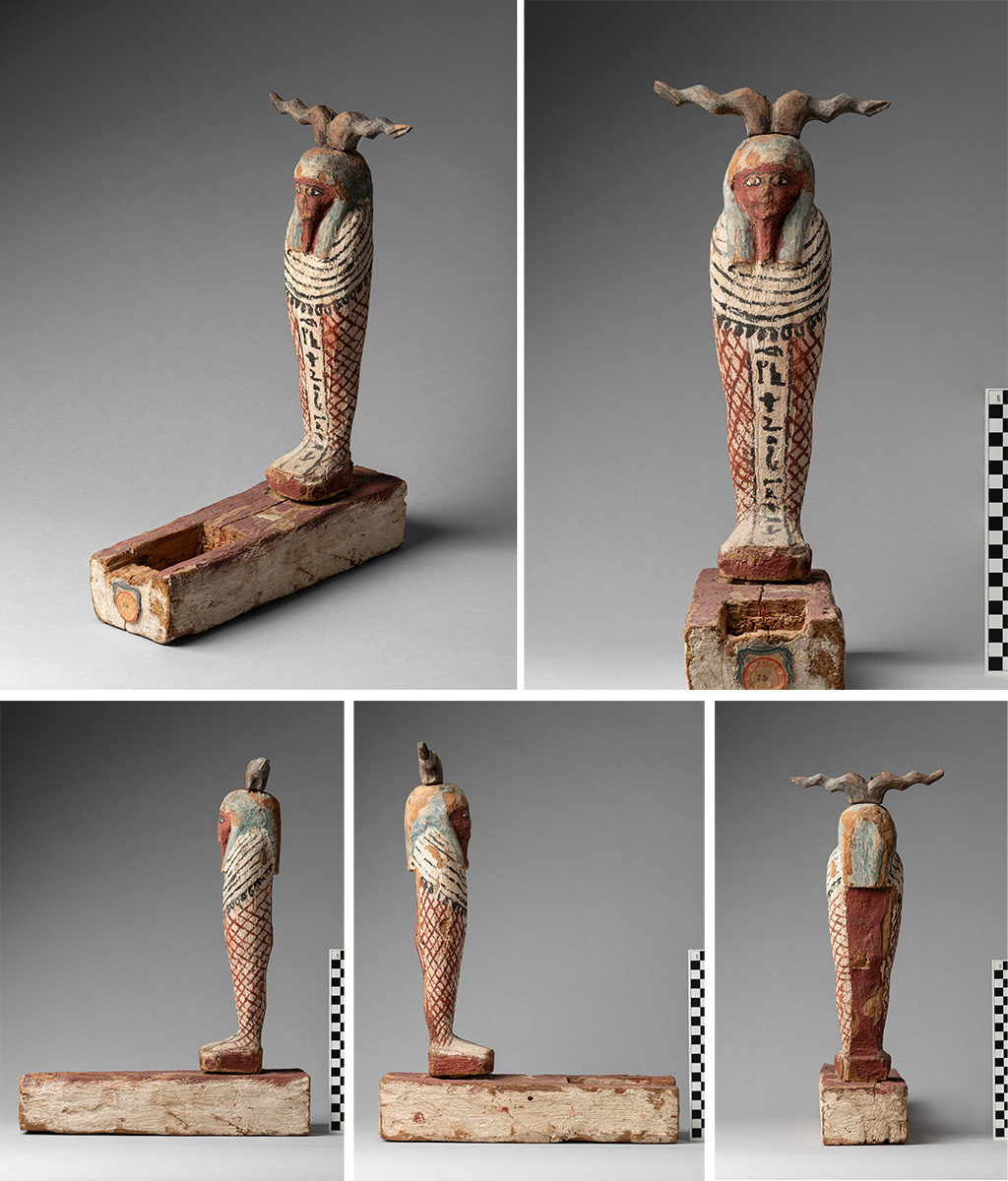
TYPE V
Ptah-Sokar-Osiris of an anonymous individual, MCABo EG 332. ©Museo Civico Archeologico, Bologna/Photo F. Taverni.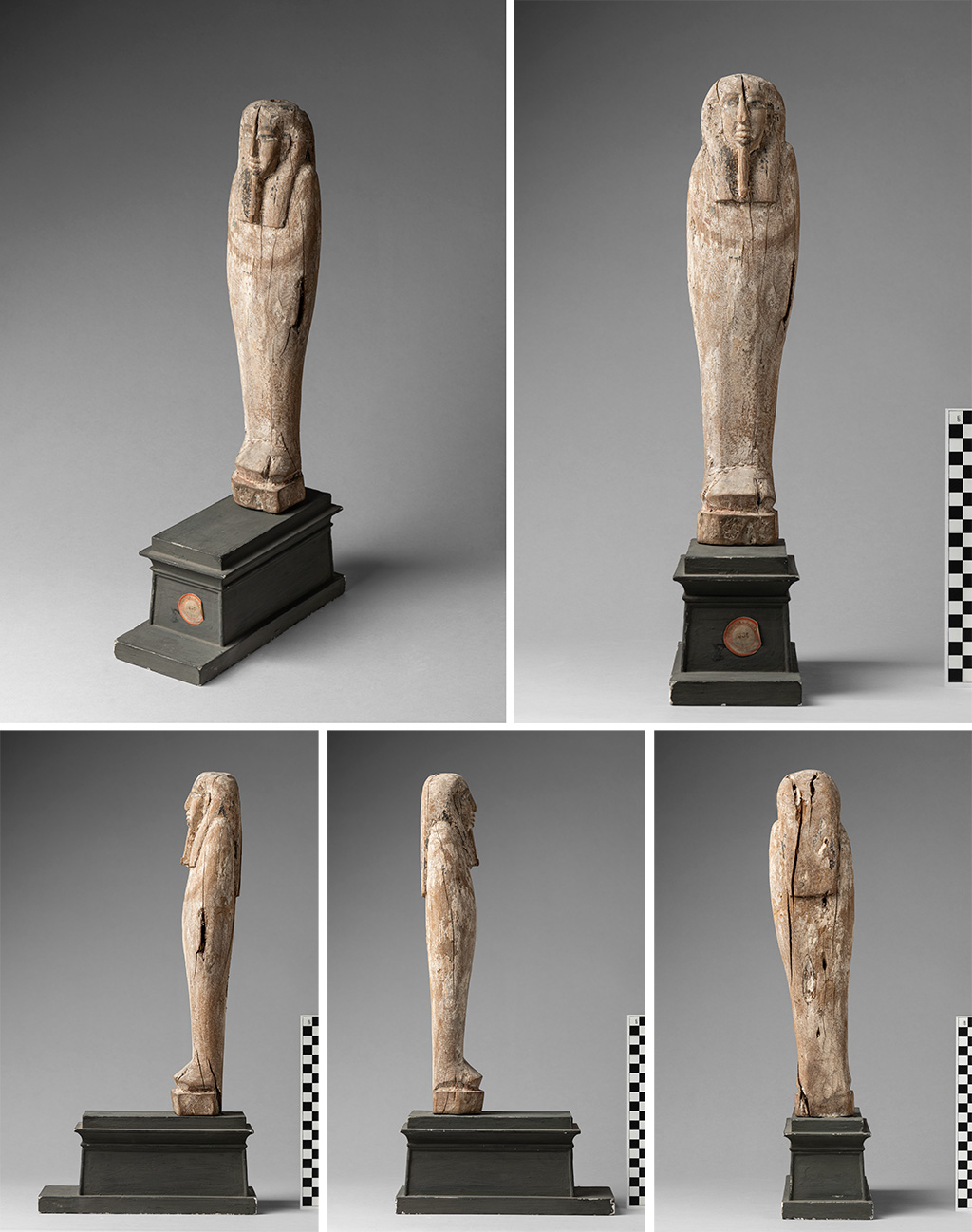
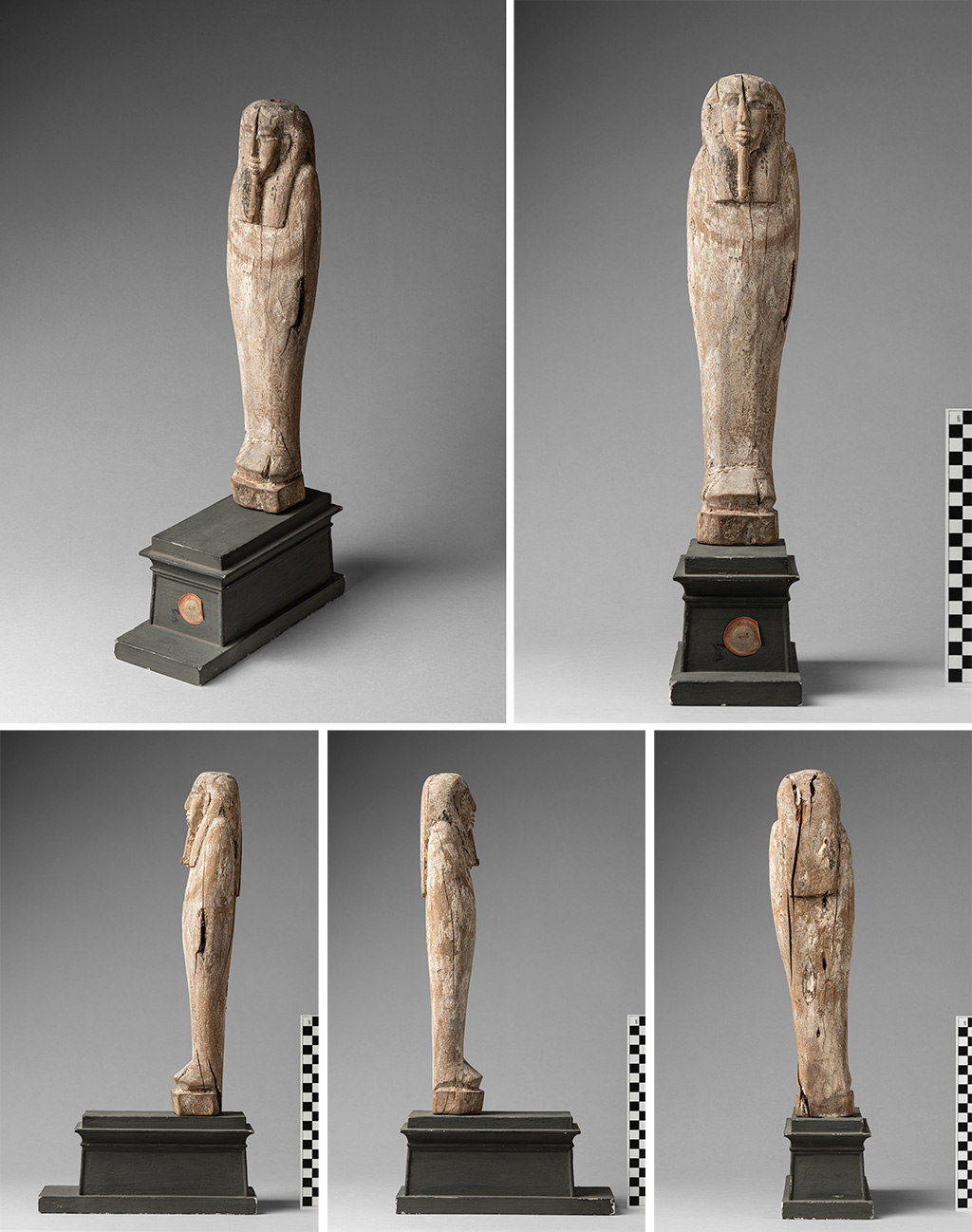
TYPE ?
Ptah-Sokar-Osiris of an anonymous individual, MCABo EG 333. ©Museo Civico Archeologico, Bologna/Photo F. Taverni.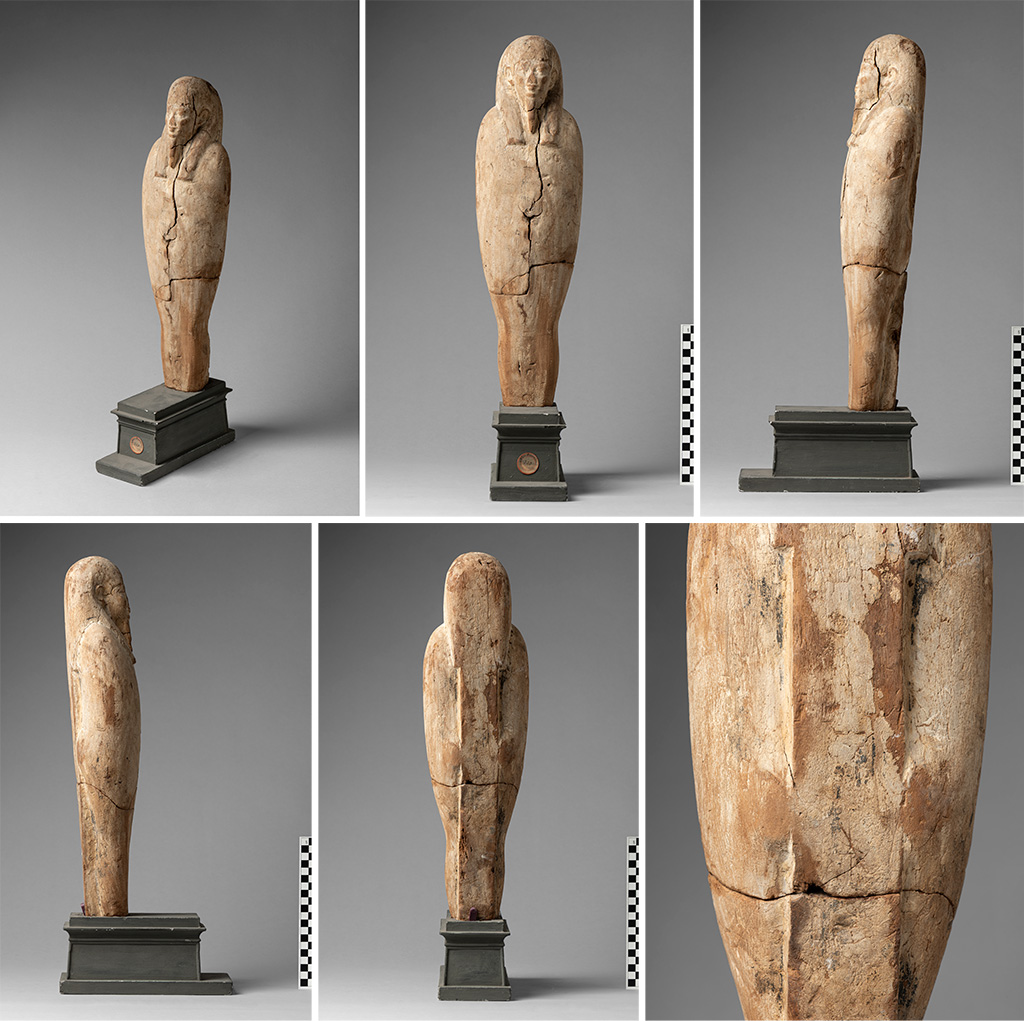
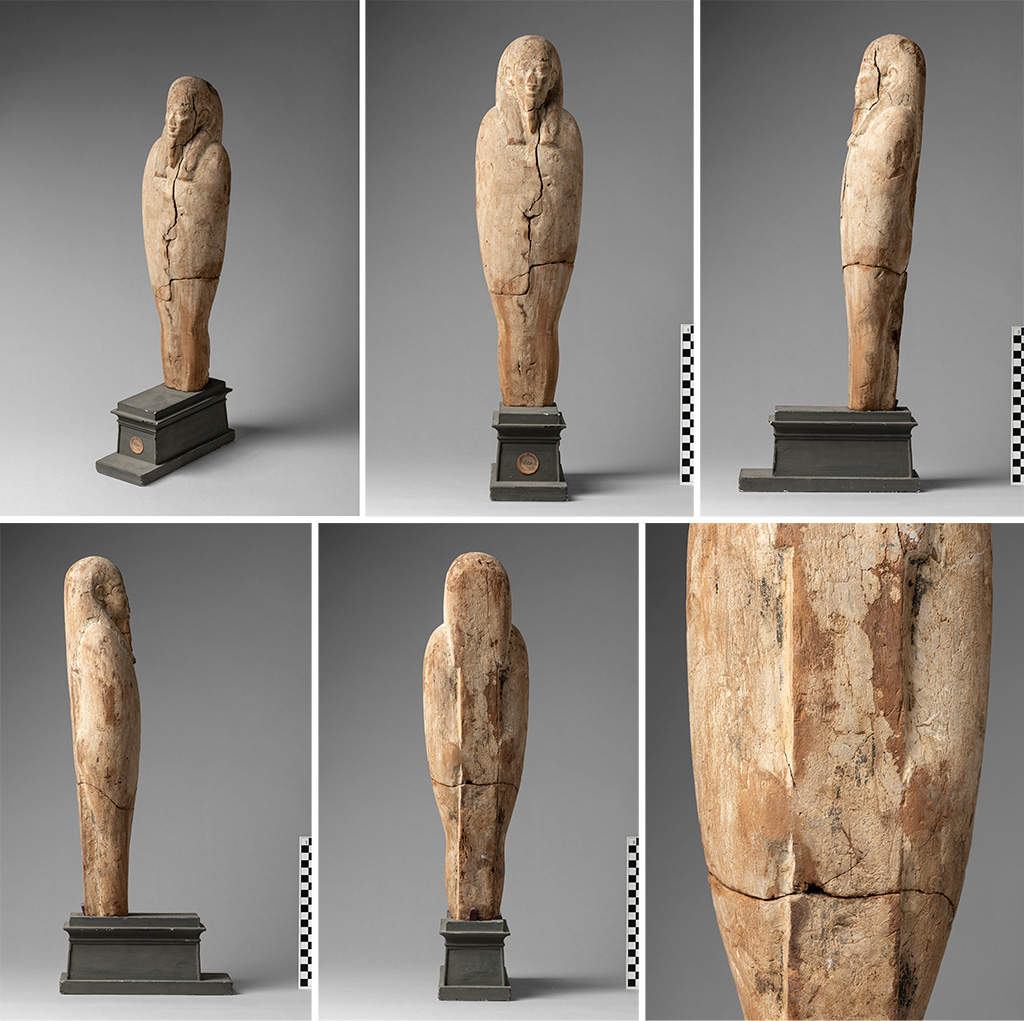
TYPE IVC
Ptah-Sokar-Osiris of Irtyru, MCABo EG 334. ©Museo Civico Archeologico, Bologna/Photo F. Taverni.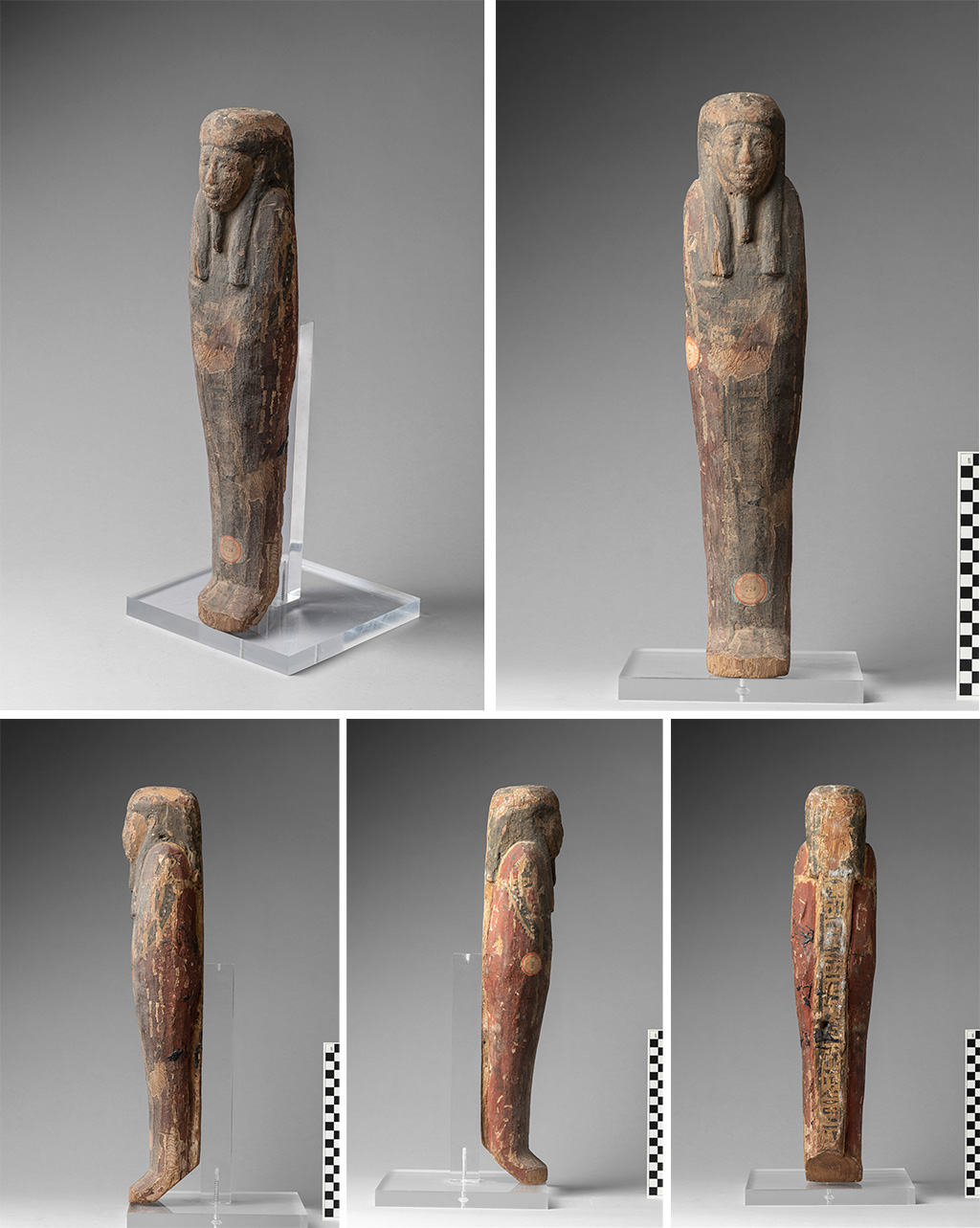
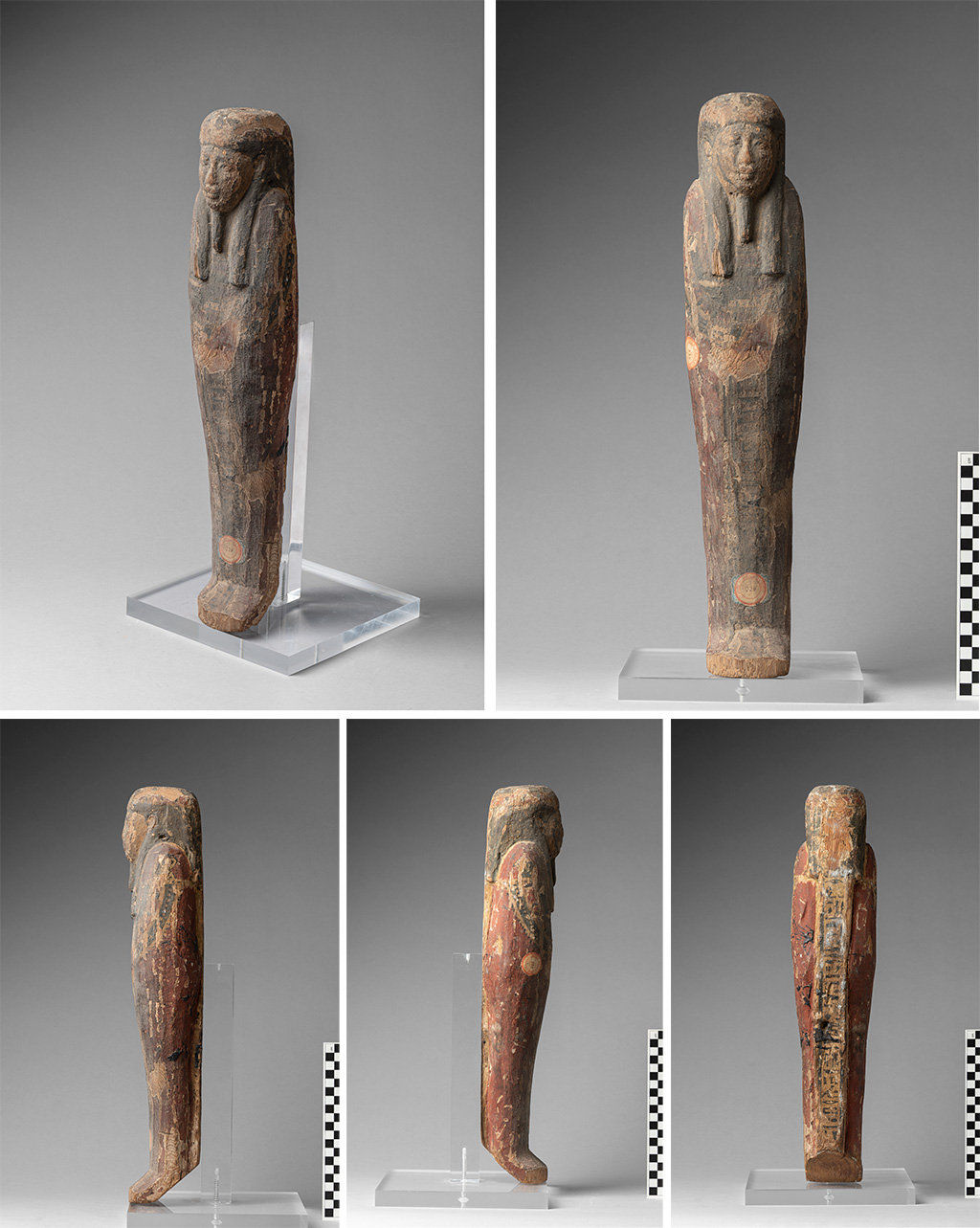
TYPE VAR.
Ptah-Sokar-Osiris of Horwedja, MCABo EG 335. ©Museo Civico Archeologico, Bologna/Photo F. Taverni.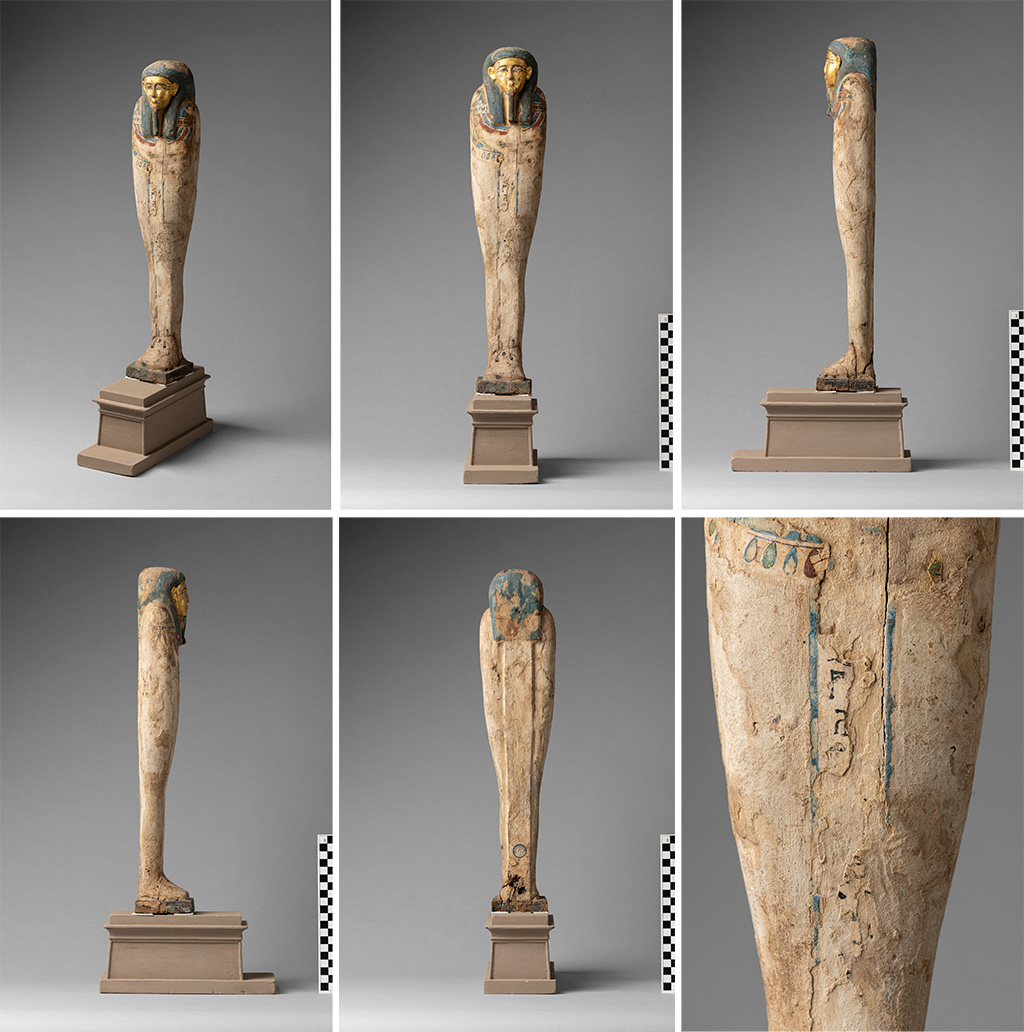
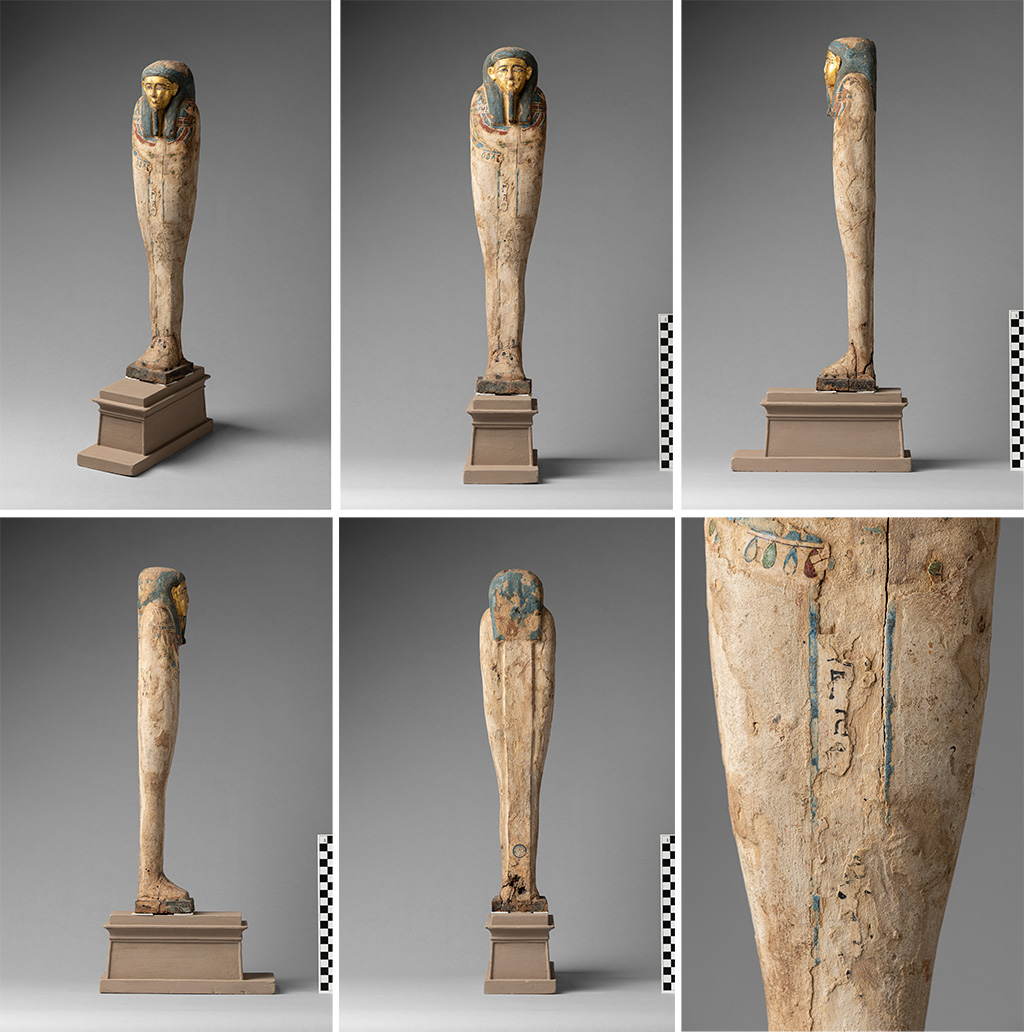
TYPE VAR.
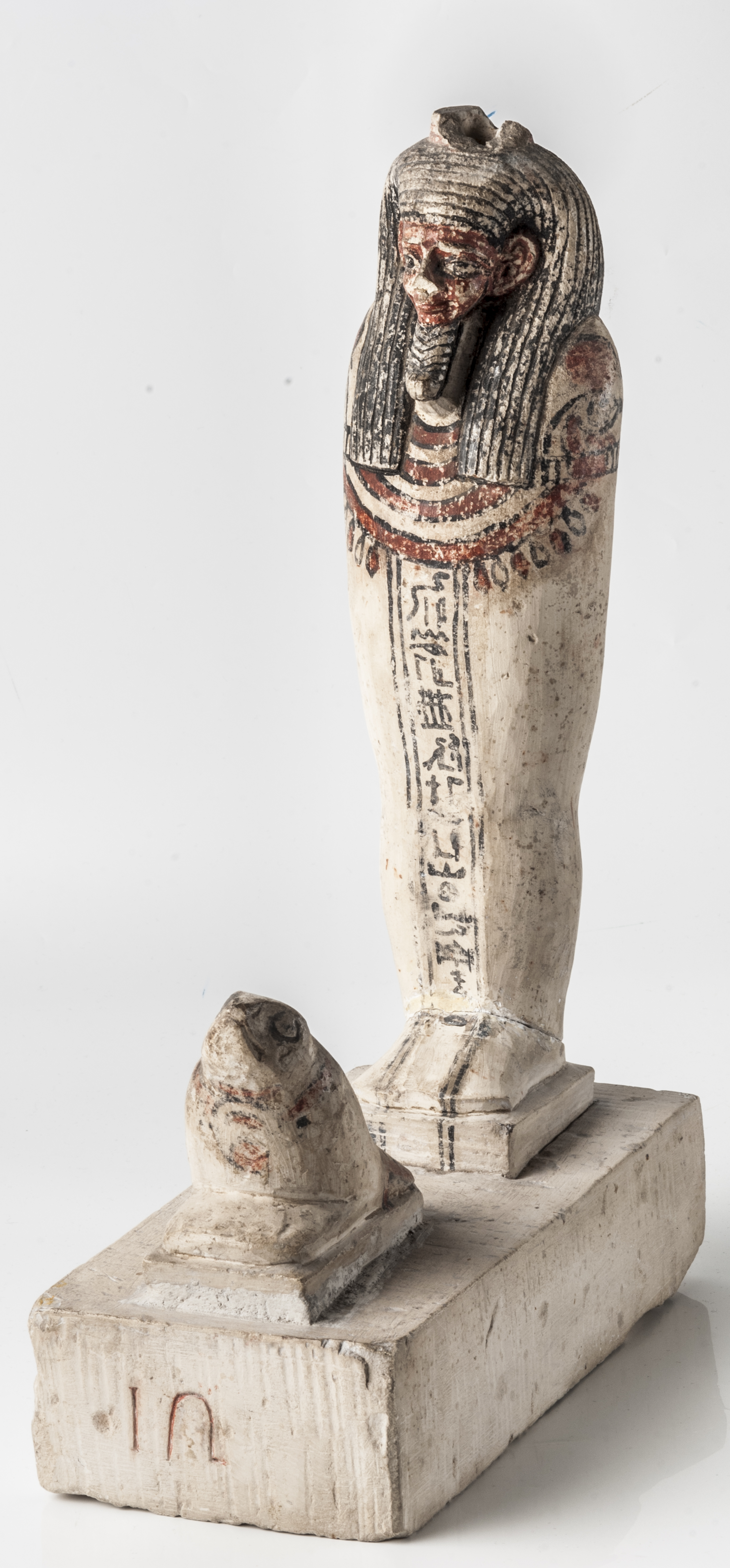
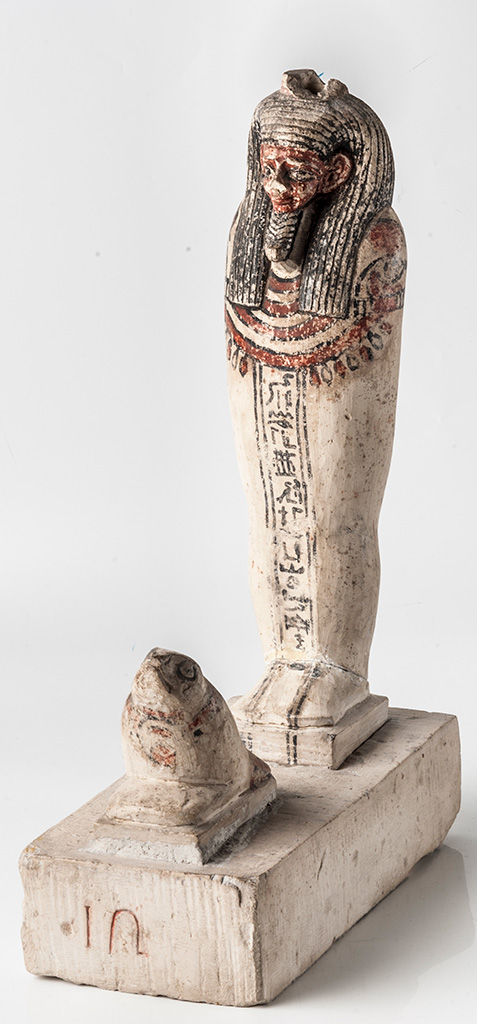
Ptah-Sokar-Osiris of an anonymous individual, MCABo EG 336, EG 415, EG 3148. ©Museo Civico Archeologico, Bologna/Photo F. Taverni.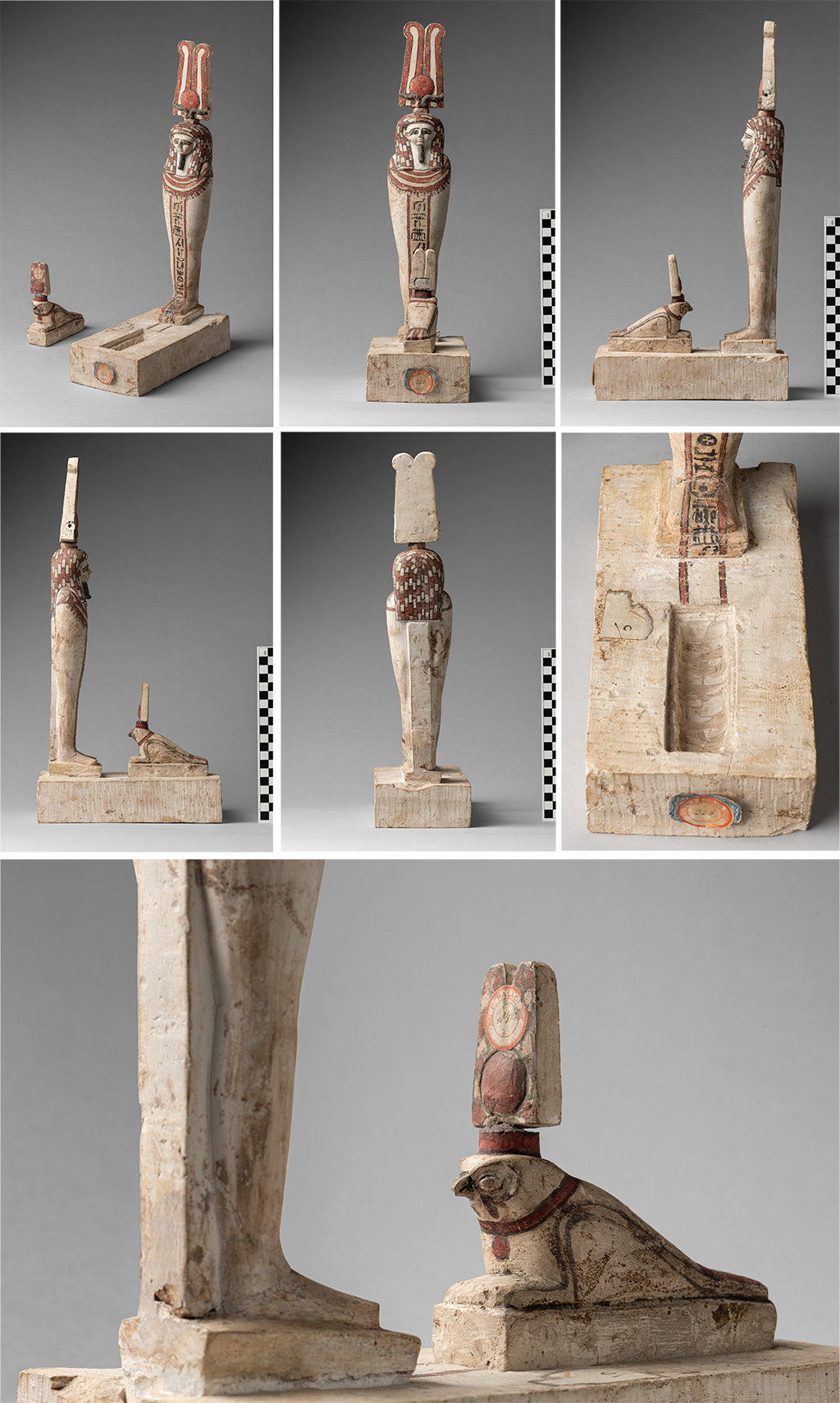
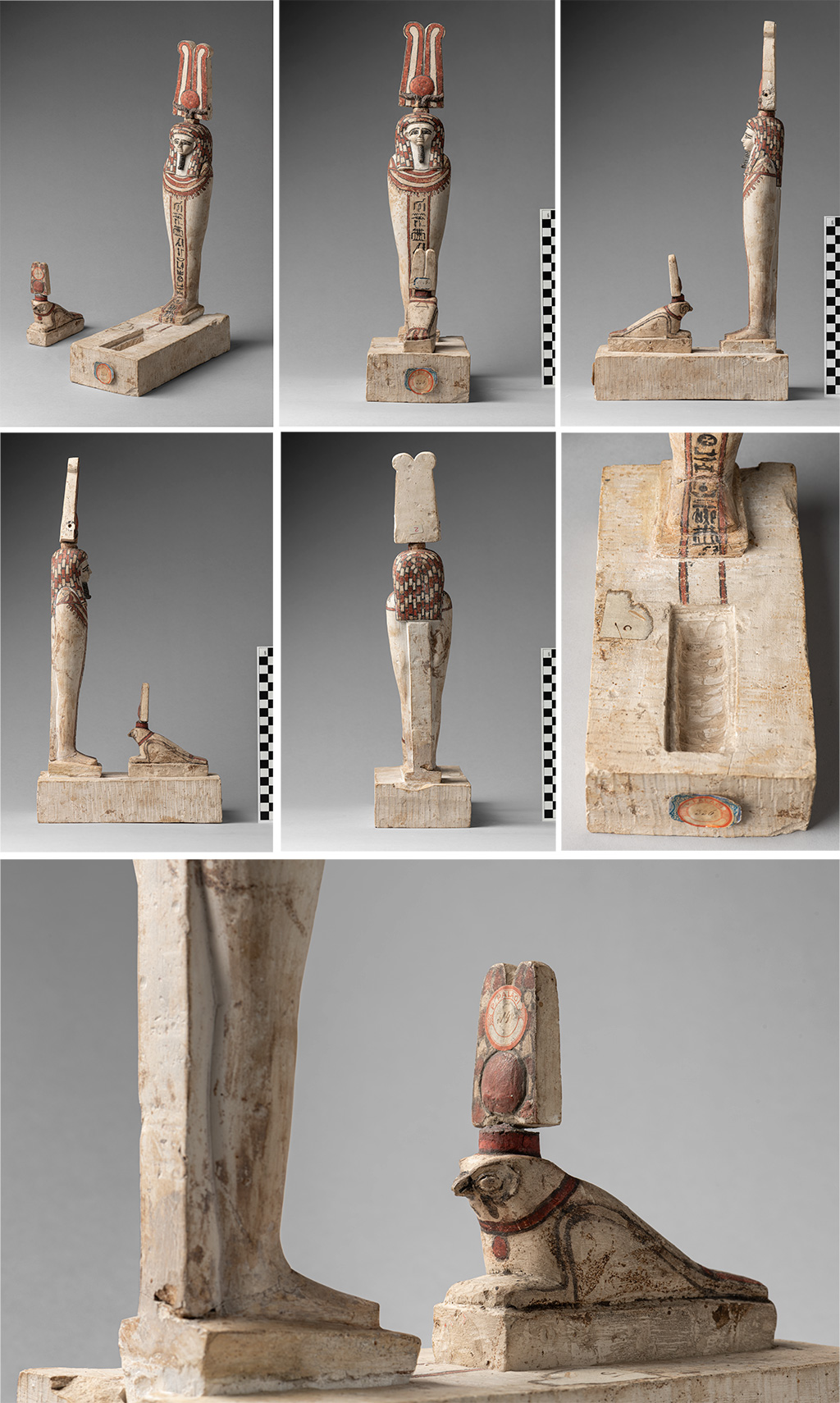
Ptah-Sokar-Osiris, MANN Inv. no. 636. ©Museo Archeologico Nazionale, Napoli/Photo G. Albano.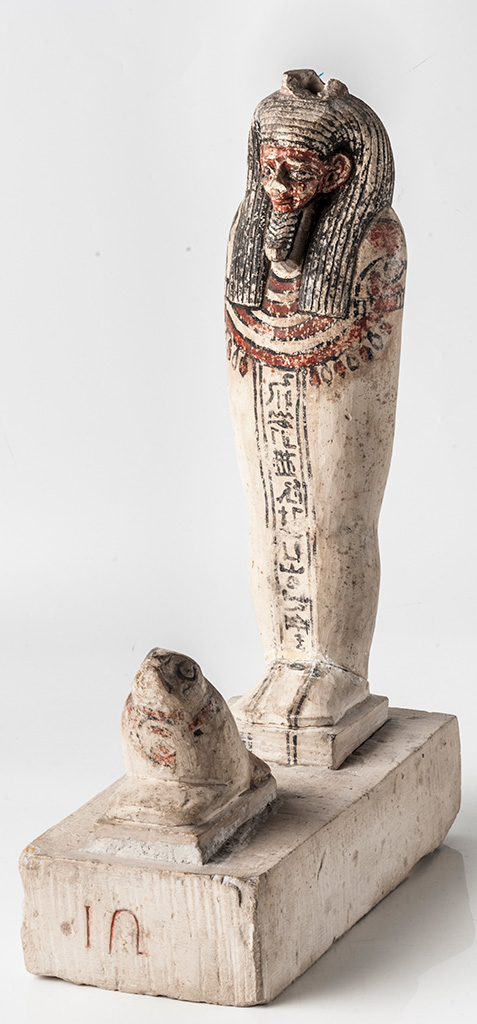
TYPE IB
Dimensions: h. 50.2, w. 12.5, base l. 23.1 cm.
Ptah-Sokar-Osiris of an anonymous individual, MCABo EG 337. ©Museo Civico Archeologico, Bologna/Photo F. Taverni.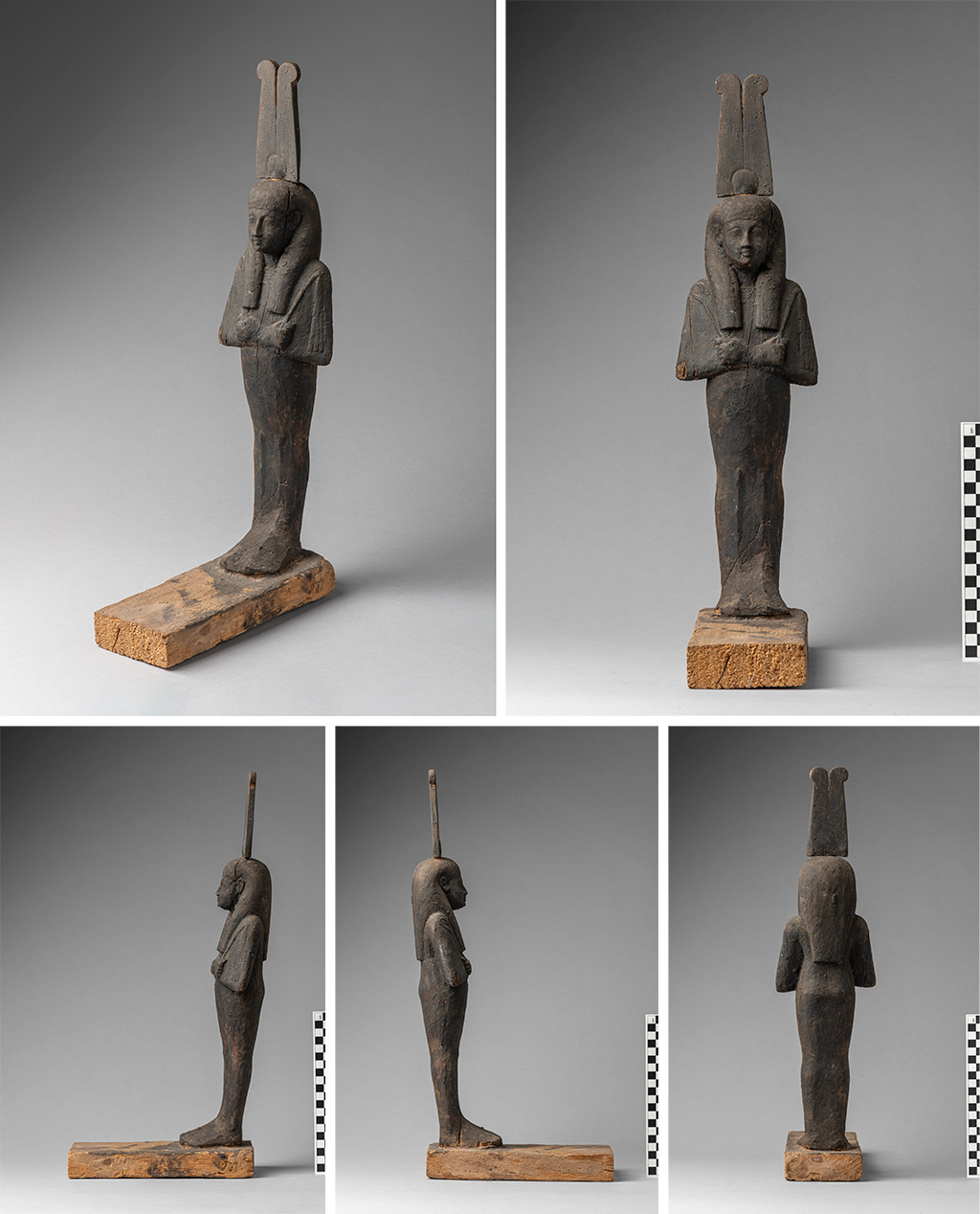
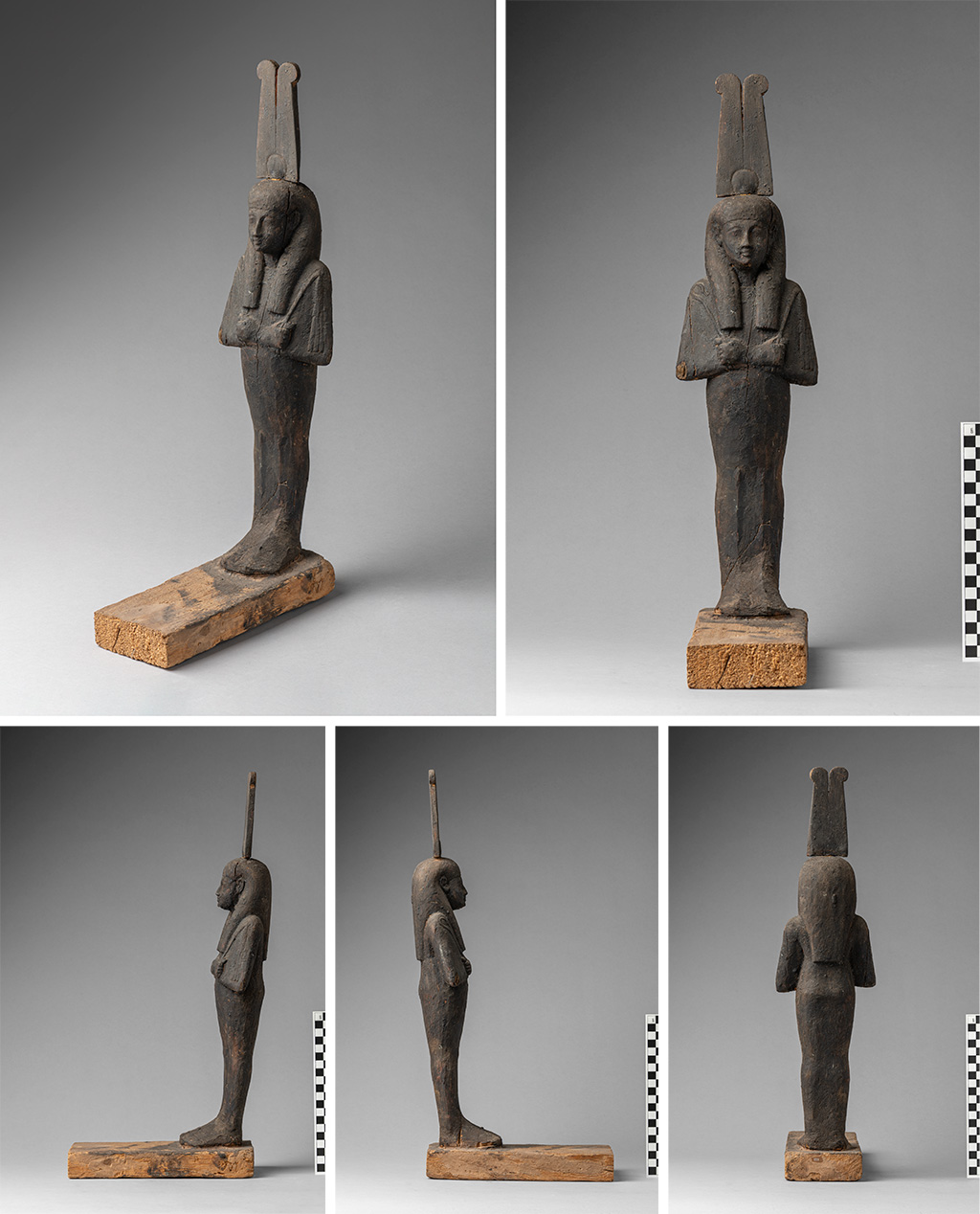
TYPE V
Dimensions: h. 38 (no crown, tenon, or base), w. 9, d. 7.9 cm.
Ptah-Sokar-Osiris of Mennefer (?), MCABo EG 338. ©Museo Civico Archeologico, Bologna/Photo F. Taverni.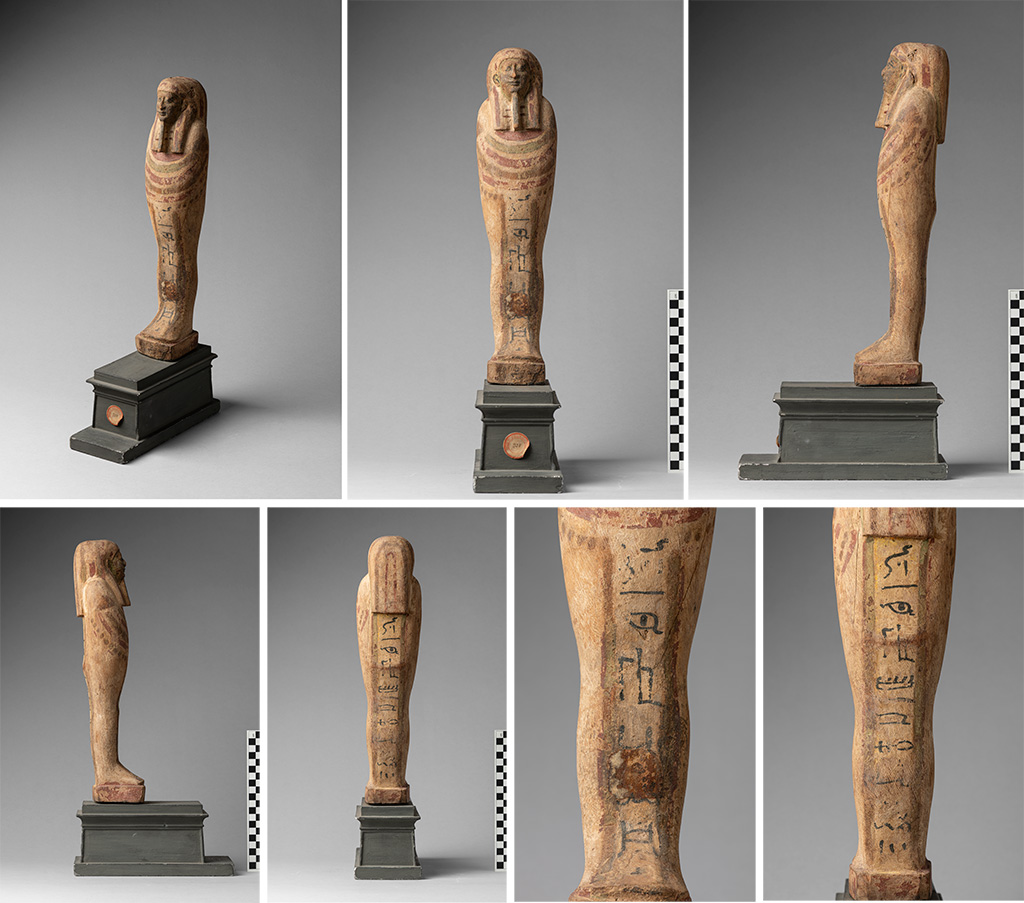
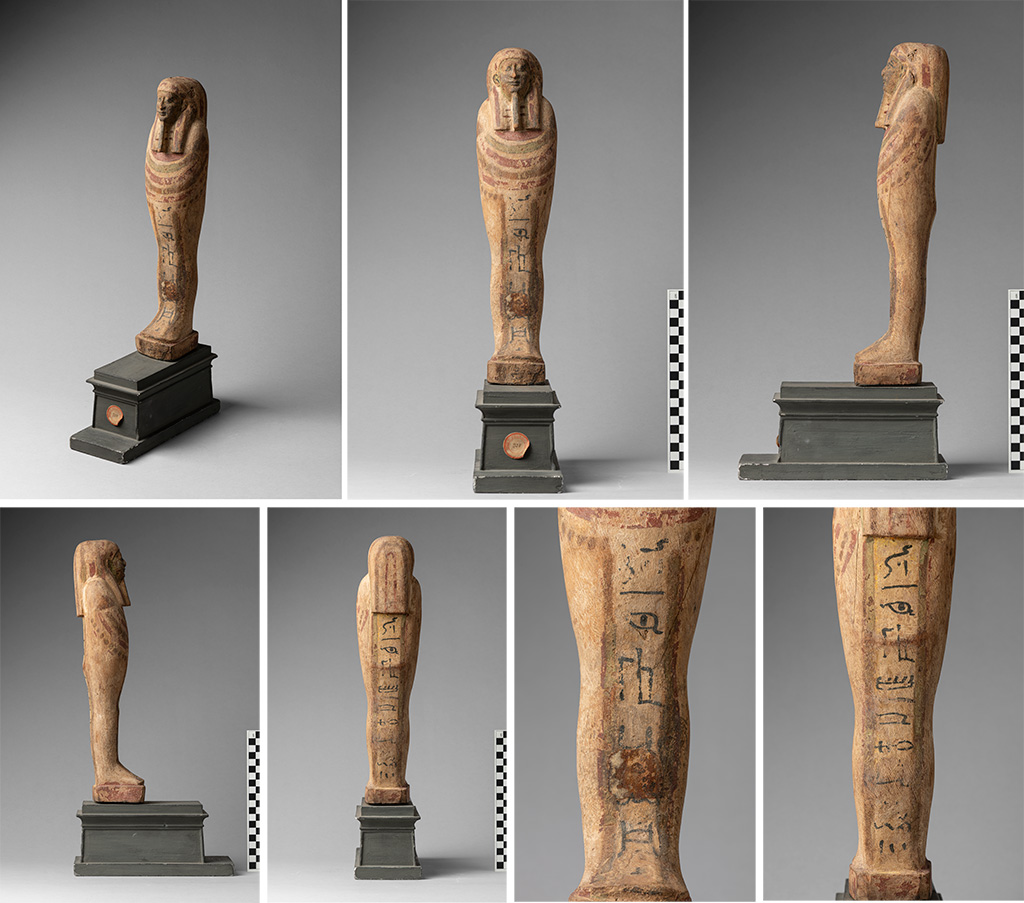
TYPE VAR.
Dimensions: h. 39 (without peg, no crown), w. 10.6, d. 9.7 cm.
Ptah-Sokar-Osiris of Amenhotep, MCABo EG 339. ©Museo Civico Archeologico, Bologna/Photo F. Taverni.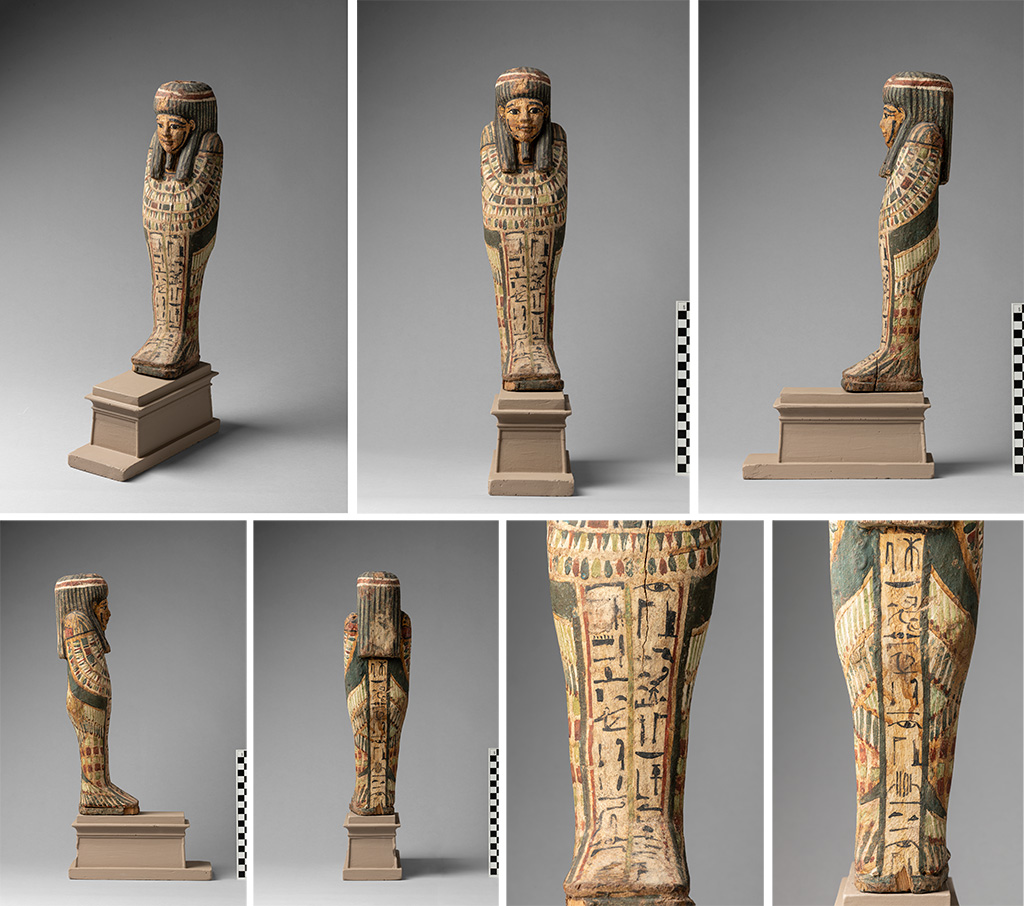
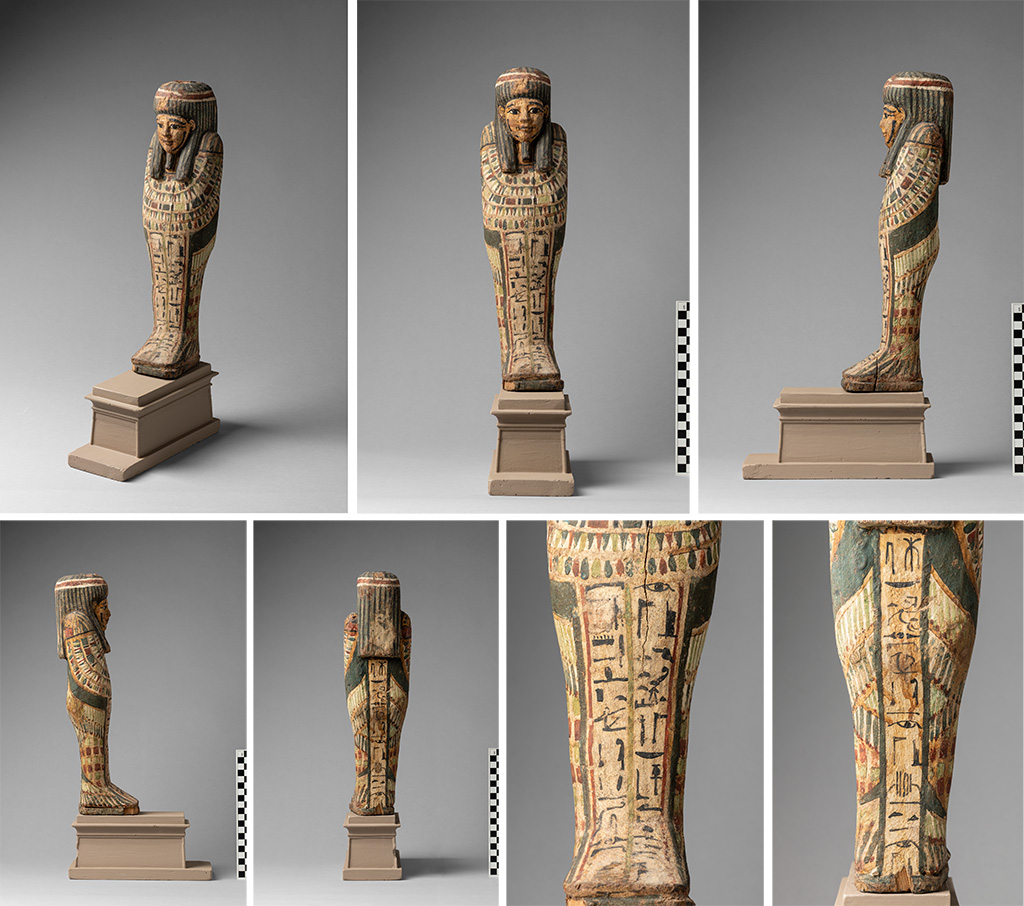
TYPE IVC
Dimensions: h. 52.5 (no crown or base, but including tenon below), w. 11.3, d. 8.3 cm.
Ptah-Sokar-Osiris of an anonymous individual, MCABo EG 340. ©Museo Civico Archeologico, Bologna/Photo F. Taverni.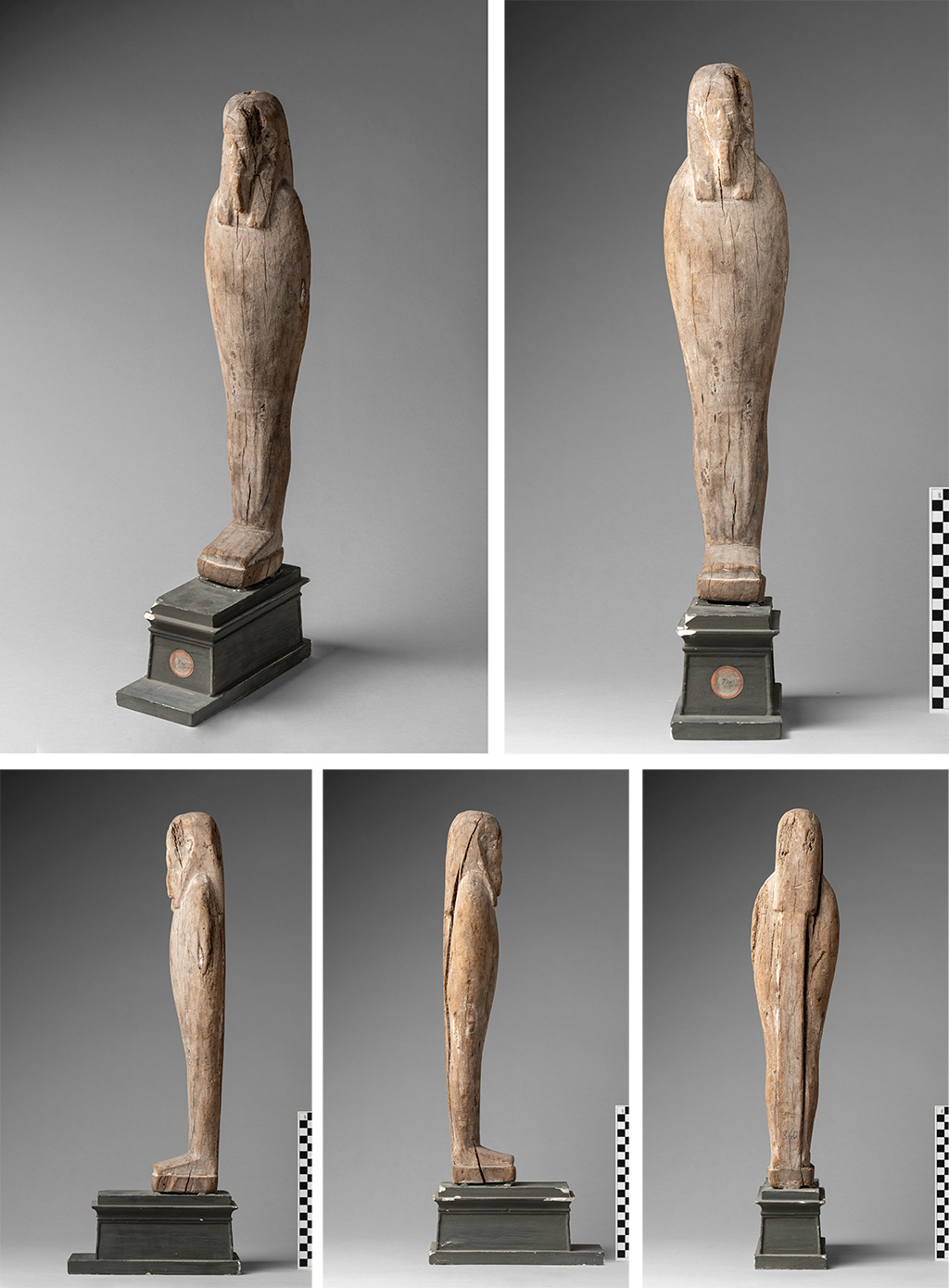
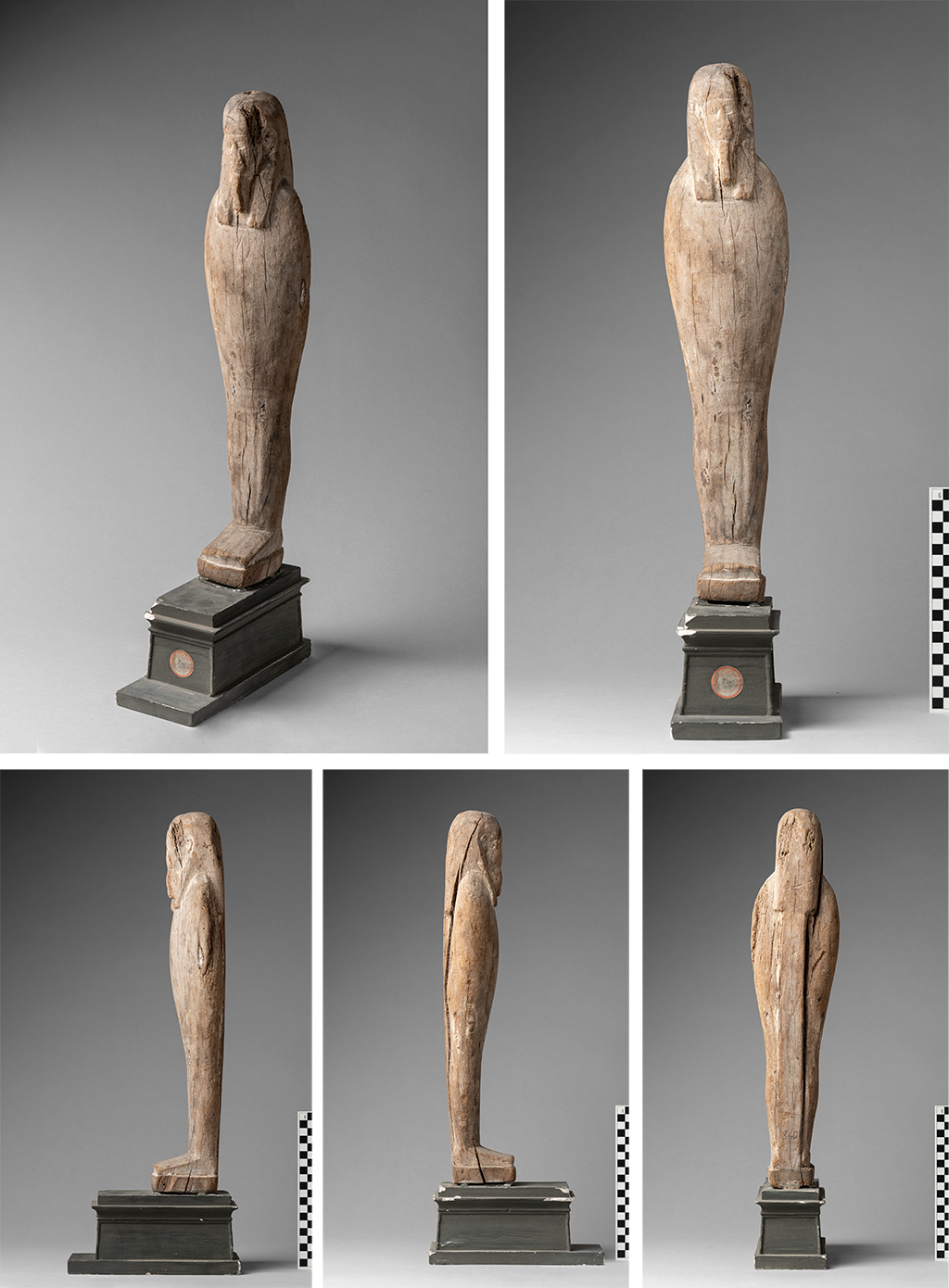
TYPE VAR.
Dimensions: h. 36.5 (no base), w. 8, d. 5.6 cm.
Ptah-Sokar-Osiris of an anonymous individual, MCABo EG 341. ©Museo Civico Archeologico, Bologna/Photo F. Taverni.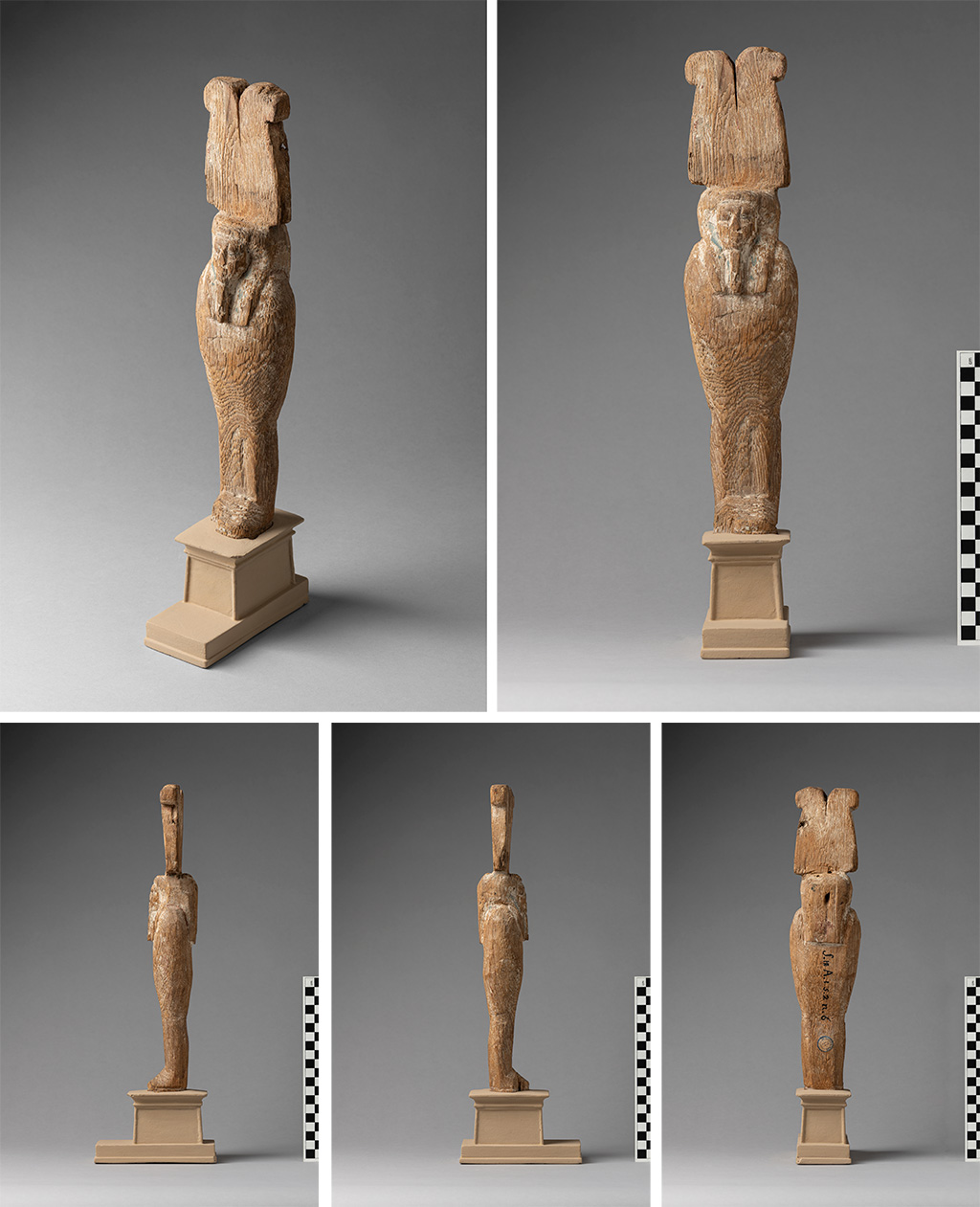
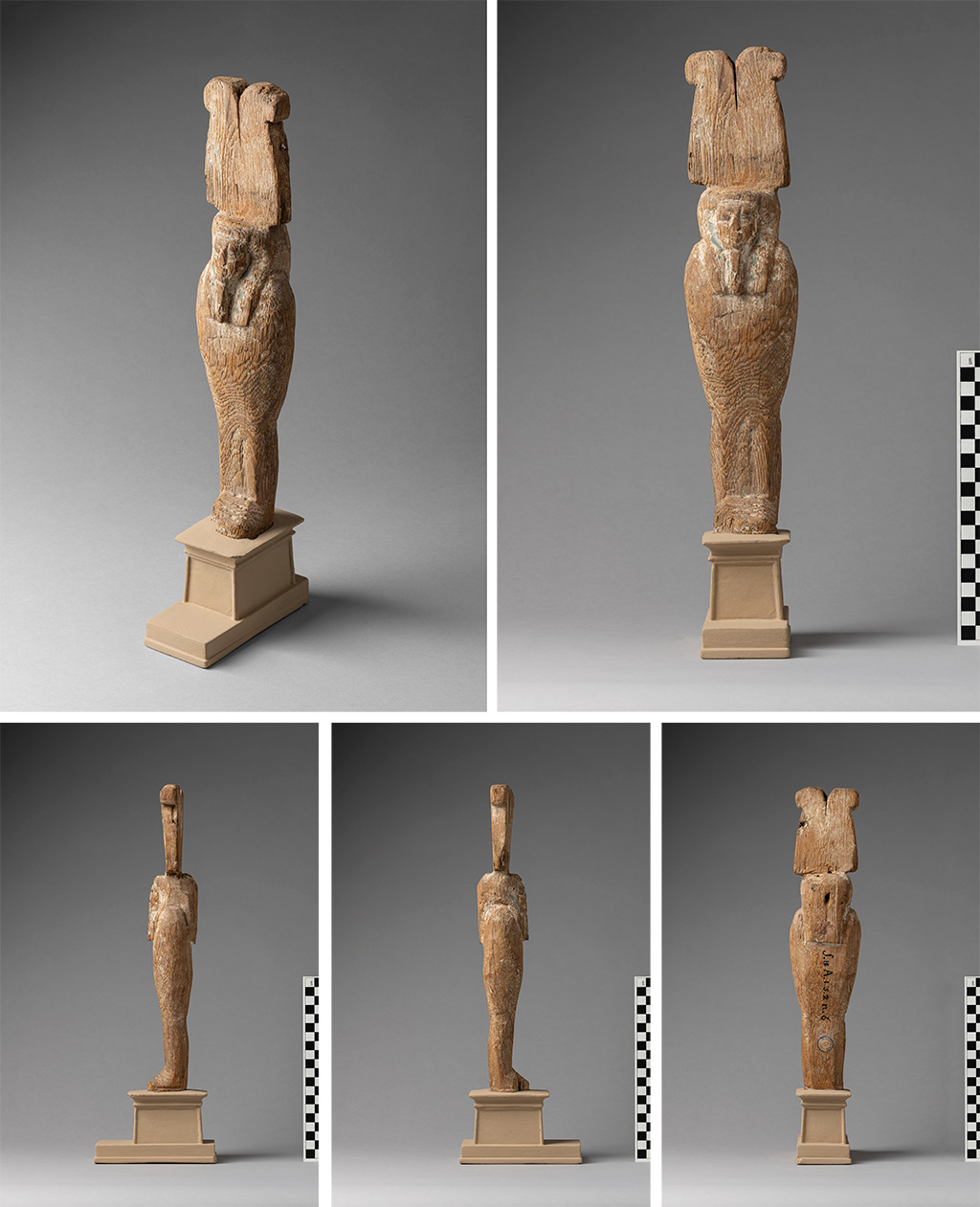
TYPE ?
Dimensions: h. 31 (no crown or base, tenon not visible), w. 7.5, d. 5.4 cm.
Ptah-Sokar-Osiris of an anonymous individual, MCABo EG 341½. ©Museo Civico Archeologico, Bologna/Photo F. Taverni.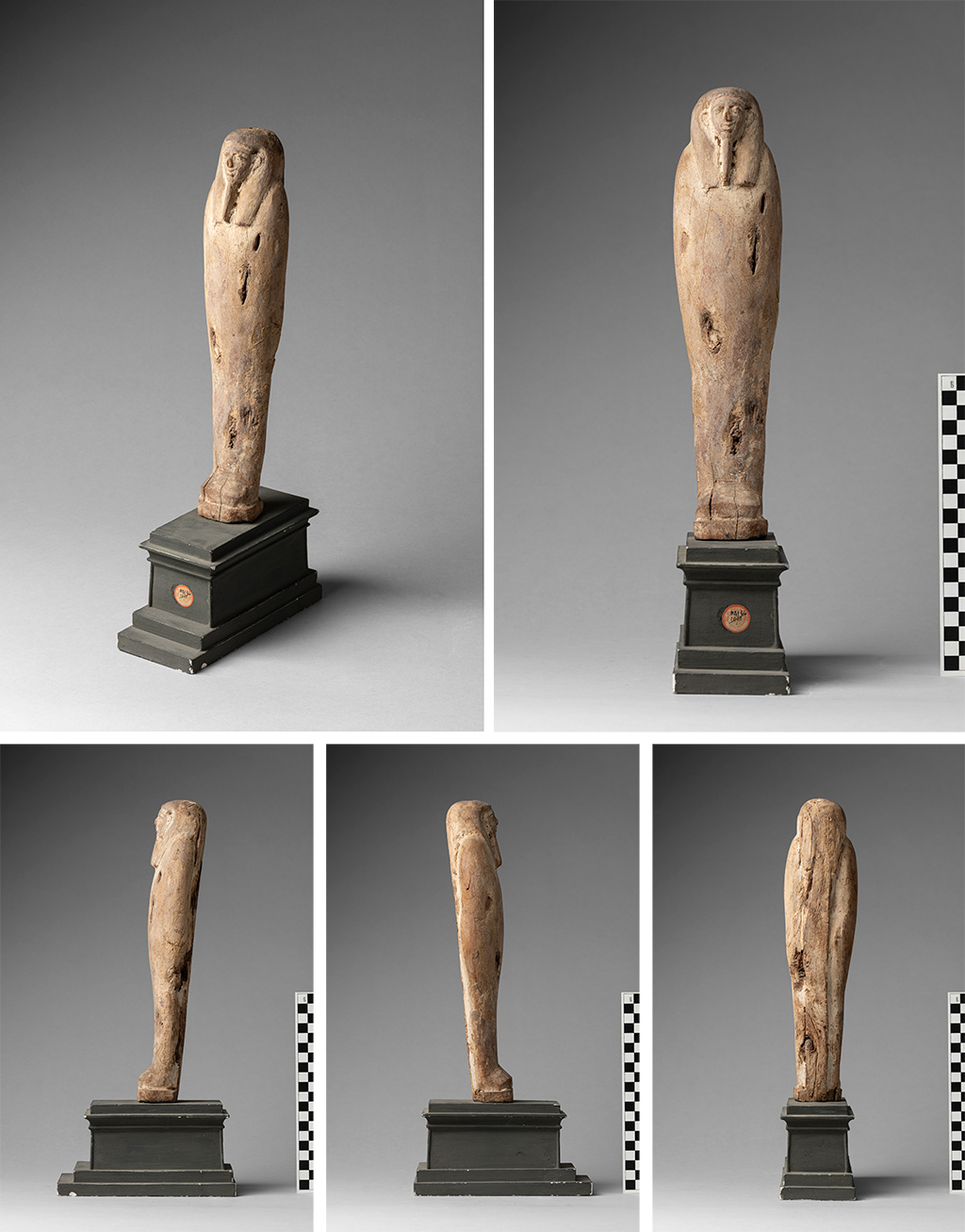
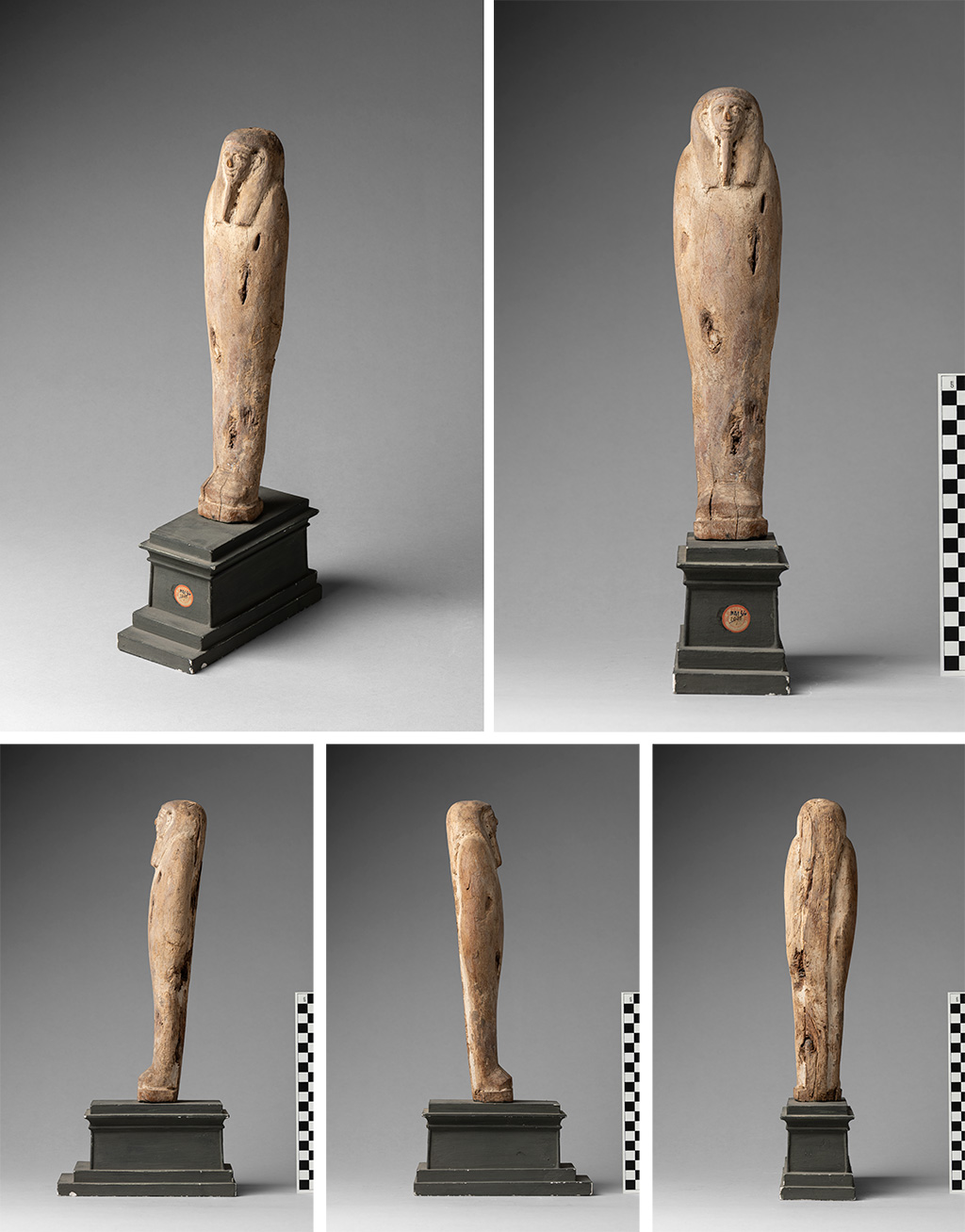
TYPE IV?
Dimensions: h. 32.5 (no crown or base, without tenon, plinth only partly visible), w. 7, d. 6.6 cm.
Ptah-Sokar-Osiris of an anonymous individual, MCABo EG 343. ©Museo Civico Archeologico, Bologna/Photo F. Taverni.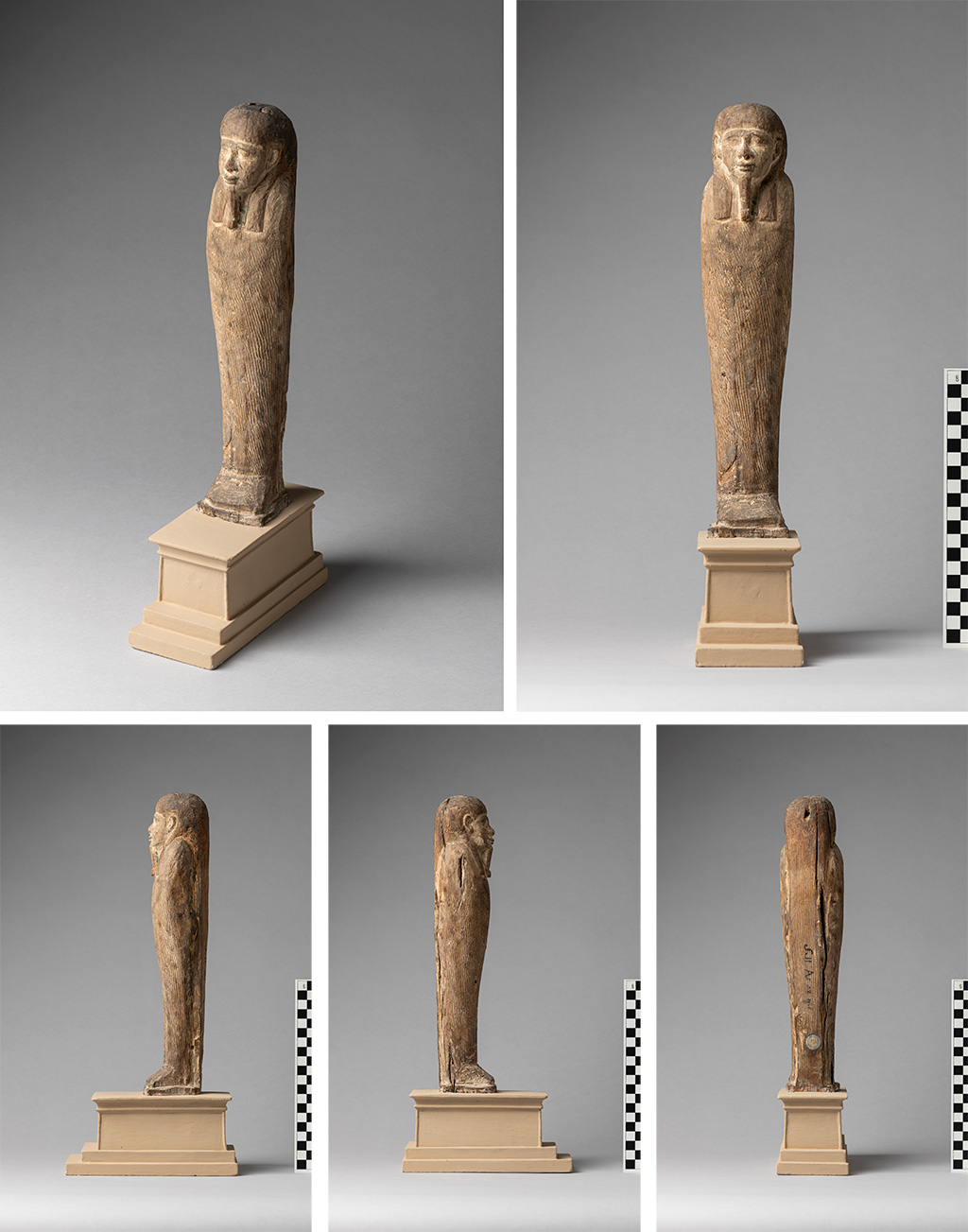
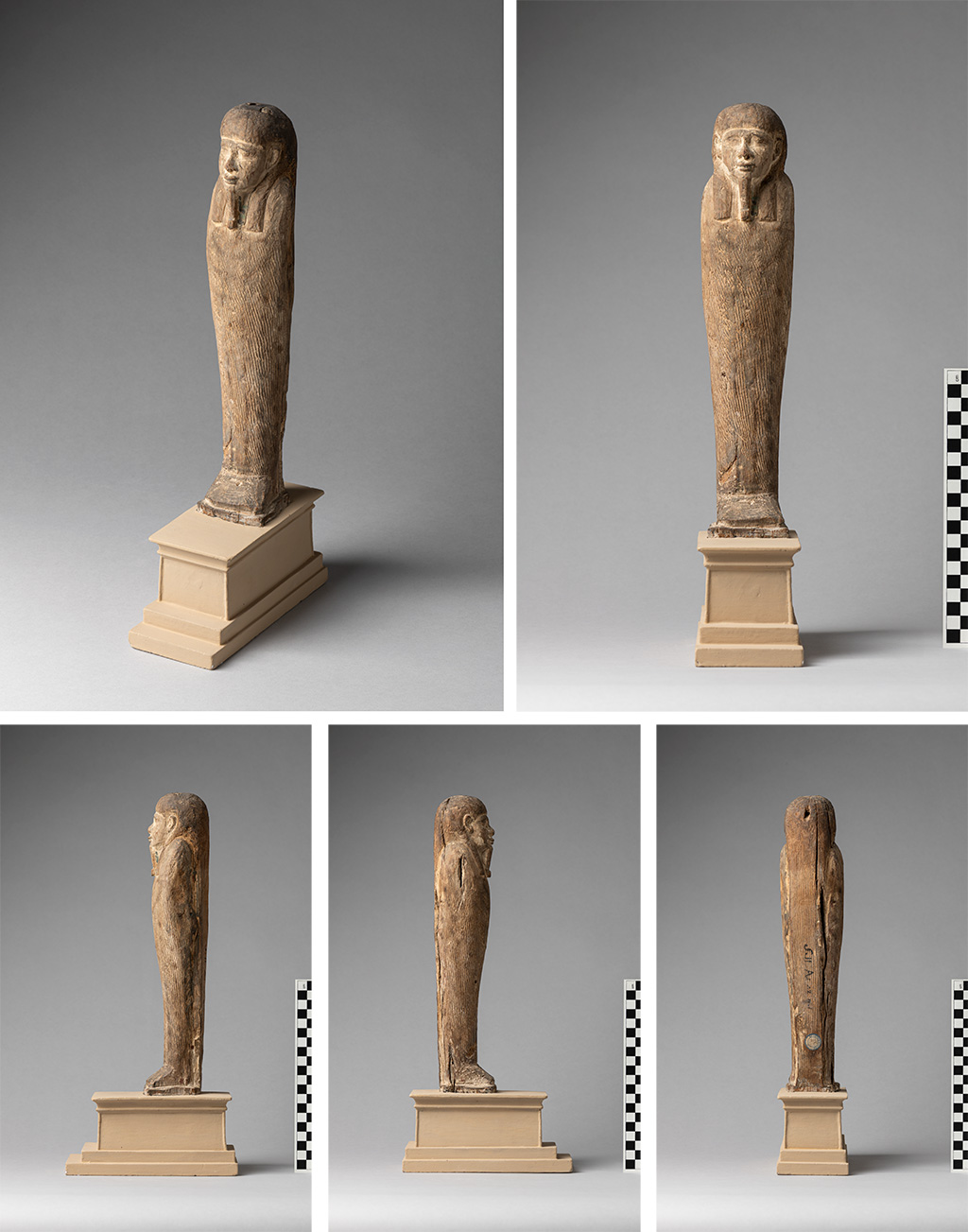
TYPE ?
Dimensions: h. 31.5 (no crown or base, but including tenon), w. 8.1, d. 6.7 cm.
Ptah-Sokar-Osiris of an anonymous individual, MCABo EG 344. ©Museo Civico Archeologico, Bologna/Photo F. Taverni.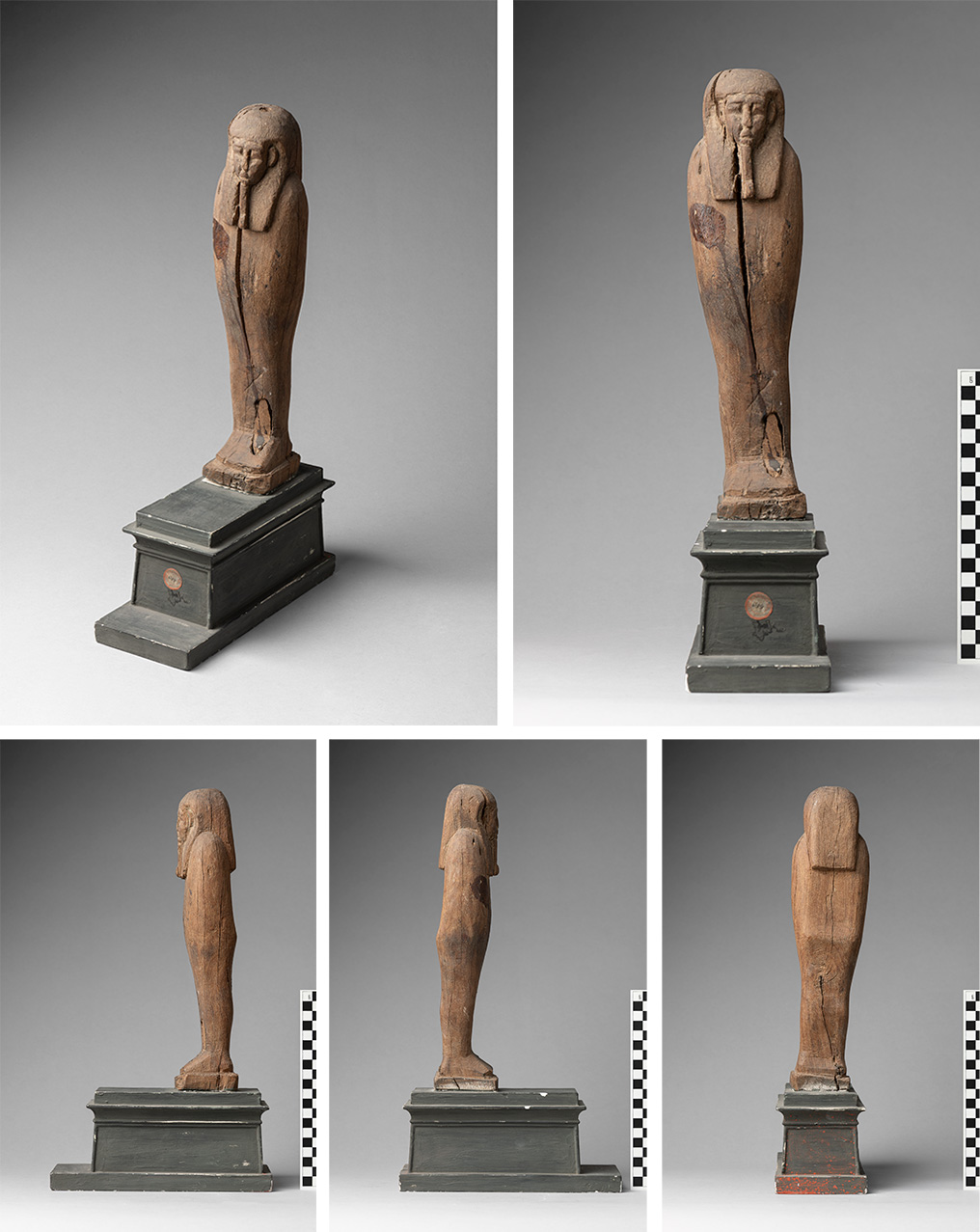
TYPE IV
Dimensions: h. 31.5 (no crown or base), w. 7.3, d. 6 cm.
Ptah-Sokar-Osiris of an anonymous individual, MCABo EG 345. ©Museo Civico Archeologico, Bologna/Photo F. Taverni.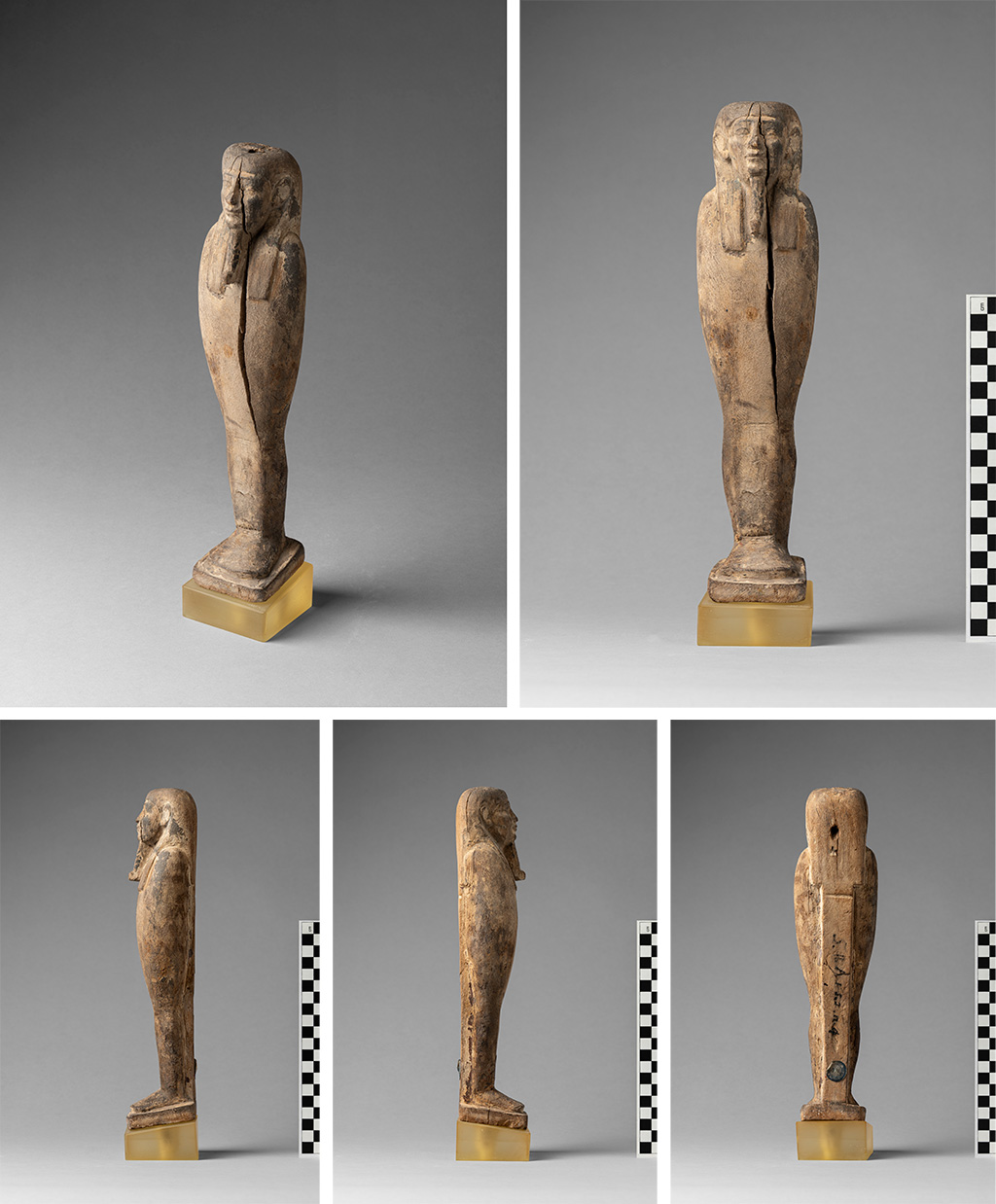
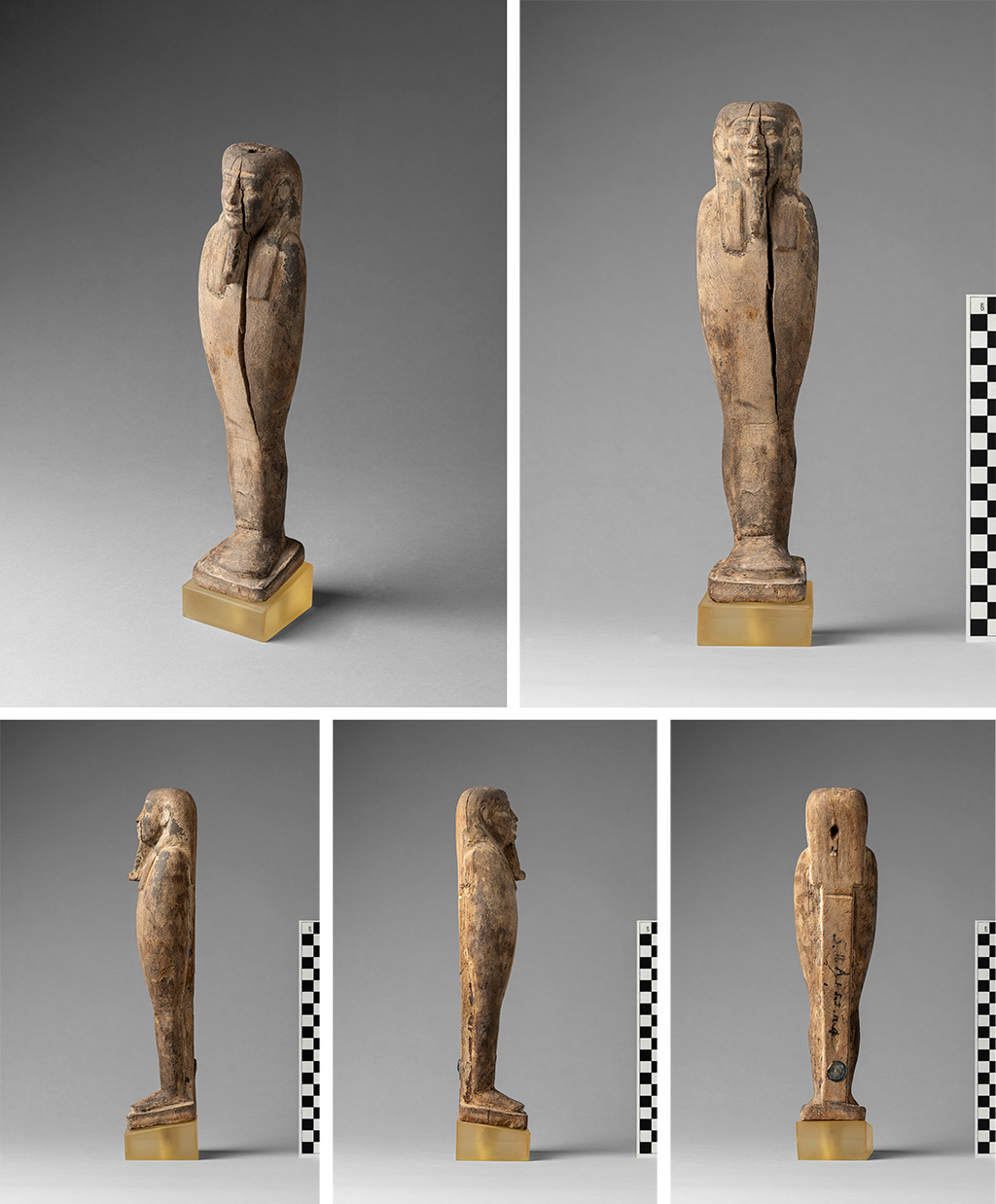
TYPE V
Dimensions: h. 36.8 (no crown or base), w. 9.5, d. 7.3 cm.
Ptah-Sokar-Osiris of an anonymous individual, MCABo EG 2076. ©Museo Civico Archeologico, Bologna/Photo F. Taverni.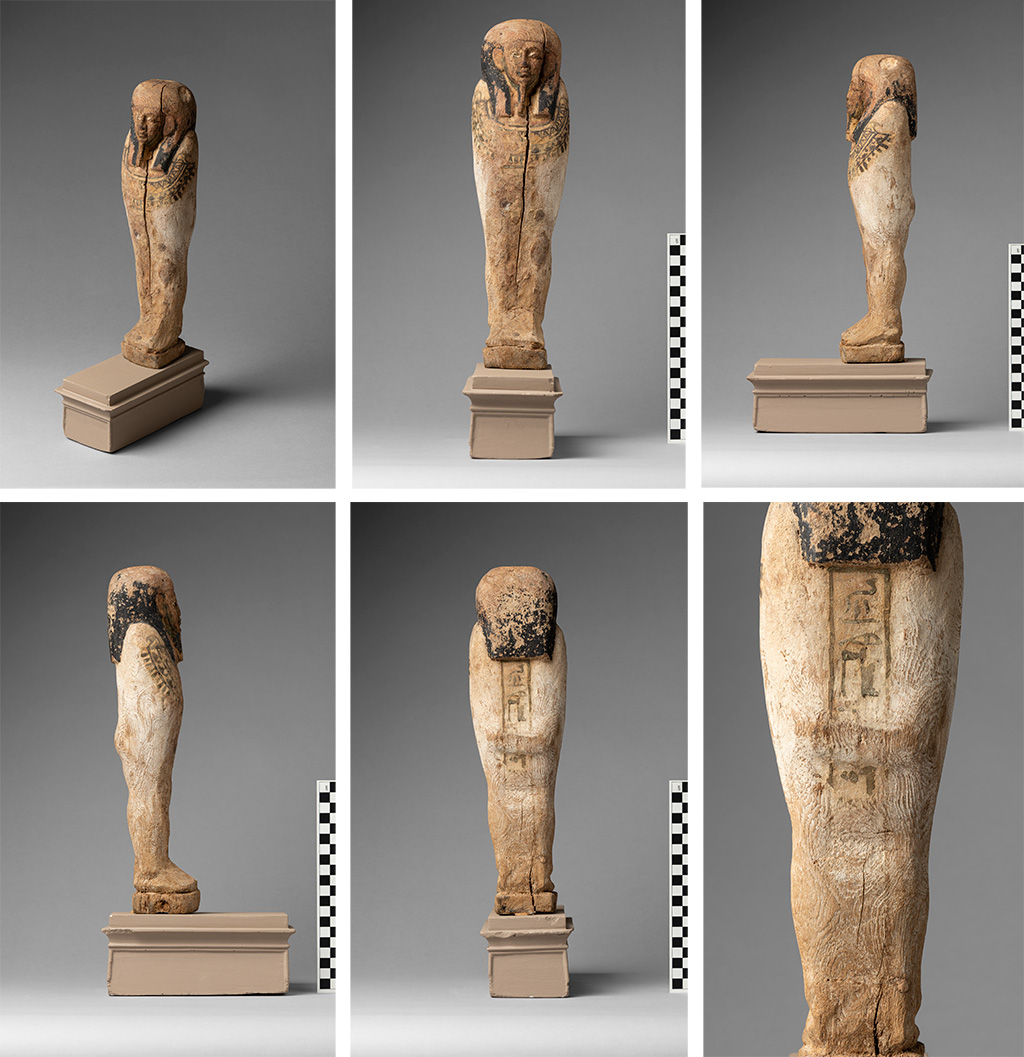
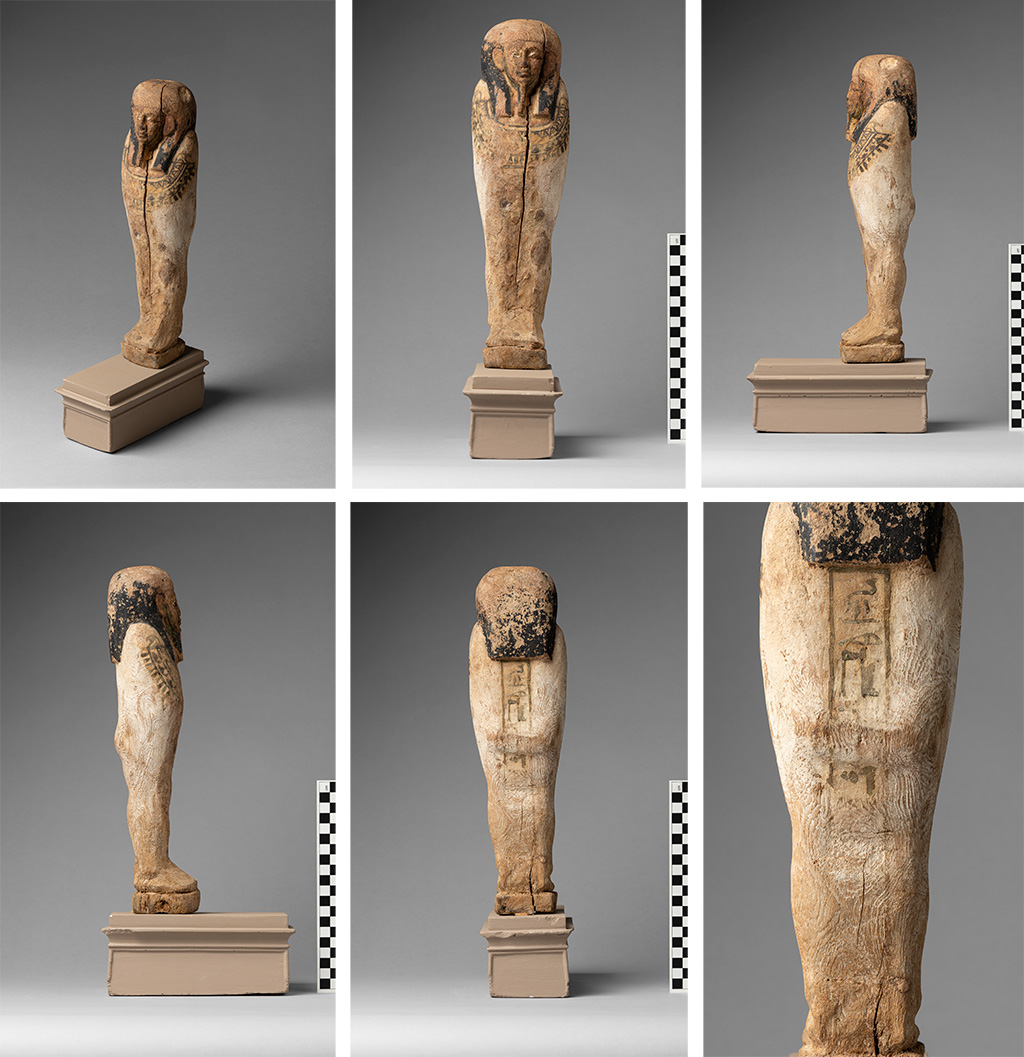
TYPE VAR.
Dimensions: h. 30.2 (no crown or base, tenon not visible), w. 8.1, d. 7.3 cm.
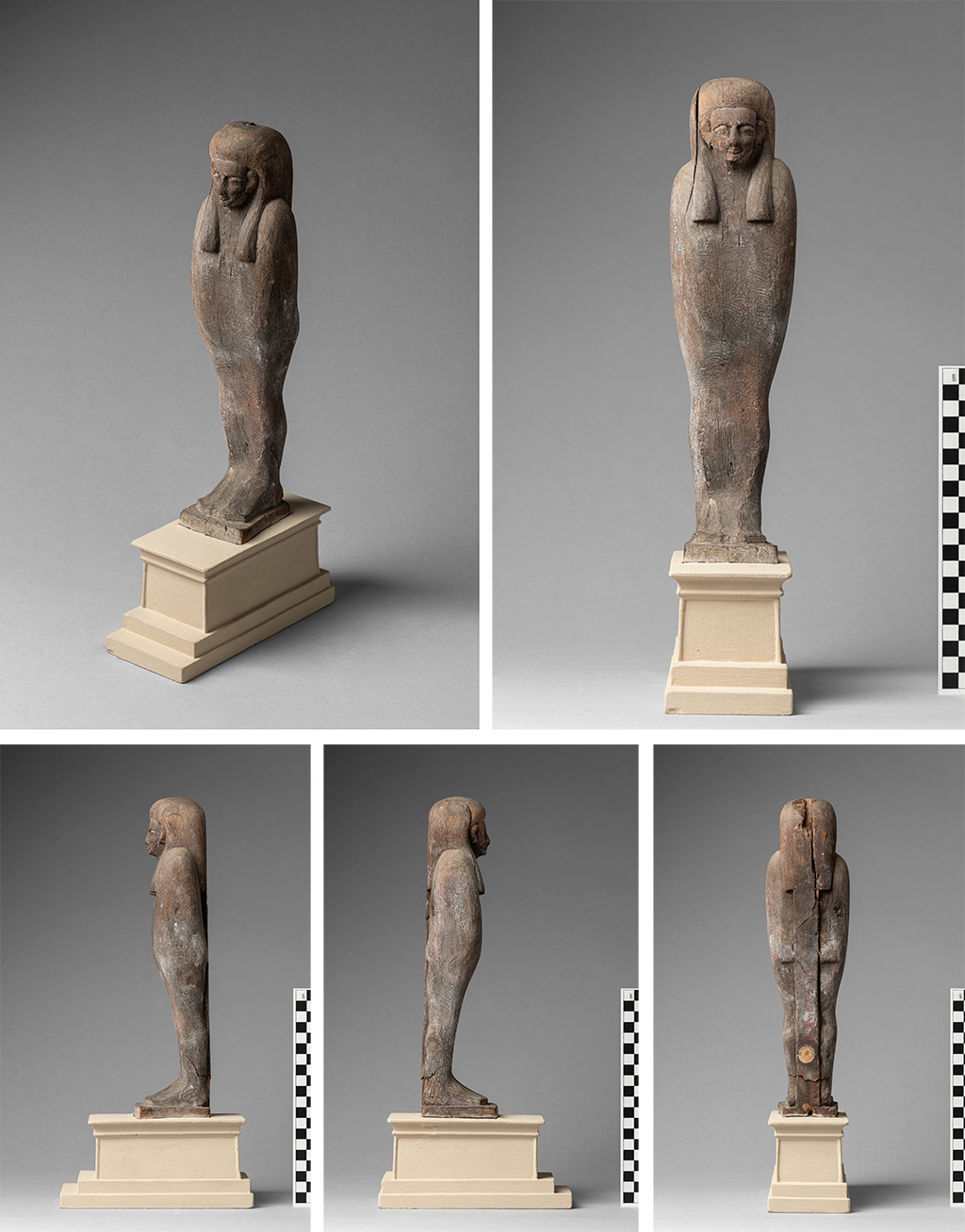
Ptah-Sokar-Osiris of an anonymous individual, MCABo EG 2078. ©Museo Civico Archeologico, Bologna/Photo F. Taverni.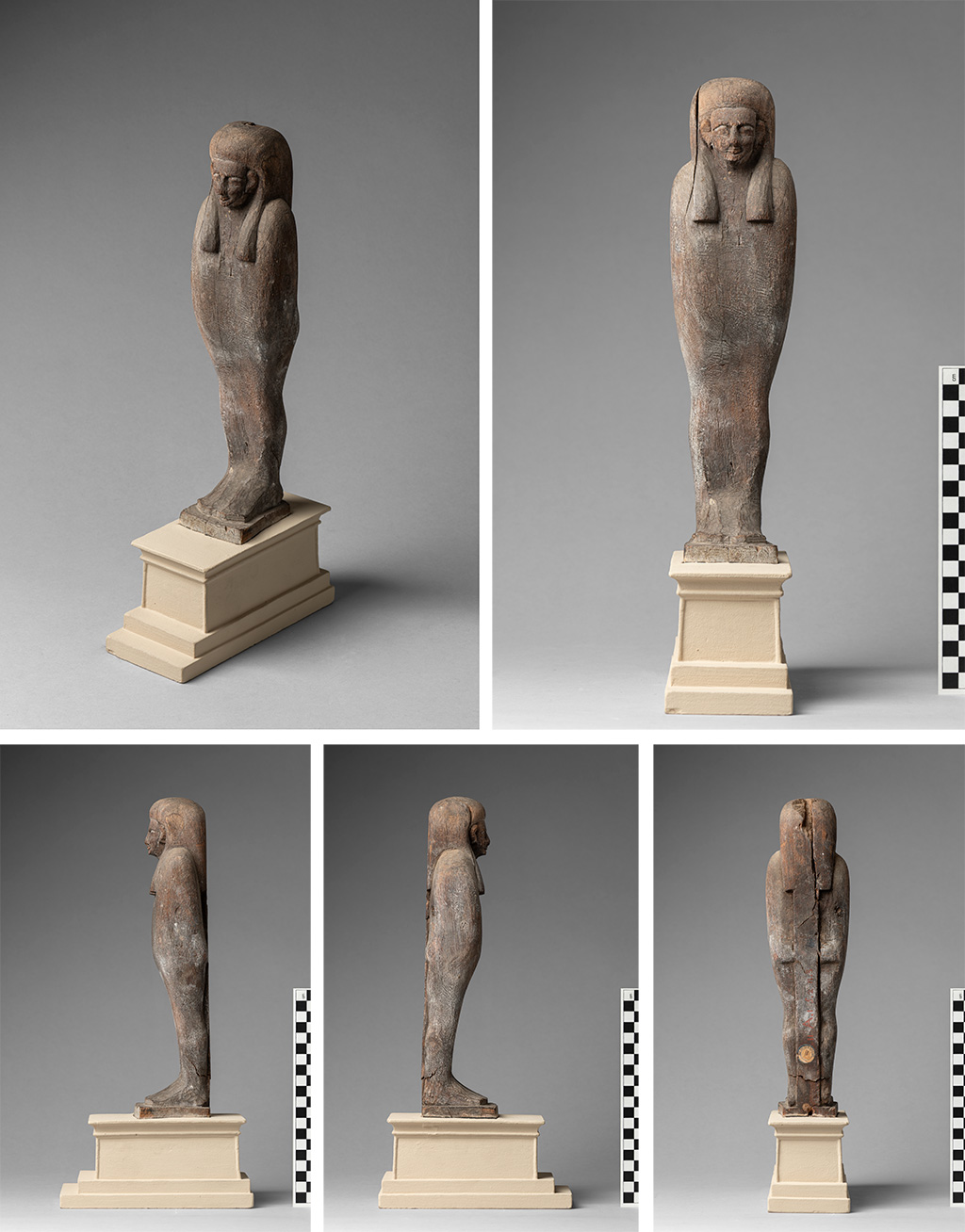
Bibliography
Aston, D.A., “Two Osiris Figures of the Third Intermediate Period”, JEA 77 (1991), pp. 95–107.
Aston, D.A., Burial Assemblages of Dynasty 21–25: Chronology – Typology – Developments, Vienna 2009.
Bács, T. and R. Parkinson, “Wall-Paintings from the Tomb of Kynebu at Luxor”, EA 39 (2011), pp. 42–43.
Bierbrier, M.L., Who Was Who in Egyptology, London 2019.
Bietak, M. and E. Reiser-Haslauer, Das Grab des cAnch-Hor, II, Vienna 1982.
Botti, G., Le casse di mummie e i sarcofagi da el-Hibeh nel Museo Egizio di Firenze, Firenze 1958.
Budge, E.A.W., The Mummy, a Handbook of Egyptian Funerary Archaeology, Cambridge 1925.
Budka, J., “Einige Bemerkungen zu Ptah-Sokar-Osiris Statuetten”, GM 193 (2003), pp. 99–101.
Budka, J., “Ptah-Sokar-Osiris Statuetten aus Grab VII im Asasif”, in: M.R.M. Hasitzka, J. Diethardt and G. Dembski, Das Alte Ägypten und seine Nachbarn, Festschrift zum 65. Geburtstag von Helmut Satzinger, Krems 2003, pp. 35–42.
Cantilena, R. and P. Rubino (eds.), La collezione egiziana del Museo Archeologico Nazionale di Napoli, Napoli 1989.
Champollion, J.F., Notice descriptive des monuments égyptiens du Musée Charles X, Paris 1827.
Curto, S., “A ricordo di due egittologi dimenticati: Giuseppe Acerbi e Giovanni Kminek-Szedlo”, in: Istituto Lombardo Accademia di Scienze e Lettere (ed.), Atti del Convegno di studi su la Lombardia e l’Oriente: Milano, 11–15 giugno 1962, Milano 1963, pp. 120–26.
Daris, S., Giuseppe Nizzoli. Un impiegato consolare austriaco nel Levante agli albori dell’Egittologia, Napoli 2005.
Desroches-Noblecourt, C. (Musée du Louvre), La crypte de l’Osiris du Département égyptien (Petits Guides des Grands Musées 61), Paris 1979.
Dizionario Biografico degli Italiani (DBI), https://www.treccani.it/biografico/.
Enany, A., “Three Papyrus Sheaths of Priestesses of Amun”, JEA 107 (2021), pp. 159–75.
First, A., “The Ptah-Sokar-Osiris Statuettes in the Cracow Collections”, SAAC 13 (2009), pp. 97–114.
Gauthier, H., Le personnel du dieu Min, Cairo 1931.
Giovetti, P. and D. Picchi (eds.), Egypt: Millenary Splendour. The Leiden Collection in Bologna, Milan 2016.
Guida alla collezione egizia del MANN, Milano 2016.
Hardwick, T., “The Iconography of the Blue Crown in the New Kingdom”, JEA 89 (2003), pp. 117–41. https://www.jstor.org/stable/3822494.
Hostovská, O., “Der tschechische Ägyptologe Giovanni Kminek-Szedlo (1828–1896)”, ArOr 66 (1998), pp. 351–68.
Jansen-Winkeln, K., Inschriften der Spätzeit, IV, Wiesbaden 2014.
Kminek-Szedlo, G., Museo Civico di Bologna. Catalogo di antichità egizie, Torino 1895.
Legati, L., Museo Cospiano annesso a quello del famoso Ulisse Aldrovandi e donato alla sua Patria dall’Illustrissimo Signor Ferdinando Cospi Patrizio di Bologna e Senatore, Bologna 1677.
Lipińska-Boldok, J., “Some Problems of the Funerary Figures of Egyptian God Ptah-Sokaris-Osiris”, Bulletin du Musée National de Varsovie 2 (1961), pp. 75–84.
Loffet, H.-C., “Une statuette de Sokar-Osiris au Musée Charles-Léandre de Domfront”, RevLouvre 2 (2007), pp. 22–28.
Malaise, M., Antiquités égyptiennes et verres du Proche-Orient ancien des Musées Curtius et du Verre à Liège, Liège 1971.
Montazio, E., Antonietta Fricci Neri Baraldi, Pietro Neri Baraldi: cenni estetico biografici, Firenze 1865.
Morigi Govi, C. and G. Sassatelli (eds.), Dalla Stanza delle Antichità al Museo Civico: storia della formazione del Museo Civico Archeologico di Bologna, Bologna 1984.
Museo Civico Archeologico di Bologna (MCABo), Sub-Allegato Collezione Palagi, Bologna 1870s.
Museo Civico Archeologico di Bologna (MCABo) (ed.), Pelagio Palagi artista e collezionista, Bologna 1976.
“Museo Nizzoli a. 1824. Catalogo ed Inventario”, in: Ministero della Pubblica Istruzione (ed.), Documenti inediti per servire alla storia dei musei d’Italia, IV, Firenze and Roma 1880, pp. 346–76.
Nardi, G., Titi Lucretii Cari De rerum natura libri sex, Florentia 1647.
Pernigotti, S., La statuaria egiziana nel Museo Civico Archeologico di Bologna, Bologna 1980.
Pernigotti, S., “Appendice II”, “Appendice III”, in: S. Pernigotti (ed.), Aegyptiaca Bononiensia, I (Monografie di SEAP – Series Minor 2), Pisa 1990, pp. 46–84.
Pernigotti, S., “Il frammento Bologna KS 1811”, in: H. Györy (ed.), « Le lotus qui sorte de terre » : Mélanges offerts à Edith Varga (BMH-Suppl.), Budapest 2001, pp. 411–17.
Pernigotti, S. and P. Piacentini (eds.), Atti del colloquio su Giovanni Kminek-Szedlo (Bologna, 7 maggio 1987) (SEAP 2), Pisa 1987.
Petrie, W.M.F., The Funeral Furniture of Egypt, London 1937.
Picchi, D., “Le antichità egiziane del Museo Cospiano”, REAC 6 (2004), pp. 51–86.
Picchi, D., “Terra, cereali e acqua: la corn-mummy KS 342 del Museo Civico Archeologico di Bologna”, in: S. Pernigotti and M. Zecchi (eds.), La terra, gli uomini e gli dèi: il paesaggio agricolo nell’Antico Egitto, Atti del secondo Colloquio, Bologna – 22/23 maggio 2006, Imola 2007, pp. 73–82.
Picchi, D., Alle origini dell’Egittologia: le antichità egiziane di Bologna e Venezia da un inedito di Georg Zoëga, Imola 2010.
Picchi, D., “Il pittore Pelagio Palagi e l’Egittologia ‘in miniatura’: amuleti, scarabei e placchette della terza collezione Nizzoli”, in: P. Buzi, D. Picchi and M. Zecchi (eds.), Aegyptiaca et Coptica. Studi in onore di Sergio Pernigotti, Oxford 2011, pp. 277–301.
Picchi, D., “Il generale Luigi Ferdinando Marsili e le prime antichità egizie dell’Istituto delle Scienze di Bologna”, in: M.E. Ciampini and P. Zanovello (eds.), Antichità egizie e Italia. Prospettive di ricerca e indagini sul campo, Venezia 2014, pp. 53–62.
Picchi, D., “Bologna’s Egyptian Collection: Five Centuries of History”, in: P. Giovetti and D. Picchi (eds.), Egypt Millenary Splendour: The Leiden Collection in Bologna, Milan 2016, pp. 28–35.
Picchi, D., “Un rilievo dalla tomba menfita di Ptahmes e le trattative fallite per la vendita a Leopoldo II della terza collezione Nizzoli”, Cadmo 30 (2021), pp. 11–37.
Picchi, D., “Giovanni Nardi (c. 1580–1654) and Ancient Egypt at the Medici Court”, Pegasus. Beiträge zum Nachleben antiker Kunst und Architektur 2 (2026), pp. 49–79.
Picchi, D. and C. Scappini, “Ulisse Aldrovandi: per hieroglyphica ad Aegyptum”, in: D. Dominici and L. Markey (eds.), Global Aldrovandi: Exchanging Nature and Material Culture in the Early Modern World, Leiden 2026 (forthcoming).
PN = Ranke, H., Die ägyptischen Personennamen, I, Glückstadt 1935.
Poppi, C. (ed.), Pelagio Palagi pittore. Dipinti dalle raccolte del Comune di Bologna, Milano 1996.
Raven, M.J., “Papyrus-Sheaths and Ptah-Sokar-Osiris Statues”, OMRO 59–60 (1978–1979), pp. 251–96.
Raven, M.J., Symbols of Resurrection: Three Studies in Ancient Egyptian Iconography, Leiden 1984.
Regulski, I. (ed.), Hieroglyphs: Unlocking Ancient Egypt, London 2022.
Rindi, C., Ptah-Sokar-Osiris Statuettes in the Collections of the Egyptian Museum of Florence, Pisa 2012.
Rindi, C., “The Ptah-Sokar-Osiris Figure of Tjesraperet, Wet Nurse of Pharaoh Taharka’s Daughter: Typological and Historical Analysis”, BSEG 29 (2011–2013), pp. 131–43.
Rindi, C., “A Ptah-Sokar-Osiris Figure in the Name of Nesmin, Son of Ankhpakhered”, EVO 35 (2012), pp. 71–82.
Rindi Nuzzolo, C., “An Unusual Group of Ptah-Sokar-Osiris Figures: Some Reflections on Typology and Provenance”, JARCE 49 (2013), pp. 193–204.
Rindi, C., “Darilo iz oaze: večni krog življenja, smrti in ponovnega rojstva skozi kipec Ptah-Sokar-Ozirisa / Gift from the Oasis: The Eternal Process of Life, Death and Rebirth Through a Ptah-Sokar-Osiris Figure”, in: M. Frelih and N. Zdravič Polič (eds.), Magija amuletov / The Magic of Amulets, Ljubljana 2014, pp. 149–55.
Rindi Nuzzolo, C., “Two Ptah-Sokar-Osiris Figures from Akhmim in the Egyptian Collection of the Museum of Fine Arts, Budapest”, BMHBA 119 (2014), pp. 13–41.
Rindi, C., “Some Remarks on the Positioning of Ptah-Sokar-Osiris Figures in Third Intermediate and Late Period Burials”, in: T. Lekov and E. Buzov (eds.), Cult and Belief in Ancient Egypt: Proceedings of the Fourth International Congress for Young Egyptologists, 25–27 September 2012, Sofia 2014, pp. 30–36.
Rindi Nuzzolo, C., “Tradition and Transformation: Retracing Ptah-Sokar-Osiris Figures from Akhmim in Museums and Private Collections”, in: T. Gillen (ed.), (Re)productive Traditions in Ancient Egypt: Proceedings of the Conference Held at the University of Liège, 6th-8th February 2013, Liège 2017, pp. 445–74.
Rindi Nuzzolo, C. and I. Guidotti, “Origins and Legacy of Giuseppe Nizzoli, Chancellor of the Austrian Consulate in Egypt”, SEP 11 (2014), pp. 149–63.
Rossi, F., “Prima Sala – Collezione Palagi”, in: E. Brizio (ed.), Cenni storici, relazioni e cataloghi del Museo Civico di Bologna per la inaugurazione fatta il 2 ottobre 1871 in occasione del I Congresso Internazionale di Antropologia e Archeologia Preistoriche, Bologna 1871, pp. 8–52.
Schiassi, F., Guida del forestiere al Museo delle Antichità della Regia di Bologna, Bologna 1814.
Tovoli, S., “La collezione di Pelagio Palagi”, in: C. Morigi Govi and G. Sassatelli (eds.), Dalla Stanza delle Antichità al Museo Civico, Bologna 1984, pp. 191–210.
Tugnoli Pattaro, S. (ed.), Lo Studio Aldrovandi in Palazzo Pubblico (1617–1742), Bologna 1993.
Wb = Erman, A. and H. Grapow (eds.), Wörterbuch der aegyptischen Sprache, I–VII, Leipzig and Berlin 1926–1963.
Whitehouse, H., “Egyptian Antiquities in the Paper Museum”, in: E. Vaiani, S. Prosperi Valenti Rodinò and H. Whitehouse, The Paper Museum of Cassiano dal Pozzo: Egyptian and Roman Antiquities and Renaissance Decorative Arts, I, London 2018, pp. 21–138.
van Wijngaarden, W.D., Grafborden en papyruskokers (Beschrijving van de Egyptische verzameling in het Rijksmuseum van Oudheden te Leiden, XIV: De monumenten van het Nieuwe Rijk en van den Saïtischen tijd), The Hague 1932.
Yoyotte, J., “La sépulture du père divin Psamétik, fils de la dame Sbarekhy”, BSFE 60 (1971), pp. 9–27.
Zanasi, C. (ed.), Storie d’Egitto. La riscoperta della raccolta egiziana del Museo Civico (Modena, Museo Civico Archeologico Etnologico, 16 febbraio 2019 – 7 giugno 2020), Firenze 2019.
Ziegler, C., “Une statue de Ptah-Sokar-Osiris au nom d’Ankhpakhered, fils de Nesmin”, in: N. Grimal, A. Kamel and C. May-Sheikholeslami (eds.), Hommages à Fayza Haikal, Cairo 2003, pp. 315–24.
Notes
- Picchi, in Giovetti and Picchi (eds.), <i>Egypt Millenary Splendour</i>, 2016.↑
- Tugnoli Pattaro (ed.), <i>Lo Studio Aldrovandi</i>, 1993; Picchi and Scappini, in Markey and Dominici (eds.), <i>Global Aldrovandi</i>, 2026 forthcoming.↑
- Picchi, <i>REAC</i> 6 (2004).↑
- Legati, <i>Museo Cospiano</i>, 1677, pp. 459–60; Kminek-Szedlo, <i>Catalogo</i>, 1895, p. 39, nos. 341, 343, 345, and p. 247, no. 2078. See also Morigi Govi and Sassatelli, <i>Dalla Stanza delle Antichità al Museo Civico</i>, 1984, p. 128; Picchi, <i>Alle origini dell’Egittologia</i>, 2010, pp. 26 and 67 with n. 201; Picchi, <i>REAC</i> 6 (2004), pp. 66–68, 82, fig. 3.↑
- Cf. Morigi Govi and Sassatelli, <i>Dalla Stanza delle Antichità</i>, 1984, p. 127; Whitehouse, in Vaiani et al. (eds.), <i>The Paper Museum</i>, 2018, p. 29, fig. 13.↑
- Dizionario Biografico degli Italiani 77 (2012), sub voce “Giovanni Nardi” <a href="https://www.treccani.it/ enciclopedia/giovanni-nardi_(Dizionario-Biografico)/">https://www.treccani.it/ enciclopedia/giovanni-nardi_(Dizionario-Biografico)/</a>.↑
- Nardi, <i>Titi Lucretii Cari</i>, 1647.↑
- Nardi, <i>Titi Lucretii Cari</i>, 1647, pp. 650–51. The same plate is republished by Whitehouse, in Vaiani et al. (eds.), <i>The Paper Museum</i>, 2018, p. 26, fig. 10.↑
- The British Museum, <i>The Townley Album</i>, AESAr.530, nos. 01140324001, 01142052001, 01142054001, 01142056001, 01142057001 <a href="https://www.bmimages.com/01142057001-townley-album-print-drawing-album-image.html">https://www.bmimages.com/01142057001-townley-album-print-drawing-album-image.html</a>; Rome, Biblioteca dell’Accademia Nazionale dei Lincei, dal Pozzo XXXV (32), fols. 7r (25 January 1642), 9v (8 February 1642), 11r–12r (22 February 1642), and 17v (11 March 1643). See Picchi, in Giovetti and Picchi (eds.), <i>Egypt Millenary Splendour</i>, 2016, pp. 29–30; Whitehouse, in Vaiani et al. (eds.), <i>The Paper Museum</i>, 2018, pp. 23–25, 32–42; Picchi, <i>Pegasus</i> 2 (2025), forthcoming.↑
- Picchi, in Giovetti and Picchi (eds.), <i>Egypt Millenary Splendour</i>, 2016, p. 31, fig. 1. Cf. also Nardi, <i>Titi Lucretii Cari</i>, 1647, pp. 642–43, Table I-Fig. G.↑
- Kminek-Szedlo, <i>Catalogo</i>, 1895, p. 38, no. 335. See also Picchi, <i>Alle origini dell’Egittologia</i>, 2010, pp. 26 and 67 with fig. 7a-b.↑
- Picchi, <i>Alle origini dell’Egittologia</i>, 2010, pp. 13–37, esp. 55–73. As for Marsili, cf. Picchi, in Ciampini and Zanovello (eds.), <i>Antichità egizie e Italia</i>, 2014.↑
- Translation of “Mumiaca di legno con volto e orecchia e collo dorati con barbetta e scuffia turchino, mozzetta [di] vari colori con due teste dorate di sparviero con cuffia turchina sopra le spalle, una colonna di geroglifici neri su fondo giallo dalla mozzetta in giù [sino] sopra le dita dei piedi. Sta sopra la sua base bislunga, con fossetta grande avanti i piedi della figura. Nella fossetta è un avanzo di asfalto simile al condimento delle mummie”, in Picchi, <i>Alle origini dell’Egittologia</i>, 2010, p. 67. Cf. Regulski (ed.), <i>Hieroglyphs</i>, 2022, pp. 60–61, figs. 36–37 with incorrect attribution to the Borgia collection.↑
- Translation of “Quattro altre figure mumiatiche di legno, scrostate affatto”, in Picchi, <i>Alle origini dell’Egittologia</i>, 2010, p. 67.↑
- Picchi, in Giovetti and Picchi (eds.), <i>Egypt: Millenary Splendour</i>, 2016, pp. 30 and 32.↑
- As for Palagi, see MCABo (ed.), <i>Pelagio Palagi artista</i>, 1976; Tovoli, in Morigi Govi and Sassatelli (eds.), <i>Dalla Stanza delle Antichità</i>, 1984; Poppi (ed.), <i>Pelagio Palagi pittore</i>, 1996.↑
- Picchi, in Buzi et al. (eds.), <i>Aegyptiaca et Coptica</i>, 2011; Picchi, <i>Cadmo</i> 30 (2021), including further bibliography. As for Nizzoli, see Daris, <i>Giuseppe Nizzoli</i>, 2005; Rindi Nuzzolo and Guidotti, <i>SEP</i> 11 (2014).↑
- Nizzoli, <i>Catalogo</i>, 1827, p. 13, no. II.19; Kminek-Szedlo, <i>Catalogo</i>, 1895, p. 38, no. 337.↑
- Nizzoli, <i>Catalogo</i>, 1827, p. 13, no. II.20; Kminek-Szedlo, <i>Catalogo</i>, 1895, p. 36, no. 327.↑
- Nizzoli, <i>Catalogo</i>, 1827, p. 19, no. III.7; Kminek-Szedlo, <i>Catalogo</i>, 1895, p. 38, no. 336 (statue), p. 46, no. 415 (falcon), and p. 349, no. 3148 (falcon’s crown).↑
- Nizzoli, <i>Catalogo</i>, 1827, republished in Pernigotti’s “Appendice II”, in Pernigotti (ed.), <i>Aegyptiaca Bononiensia</i>, 1990, pp. 46–79.↑
- Biblioteca comunale dell’Archiginnasio, Fondo <i>Pelagio Palagi</i>, b. 31, fasc. 2, lett. c, no. 5. This document was republished without the cost of the objects in Pernigotti's “Appendix III”, in Pernigotti (ed.), <i>Aegyptiaca Bononiensia</i>, 1990, pp. 80–84; lett. d, no. 3, ff. 12–13 and no. 6; lett. e, no. 3; lett. f, nos. 5–7. The sale and delivery of these materials took place by the end of November 1832.↑
- Pernigotti, in Pernigotti (ed.), <i>Aegyptiaca Bononiensia</i>, 1990, pp. 81–82.↑
- Kminek-Szedlo, <i>Catalogo</i>, 1895, p. 38, no. 339; Pernigotti, in Pernigotti (ed.), <i>Aegyptiaca Bononiensia</i>, 1990, p. 81, “Una figura grande di legno ad uso di Mummia con bellissime pitture dappertutto, due linee verticali di geroglifici davanti, una di dietro e le ali di Iside ai lati”.↑
- Kminek-Szedlo, <i>Catalogo</i>, 1895, p. 36, no. 326; Pernigotti, in Pernigotti (ed.), <i>Aegyptiaca Bononiensia</i>, 1990, p. 82, “Un grande idolo di legno rappresentante Osiride con la sua mitria, viso dipinto in verde, collana verde con strisce gialle, mantellata color caffè a stelle, tenendo i suoi attributi colle mani sul petto. Il resto fino abbasso è dipinto in bianco e vi si vede una linea verticale di bei geroglifici dipinti in nero”; Giovetti and Picchi (eds.), <i>Egypt Millenary Splendour</i>, 2016, p. 565, no. VII.40.↑
- Kminek-Szedlo, <i>Catalogo</i>, 1895, p. 37, no. 331; Pernigotti, in Pernigotti (ed.), <i>Aegyptiaca Bononiensia</i>, 1990, p. 82, “Un’assai bella figuretta di legno con capigliatura tutta nera viso rosso scuro, ed una linea di geroglifici scritti in nero sul davanti”.↑
- Kminek-Szedlo, <i>Catalogo</i>, 1895, p. 37, no. 329, the statue is said to be with crown, as well as in Pernigotti, in Pernigotti (ed.), <i>Aegyptiaca Bononiensia</i>, 1990, p. 82, “Una figura mummiatica con mitria, sopra piedistallo, con pitture e linea verticale di geroglifici”.↑
- Picchi, <i>Cadmo</i> 30 (2021), pp. 16–17.↑
- Kminek-Szedlo, <i>Catalogo</i>, 1895, pp. 36–37, no. 328, p. 37, nos. 330 and 332, pp. 37–38, no. 334, p. 38, no. 338, p. 39, nos. 340, 341 ½, and 344, p. 247, no. 2076.↑
- Kminek-Szedlo, <i>Catalogo</i>, 1895, p. 349, nos. 3149–3150.↑
- It is worth noting that the Istituto delle Scienze was suppressed in 1804. The archaeological materials from the Istituto’s “Stanza delle Antichità” later gave rise to the Museo delle Antichità della Regia Università, opened from 1810–1878. The University materials were incorporated in the City’s heritage in 1878. Cf. “Ministero della Pubblica Istruzione. Regia Università di Bologna. Inventario delle proprietà mobili dello Stato esistenti al 31 Dicembre 1870 nell’Archeologia”, in Archivio Storico Museo Civico Archeologico di Bologna, particularly nos. 836–844, which presumably include the Ptah-Sokar-Osiris statues.↑
- Kminek-Szedlo, <i>Catalogo</i>, 1895, p. 37, no. 333.↑
- Archivio Storico Museo Civico Archeologico di Bologna, Fondo <i>Acquisti e doni</i>, “Doni al Museo Civico, 1880–1881”.↑
- Kminek-Szedlo, <i>Catalogo</i>, 1895, p. 147, no. 1802; Pernigotti, <i>La statuaria egiziana</i>, 1980, pp. 40–41, no. 10; Hardwick, <i>JEA</i> 89 (2003), p. 137; Giovetti and Picchi (eds.), <i>Egypt Millenary Splendour</i>, 2016, p. 554, no. VI.78. The provenance of this head is not specified in the Museum’s archive documents and needs further investigation.↑
- Kminek-Szedlo, <i>Catalogo</i>, pp. 149–50, no. 1811; Pernigotti, in Györy (ed.), « <i>Le lotus qui sorte de terre</i> », 2001, which attributes the fragment to the Palagi (Nizzoli) collection.↑
- Cf. Montazio, <i>Antonietta Fricci</i>, 1865; Dizionario Biografico degli Italiani 50 (1998), sub voce “Antonietta Frietsche” <a href="https://www.treccani.it/enciclopedia/antonietta-frietsche_%28Dizionario-Biografico%29/">https://www.treccani.it/enciclopedia/antonietta-frietsche_%28Dizionario-Biografico%29/</a>.↑
- Cf. Lettera di Giuseppe Verdi a Giulio Ricordi, Busseto 7 Novembre 1870 <a href:"digitalarchivioricordi.com/it/letter/display/LLET001119">digitalarchivioricordi.com/it/letter/display/LLET001119</a>.↑
- Bierbrier, <i>Who Was Who</i>, 2019, p. 401.↑
- Rossi, in Brizio (ed.), <i>Cenni storici</i>, 1871.↑
- Cf. n. 29. See also [Rossi], in <i>Sub-Allegato</i>, 1870s, nos. 2127 (EG 334) and 2128 (EG 340, which correspond to two wooden statues of an average height of about 48 cm in bad condition; Rossi, in Brizio (ed.), <i>Cenni storici</i>, 1871, p. 9, nos. 116–17.↑
- Cf. n. 29. See also [Rossi], in: <i>Sub-Allegato</i>, 1870s, no. 2082 or 2084 (the label on the statue is illegible); Rossi, in Brizio (ed.), <i>Cenni storici</i>, 1871, p. 8, nos. 71–75.↑
- Cf. n. 29. See also [Rossi], in <i>Sub-Allegato</i>, 1870s, no. 2083, included in a group of five statues with almost vanished colours (nos. 2082–86); Rossi, in Brizio (ed.), <i>Cenni storici</i>, 1871, p. 8, nos. 71–75.↑
- Cf. n. 29. See also [Rossi], in <i>Sub-Allegato</i>, 1870s, no. 2086; Rossi, in Brizio (ed.), <i>Cenni storici</i>, 1871, p. 8, nos. 71–75.↑
- Cf. n. 29. See also [Rossi], in <i>Sub-Allegato</i>, 1870s, no. 2085, one of the five statues with almost vanished colours (nos. 2082–86); Rossi, in Brizio (ed.), <i>Cenni storici</i>, 1871, p. 8, nos. 71–75.↑
- Cf. n. 29. See also [Rossi], in <i>Sub-Allegato</i>, 1870s, nos. 2082 or 2084, one of the five statues with almost vanished colours (nos. 2082–86) of an average height of about 32 cm; Rossi, in Brizio (ed.), <i>Cenni storici</i>, 1871, p. 8, nos. 71–75.↑
- Cf. n. 27. See also [Rossi], in <i>Sub-Allegato</i>, 1870s, no. 2123, the statue is without a crown, presumably inventoried under no. 2194, which groups five crowns; Rossi, in Brizio (ed.), <i>Cenni storici</i>, 1871, p. 9, no. 112 and p. 14, nos. 190–94 and 183.↑
- Cf. n. 20. See also [Rossi], in <i>Sub-Allegato</i>, 1870s, nos. 2125 (a label with this number is attached to the statue, which is wrongly said to be made of wood), 2144 (falcon without crown), and 2194 (one of the five crowns inventoried under this number is of limestone); Rossi, in Brizio (ed.), <i>Cenni storici</i>, 1871, p. 9, no. 114 (statue), p. 10, no. 133 (falcon without crown), and p. 14, no. 183 (falcon’s crown).↑
- Cf. n. 18. See also [Rossi], in <i>Sub-Allegato</i>, 1870s, nos. 2088–2106 (a label with number 2091 is visible on the statue); Rossi, in Brizio (ed.), <i>Cenni storici</i>, 1871, p. 8, nos. 77–95. The manuscript and the printed text by Rossi correspond in their concise descriptions without any reference to crowns. In Kminek-Szedlo’s catalogue, the statue is without a feather crown, which Nizzoli mentions instead. As for the other two statues in the collection (EG 329 and EG 336), the crown may have been broken off and only put back on after the publication of Kminek-Szedlo’s catalogue.↑
- Cf. n. 30. See also [Rossi], in <i>Sub-Allegato</i>, 1870s, no. 2194; Rossi, in Brizio (ed.), <i>Cenni storici</i>, p. 14, nos. 190–94.↑
- Museo Civico Archeologico di Bologna, Archivio Storico, <i>Note degli oggetti Egizi spettanti all’Università</i>, particularly nos. 48 = EG 343, 49 = EG 345, 50 = EG 2078, 51 = EG 341, 52 = EG 335.↑
- Cf. Schiassi, <i>Guida del forestiere</i>, 1814, p. 97.↑
- For some background to this Memorandum of Understanding, see Giovetti and Picchi (eds.), <i>Egypt Millenary Splendour</i>, 2016, p. 17.↑
- I wish to thank Paola Giovetti (director) and Daniela Picchi (curator) for their kind invitation, for their assistance while working in the galleries of the Bologna Museum, and for the archival information. I am no less grateful to Fabrizia Fiumi, Giorgio and Marialuisa Gasperetti, and the CISE (Centro Italiano di Studi Egittologici) as a whole for their hospitality in Imola.↑
- Raven, <i>OMRO</i> 59–60 (1978–1979), pp. 251–96.↑
- Raven, <i>OMRO</i> 59–60 (1978–1979), p. 252 n. 1, referring to Champollion, <i>Notice descriptive</i>, 1827, p. 156.↑
- Raven, <i>OMRO</i> 59–60 (1978–1979), p. 253 n. 11; Champollion, <i>loc. cit</i>.↑
- Raven, <i>OMRO</i> 59–60 (1978–1979), p. 259 n. 69; cf. also Aston, <i>Burial Assemblages</i>, 2009, 304 n. 2711. Two further figures from the Cachette of the Priests have recently been published by Enany, <i>JEA</i> 107 (2021), pp. 162–73. The third statue discussed there (pp. 172–75) comes from the Royal Cache.↑
- Raven, <i>OMRO</i> 59–60 (1978–1979), p. 254 n. 24, referring to Budge, <i>The Mummy</i>, 1925, pp. 382–85; Petrie, <i>Funeral Furniture</i>, 1937, p. 28.↑
- The exceptions are noted by Raven, <i>OMRO</i> 59–60 (1978–1979), p. 254 n. 23: see van Wijngaarden, <i>Grafborden en papyruskokers</i>, 1932; Malaise, <i>Antiquités égyptiennes à Liège</i>, 1971, pp. 91–95 and figs. 35–40; add Lipińska-Boldok, <i>Bulletin du Musée National de Varsovie</i> 2 (1961), pp. 75–84.↑
- See Raven, <i>Symbols of Resurrection</i>, 1984.↑
- Aston, <i>JEA</i> 77 (1991), pp. 95–107. This article was an offspring of Aston’s PhD research.↑
- The 25th-Dynasty date given by Petrie, <i>Qurneh</i>, 1909, p. 15, and quoted by Raven, <i>OMRO</i> 59–60 (1978–1979), p. 259 n. 74, is far too late: see Aston, <i>JEA</i> 77 (1991), p. 101 with nos. 40–41.↑
- Aston, <i>Burial Assemblages</i>, 2009, pp. 302–08.↑
- Rindi Nuzzolo, <i>Ptah-Sokar-Osiris Statuettes</i>, 2012.↑
- Omitting the 25 items excavated at el-Hibeh and published by Botti, <i>Casse di mummie</i>, 1958.↑
- Rindi Nuzzolo, <i>Ptah-Sokar-Osiris Statuettes</i>, 2012, p. 30. According to Budka, in Hasitzka et al., <i>Das Alte Ägypten</i>, 2003, p. 35, the 25th Dynasty date originally suggested for Cairo <i>JE</i> 94773 has to be corrected to Dynasty 30 or Ptolemaic Period. However, cf. Aston, <i>Burial Assemblages</i>, 2009, p. 305 with n. 2718, who tends to stick to my original early dating of Type IVB.↑
- Rindi Nuzzolo, <i>BSEG</i> 29 (2011–2013), pp. 131–43; Rindi Nuzzolo, <i>EVO</i> 35 (2012), pp. 71–82; Rindi Nuzzolo, in Frelih and Zdravič Polič (eds.), <i>The Magic of Amulets</i>, 2014, pp. 149–55; Rindi Nuzzolo, <i>BMHBA</i> 119 (2014), pp. 13–41; Rindi Nuzzolo, in Lekov and Buzov (eds.), <i>Cult and Belief</i>, 2014, pp. 30–36; Rindi Nuzzolo, in Gillen (ed.), <i>(Re)productive Traditions</i>, 2017, pp. 445–74.↑
- Rindi Nuzzolo, <i>JARCE</i> 49 (2013), p. 204.↑
- Cf., among others, Budka, <i>GM</i> 193 (2003), pp. 99–101; Ziegler, in Grimal et al. (eds.), <i>Hommages à Fayza Haika</i>, 2003, pp. 315–24; Loffet, <i>RevLouvre</i> 2 (2007), pp. 22–28; First, <i>SAAC</i> 13 (2009); Enany, <i>JEA</i> 107 (2021), pp. 159–75.↑
- Curto, in Istituto Lombardo-Accademia di Scienze e Lettere (ed.), <i>Atti del Convegno di studi</i>, 1963, pp. 120–26; Pernigotti and Piacentini (eds.), <i>Atti del Colloquio</i>, 1987; Hostovská, <i>ArOr</i> 66 (1998); Bierbrier, <i>Who was Who</i>, 2019, p. 256.↑
- Kminek-Szedlo, <i>Catalogo</i>, 1895, pp. 36–39.↑
- See Picchi, in Pernigotti and Zecchi (eds.), <i>La terra, gli uomini e gli dèi</i>, 2007.↑
- Kminek-Szedlo, <i>Catalogo</i>, 1895, pp. 247.↑
- Rindi Nuzzolo, <i>Ptah-Sokar-Osiris Statuettes</i>, 2012, p. 78, mentions 23, probably by including EG 346.↑
- Rindi Nuzzolo, <i>Ptah-Sokar-Osiris Statuettes</i>, 2012, p. 78 with n. 545.↑
- Botti, <i>Le casse di mummie</i>, 1958, pp. 173–84 and pls. LI, LIII (cat. nos. 187–211); Rindi Nuzzolo, <i>Ptah-Sokar-Osiris Statuettes</i>, 2012, pp. 118–87.↑
- See <a href="https://collezioni.museoegizio.it/it-IT/search/?action=s&description=Ptah-Sokar-Osiride&title=&inventoryNumber=&cgt=&yearFrom=&yearTo=&provenance=&acquisition=">https://collezioni.museoegizio.it/it-IT/search/?action=s&description=Ptah-Sokar-Osiride&title=&inventoryNumber=&cgt=&yearFrom=&yearTo=&provenance=&acquisition=</a>.↑
- But see the meticulous reconstruction of the evidence by Daniela Picchi (above, Part I).↑
- “Museo Nizzoli”, in Ministero della Pubblica Istruzione (ed.), <i>Documenti inediti</i>, 1880, p. 376, “I legni tutti furono il frutto degli scavi in Menfi”.↑
- Raven, <i>OMRO</i> 59–60 (1978–1979), pp. 274–76.↑
- Raven, <i>OMRO</i> 59–60 (1978–1979), pp. 276–81; Rindi Nuzzolo, <i>Ptah-Sokar-Osiris Statuettes</i>, 2012, pp. 47–54. The hymn occurs on statues datable to the Late Period (Dynasties 25–30).↑